
- NCA Concludes 700 MHz Licensing as MTN Ghana Emerges Sole Successful Applicant
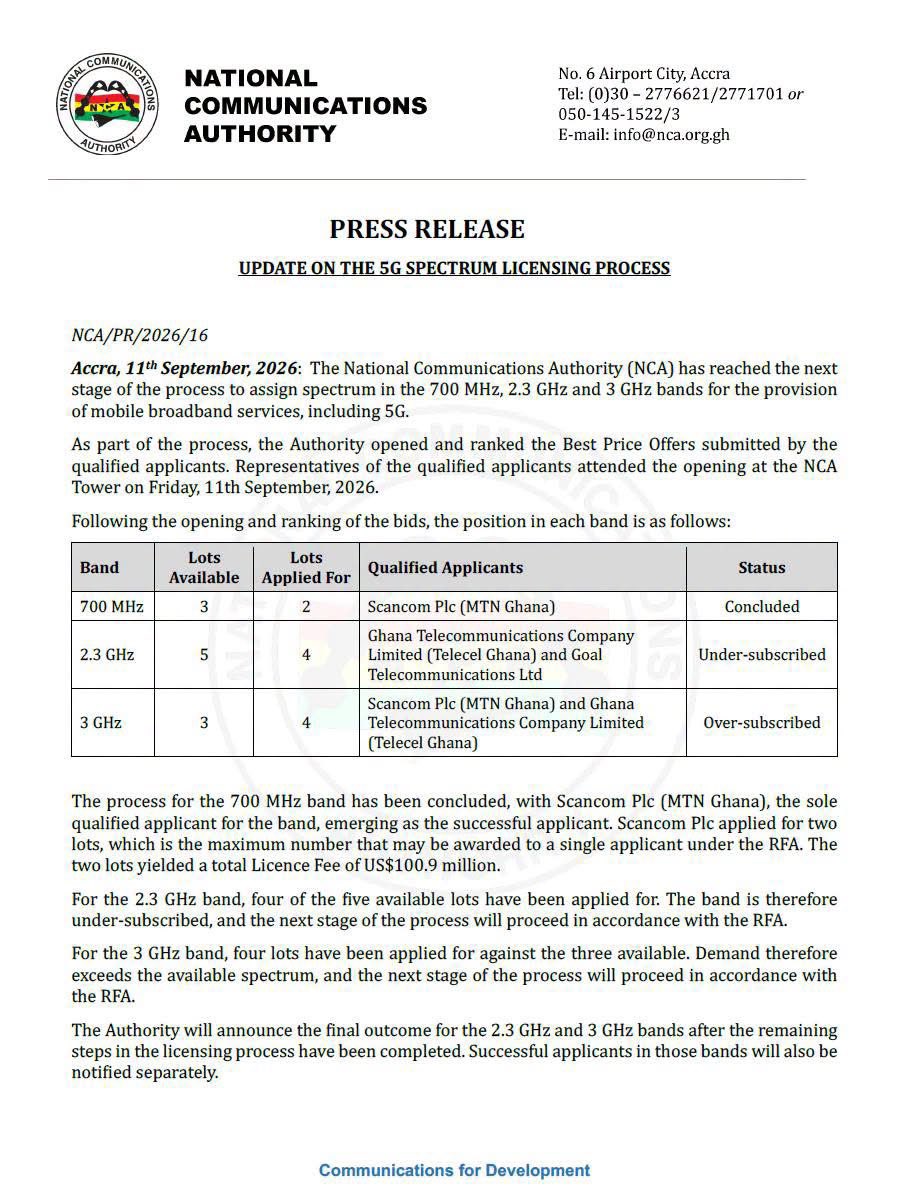
MTN Ghana has emerged as the sole successful applicant for spectrum in the 700 MHz band, securing two lots for a combined licence fee of US$100.9 million as Ghana’s latest spectrum allocation process for mobile broadband services, including 5G, moves into its next stage.
The National Communications Authority said it had completed the process for the 700 MHz band after opening and ranking Best Price Offers submitted by qualified applicants on September 11, 2026.
Three lots were available in the band, but MTN Ghana applied for two, the maximum number that could be awarded to a single applicant under the Request for Applications.
The two lots ultimately yielded a total licence fee of US$100.9 million, giving MTN an early lead in the latest round of spectrum allocations while competition continues in the 2.3 GHz and 3 GHz bands.
The licensing exercise is part of the NCA’s broader effort to assign spectrum across the 700 MHz, 2.3 GHz and 3 GHz bands for the provision of mobile broadband services, including 5G.
The results reveal different levels of demand across the three bands.
In the 2.3 GHz band, five lots were made available but only four were applied for, leaving the band under-subscribed.
The qualified applicants in that band are Ghana Telecommunications Company Limited, which operates as Telecel Ghana, and Goal Telecommunications Limited.
The NCA said the next stage of the process for the 2.3 GHz allocation would proceed in accordance with the terms set out in the Request for Applications.
The competitive pressure is considerably stronger in the 3 GHz band.
Three lots are available, but qualified applicants submitted applications for four, meaning demand exceeds the available spectrum.
MTN Ghana and Telecel Ghana are the qualified applicants in that segment, setting the stage for a more competitive allocation process before the Authority determines the final outcome.
The NCA said it would announce the final results for both the 2.3 GHz and 3 GHz bands after the remaining stages of the licensing exercise have been completed, with successful applicants to be informed separately.
The outcome places MTN Ghana in a strong position in the spectrum process, having already secured two 700 MHz lots while remaining in contention in the 3 GHz band.
For the wider telecommunications market, the exercise represents an important phase in Ghana’s effort to expand next-generation mobile broadband capacity and create the spectrum framework required for wider 5G deployment.
Spectrum is a critical asset for mobile network operators because it determines the radio frequencies available to carry voice and data traffic. The amount and type of spectrum assigned to operators therefore have direct implications for network capacity, service quality and the ability to deploy newer generations of mobile technology.
The latest allocation also comes at a time when Ghana is seeking to deepen digital connectivity and position telecommunications infrastructure as a foundation for broader economic activity.
The US$100.9 million paid for MTN’s two 700 MHz lots consequently represents more than a licensing transaction. It signals the commercial value operators attach to additional spectrum as data consumption rises and the telecom market moves further towards higher-capacity broadband services.
The structure of demand across the three bands also provides an early indication of how operators are assessing the available assets.
The 700 MHz process has been concluded with MTN as the only successful applicant, while the 2.3 GHz band remains under-subscribed despite five available lots.
The 3 GHz segment, by contrast, has attracted more applications than available lots, making it the most contested portion of the current process.
That oversubscription means the NCA still has important decisions to complete before the full competitive structure of the latest spectrum allocation becomes clear.
The eventual outcome will determine how the new spectrum is distributed among operators and could influence the next phase of investment in Ghana’s mobile broadband market.
For MTN Ghana, the immediate result is clear: two 700 MHz lots secured and US$100.9 million committed.
For Telecel Ghana and Goal Telecommunications, attention now turns to the remaining stages of the 2.3 GHz and 3 GHz processes.
For the NCA, the broader test will be whether the licensing exercise translates into the intended expansion of mobile broadband services and supports Ghana’s evolving 5G ecosystem.
The September 11 announcement therefore marks an important milestone rather than the conclusion of Ghana’s spectrum race.
MTN has secured the first definitive outcome, but the more competitive phase of the process is still unfolding in the 3 GHz band, where demand has already exceeded supply and the final allocation could shape the balance of Ghana’s next-generation telecom market.