


- NDPC Turns to Parliament to Anchor Ghana’s Economic Transformation Plan
Ghana is making a fresh attempt to confront one of the most persistent weaknesses in its development history: the repeated abandonment of national plans whenever political power changes hands.
The National Development Planning Commission is compiling four major development blueprints produced over the past decade into a single Ghana Consolidated National Development Plan, which it hopes Parliament will adopt as a binding national framework to guide economic, social and institutional development beyond electoral cycles.
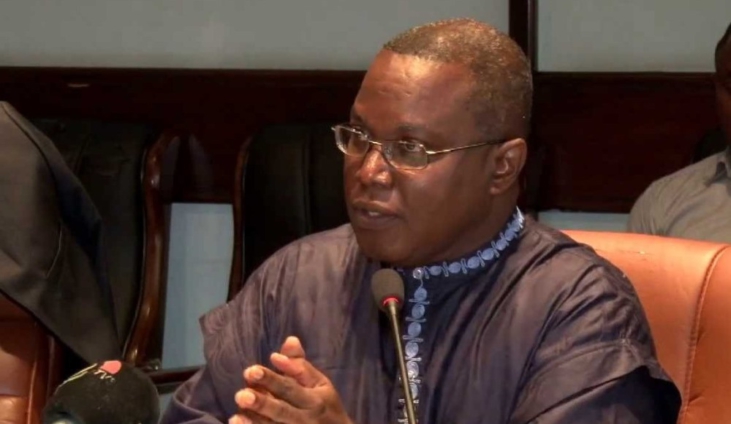
The Chairman of the NDPC, Dr Nii Moi Thompson, briefed the Speaker of Parliament, Rt Hon Alban Kingsford Sumana Bagbin, on Wednesday, July 22, 2026, on the Commission’s work to prepare the plan as part of a broader effort to secure continuity, consistency and improved development outcomes across successive governments.
The four existing plans being consolidated are the 40-Year Development Plan prepared in 2016, Ghana Beyond Aid prepared in 2019, Ghana@100 also prepared in 2019, and Vision 2057 prepared in 2024.
Each of these plans carried ambitions about Ghana’s future. Yet, according to the NDPC, they were never implemented. The Commission’s current work is therefore not merely another planning exercise. It is an attempt to rescue Ghana’s “unfinished business of development” from the familiar cycle of political discontinuity, institutional drift and policy abandonment.
Dr Thompson told the Speaker that the Commission expects the Ghana Consolidated National Development Plan to be adopted by Parliament as “the legislated will of the people.” That phrase is significant. It suggests the NDPC wants the plan to have a legitimacy that goes beyond the executive arm of government and beyond the manifesto of any single political party.
If adopted by Parliament, the plan could become a strategic national framework against which medium-term development plans, annual action plans and public investment decisions are aligned. The larger objective is to ensure that Ghana’s long-term development priorities are not rewritten every four years or suspended whenever a new administration takes office.
This is one of the most important governance questions facing Ghana. The country has not suffered from a shortage of visions. It has suffered from a shortage of continuity. From infrastructure to education, industrialisation, agriculture, health, energy, technology and institutional reform, successive governments have often launched new agendas instead of building consistently on existing frameworks.
The cost has been high. Projects are delayed, priorities are reversed, institutions lose momentum, and public resources are wasted on repeated planning rather than sustained execution. Development becomes episodic rather than cumulative.
The NDPC’s proposed consolidated plan is therefore a direct response to a structural problem in Ghana’s democracy: the tension between electoral competition and long-term national planning.
Dr Thompson warned that Ghana has remained stuck in a “middle-income trap” since becoming a lower middle-income country in 2010. His argument is that without a disciplined national framework to guide planning and implementation, Ghana risks remaining trapped or even slipping backwards.
The warning should not be taken lightly. Escaping the middle-income trap requires more than macroeconomic stabilisation. It demands sustained productivity growth, industrial upgrading, export diversification, stronger human capital, better infrastructure, more efficient public institutions and a private sector capable of competing regionally and globally.
These are not reforms that can be completed within one political term. They require a national plan that is stable enough to guide public investment and flexible enough to adapt to changing circumstances.
The Speaker welcomed the briefing and pledged Parliament’s support for the development of the Ghana Consolidated National Development Plan. He highlighted the importance of governance and institutional reforms in meeting Ghana’s development aspirations, while pointing to the achievements of Ghana’s political development under the Fourth Republic.
According to the Speaker, Ghana has become a destination for study tours by legislators from advanced and emerging democracies seeking best practices in parliamentary procedure. His point reinforces a broader argument: Ghana’s democratic institutions have achieved a degree of stability, but the country must now translate political stability into development discipline.
The Speaker also urged the Commission to give prominence to ethics in leadership and public service in the Consolidated Plan. That intervention is important because Ghana’s development challenge is not only technical. It is also ethical.
Plans fail when public officials treat national projects as partisan property. They fail when procurement is abused, when institutions are weakened, when public funds are misused, when policies are announced without financing, and when implementation is subordinated to political convenience.
A development plan that does not address ethics, accountability and leadership culture risks becoming another elegant document with limited practical force.
The NDPC is expected to address Parliament’s Committee of the Whole at the invitation of the Speaker. This will be a crucial engagement because Parliament’s role is central to the legitimacy and durability of the proposed framework.
If the plan is to become a national compact, Parliament cannot treat it as a routine briefing. It must interrogate its assumptions, demand clarity on implementation, examine how it will bind medium-term plans, and ensure that it does not become a technocratic document disconnected from citizens’ needs.
The Commission also plans to engage key stakeholders, including political parties, traditional authorities and faith-based organisations, while inviting submissions from the public.
That broader consultation will be vital. A long-term national development plan cannot survive if it is seen as belonging to one administration, one political tradition or one group of technocrats. It must carry broad ownership across political, social, traditional, religious and civic institutions.
Political parties will be particularly important. Ghana’s long-term plan will only matter if parties are willing to align their manifestos and government programmes with it. That does not mean elections should lose meaning or that parties should stop offering different policy choices. It means those choices should operate within an agreed national development architecture.
Traditional authorities also have a major role to play, especially because land, local development, social legitimacy and community mobilisation remain central to Ghana’s economic transformation. Faith-based organisations, which command deep public trust and operate extensive education, health and social networks, can also help build citizen ownership of the plan.
The public consultation element is equally important. Ordinary Ghanaians must see themselves in the plan. They must understand what it means for jobs, roads, schools, health facilities, housing, agriculture, local industries, digital opportunity and social protection.
The danger is that the Consolidated Plan becomes a high-level institutional document without a clear delivery mechanism. To avoid that, the NDPC and Parliament must ensure that the plan is linked to budgets, project selection, sector strategies, district development plans and measurable targets.
The true test will not be whether Ghana produces another plan. The true test will be whether the plan changes behaviour.
Will governments be required to explain deviations from the plan? Will Parliament use it to assess budgets? Will public investment be screened against it? Will MMDAs align their medium-term plans to it? Will citizens be able to track progress? Will political parties accept that national development cannot begin again after every election?
These are the questions that will determine whether the Ghana Consolidated National Development Plan becomes a turning point or another document added to the shelves of unfinished ambition.
Dr Thompson’s briefing to the Speaker therefore marks an important institutional moment. It signals an effort to move Ghana from fragmented visions to a unified national development framework, from abandoned plans to legislated continuity, and from election-cycle thinking to long-term transformation.
Ghana has had many visions. The challenge now is execution.
If Parliament adopts the Consolidated Plan and protects it as the will of the people, the country may finally begin to build a development pathway that survives politics. If not, Ghana risks doing what it has done too often: writing its future boldly, then abandoning it quietly.

