

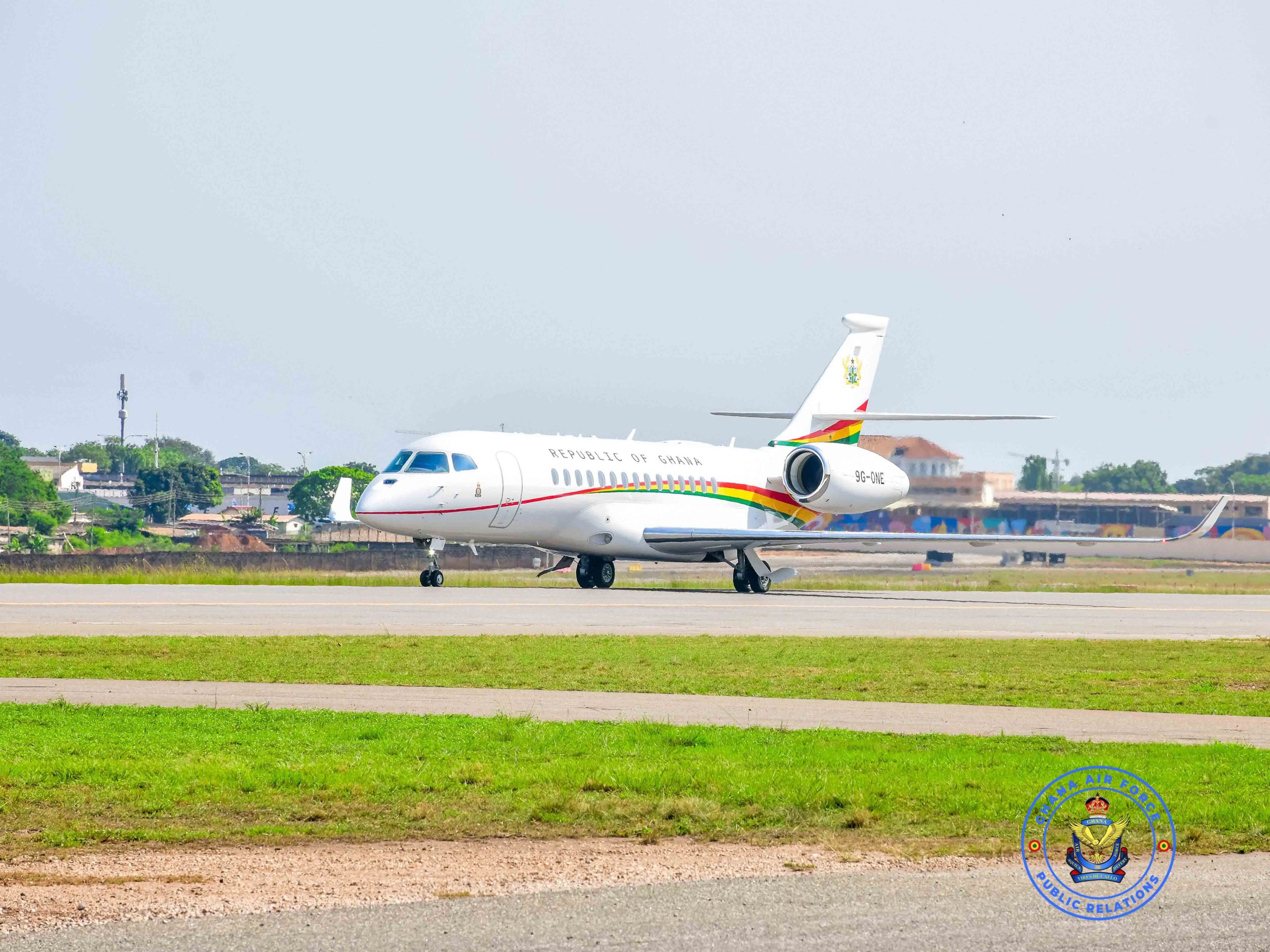

- New Falcon 6X Replaces Ageing State Jet as Ibrahim Mahama’s Former Aircraft Enters Ambulance Conversion
The Ghana Air Force has taken delivery of a new Dassault Falcon 6X executive jet, replacing a 16-year-old Falcon 900EX that has faced recurring maintenance problems.
The purchase, approved by Parliament in December 2025 for US$60.68 million, is intended to improve the state’s capacity for long-distance executive travel.
The delivery brings a public procurement debate into sharper focus: whether the aircraft’s improved range and reliability will justify its cost over time, and whether the state will fund the training and maintenance systems needed to keep it operational.
The new aircraft was manufactured by French aerospace company Dassault Aviation. Government spokesperson Felix Kwakye Ofosu said it is intended to replace the Falcon 900EX, which has been in service since 2010 and has experienced maintenance challenges. Its longer range is expected to reduce the need for refuelling stops on long-distance journeys.
Parliament’s Defence and Interior Committee described the old Falcon’s problems in its report on the acquisition.
Inspections had identified corrosion and fuel leakage, while the discontinuation of the model made sourcing parts more difficult. The committee said the ageing aircraft had become costly and operationally inefficient to maintain.
The case for replacement was therefore framed around operational readiness, not simply the age of the aircraft.
The committee argued that the Air Force needed modern platforms for air mobility and executive transport, and recommended the Falcon 6X alongside four helicopters under a separate contract with Airbus Helicopters.
The Falcon agreement was valued at US$60.68 million; the helicopter agreement was valued at €125.97 million.
That broader procurement context matters. The new jet is one part of a programme to modernise an aviation fleet that the committee described as ageing and unreliable.
But the Falcon’s delivery also focuses attention on how the state will manage a high-value asset after purchase.
Acquisition is only the first expense: pilots need training, maintenance systems and infrastructure need funding, and the aircraft must be kept in service if the investment is to deliver its intended value.
The committee itself underscored that point. It recommended adequate funding for pilot training, maintenance support and associated infrastructure, and said these were necessary for the aircraft to achieve optimal performance and long-term value.
The report also estimated that the new aircraft fleet’s lifecycle costs over 15 years could be 30% to 40% lower than continuing to maintain and operate the existing ageing aircraft. That is the committee’s estimate, not a guarantee of future savings.
The delivery has also drawn attention because Ibrahim Mahama, the President’s brother, previously announced that his former private jet would be converted into an air ambulance for public use.
The aircraft left Ghana in April for specialised modifications, including the installation of medical and life-support equipment.
The conversion was presented as a contribution to emergency medical response; the Falcon 6X, by contrast, is a state aircraft intended for executive transport. The two aircraft serve different purposes and should not be treated as substitutes.
The juxtaposition nevertheless raises a broader public question about the responsibilities of private philanthropy and public procurement.
A privately owned aircraft being adapted for medical emergencies may support a public need, but the state remains responsible for maintaining its own official transport and military capabilities.
The relevant test for the new jet is whether it provides reliable service at a sustainable lifecycle cost, with transparent oversight of its use and upkeep.
For the government, the purchase was approved by Parliament before delivery. The next measure of accountability will be how the aircraft is used and maintained, and whether the operational benefits match the rationale presented to lawmakers.
The committee report cited reduced reliance on leased aircraft, improved efficiency and enhanced national security as part of the case for the purchase. It also warned that adequate operating support would be necessary to realise those benefits.
That makes the aircraft’s longer range a meaningful but incomplete measure of value. Fewer refuelling stops may make some long-distance journeys more direct, but they do not answer questions about annual operating costs, maintenance arrangements or how the aircraft will be integrated into the Air Force’s wider responsibilities.
The new Falcon 6X replaces an aircraft whose maintenance difficulties had become a concern. Yet replacing an ageing asset only solves part of the problem. The state must now ensure that the new jet remains serviceable, that its use is properly managed and that long-term support is funded.
The public conversation around the aircraft will likely continue to weigh its price against competing needs. The parliamentary approval and the committee’s operational case explain why the purchase was pursued.
Whether it proves worthwhile will depend less on the arrival ceremony than on years of reliable service and disciplined management.

