

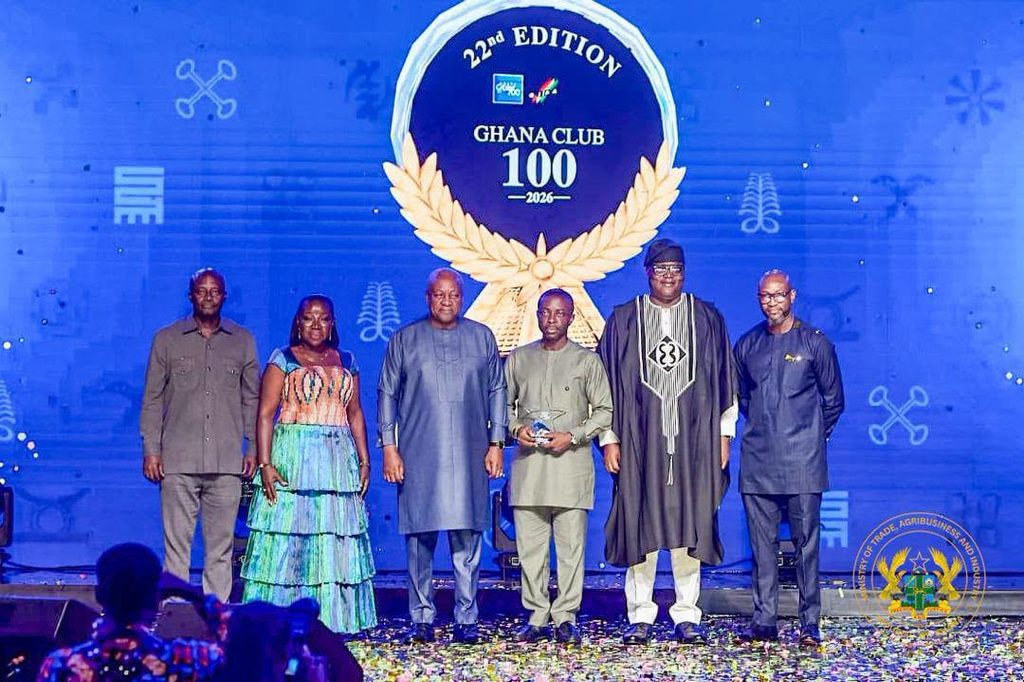

- Newmont Crowned Ghana’s Top Company as President Mahama Pledges Economic Stability and Cheaper Credit
Newmont Ghana Gold Limited has emerged as the country’s top-performing company in the 2026 Ghana Club 100 rankings, reinforcing the dominance of mining and telecommunications businesses in Ghana’s corporate landscape as President John Dramani Mahama challenged indigenous companies to take the lead in implementing the government’s proposed US$10 billion New Economy Programme.
The mining company secured the overall first position at the 22nd Ghana Club 100 Awards held in Accra on Wednesday, November 18, ahead of Scancom PLC, operators of MTN Ghana, and Gold Fields Ghana Limited, which placed second and third respectively.
The rankings, organised by the Ghana Investment Promotion Authority, recognise corporate performance across various sectors of the economy, including mining, telecommunications, banking, manufacturing, insurance and other commercial activities.
However, the occasion also provided a platform for a broader discussion about Ghana’s economic direction, particularly the role of domestic businesses in transforming an economy that remains heavily dependent on primary commodity exports.
President Mahama used the ceremony to urge Ghanaian companies to position themselves for opportunities under the New Economy Programme, a four-year investment initiative covering 2027 to 2030.
The programme, presented in the government’s 2027 Budget, seeks to mobilise approximately US$10 billion for investments across eight strategic sectors, with an emphasis on productive capacity, industrial development, job creation and export diversification.
The President emphasised that the private sector would be central to implementing the initiative, with government providing an enabling environment rather than directly operating the proposed investments.
“The new economy will be implemented by the private sector.”
His remarks represent an attempt to redefine the relationship between government and businesses, moving beyond traditional public-sector-led development towards a model in which private investment, industrial expansion and domestic entrepreneurship play a greater role in economic transformation.
The programme identifies opportunities in agriculture, agribusiness, irrigation, tourism, pharmaceuticals, textiles and garments, among other priority activities.
For Ghanaian businesses, the initiative potentially opens investment opportunities in sectors capable of generating employment, expanding manufacturing output and reducing the country’s dependence on imported finished products.
However, the central challenge will be whether domestic enterprises possess the financing capacity, technical expertise and operational scale required to take advantage of these opportunities.
This concern is particularly relevant because Ghana’s corporate landscape remains dominated by relatively large companies operating in mining, telecommunications and financial services.
The composition of the latest Ghana Club 100 rankings illustrates this concentration.
Newmont’s position at the top was followed by MTN Ghana in second place and Gold Fields Ghana in third, while GCB Bank PLC ranked fourth.
MobileMoney LTD placed fifth, followed by Ecobank Ghana PLC in sixth position and Stanbic Bank Ghana Limited in seventh.
Zijin Golden Ridge Limited and AngloGold Ashanti Iduapriem Mines occupied the eighth and ninth positions, while Zenith Bank Ghana completed the top ten.
The strong representation of mining companies reflects the continuing economic importance of Ghana’s extractive industries, particularly gold production.
Indeed, the Bank of Ghana’s latest economic data show that cumulative gold export receipts reached US$20.92 billion during the first ten months of 2026, accounting for approximately 68.79% of the country’s total merchandise exports.
Gold’s substantial contribution to export earnings underscores the sector’s importance to Ghana’s external position, particularly in an environment where foreign exchange availability remains an important consideration for businesses and policymakers.
However, the concentration of corporate strength in extractive industries also raises questions about the wider distribution of productive capacity across the economy.
Mining companies can generate substantial export revenues, taxes and employment, but Ghana’s longer-term economic transformation will depend on whether comparable levels of investment and corporate competitiveness can be developed in agriculture, manufacturing, pharmaceuticals and other value-adding sectors.
The New Economy Programme seeks to address this challenge by directing investment towards industries considered critical for economic diversification.
For President Mahama, the government’s role will be to create conditions that allow domestic companies to mobilise capital and expand their operations.
He reaffirmed his administration’s commitment to maintaining fiscal discipline and macroeconomic stability, arguing that predictable economic conditions are essential for sustainable private-sector investment.
“I can assure you, and I pledge to you, that as long as I’m president, we will maintain the fiscal discipline and the stability, macroeconomic stability we have achieved.”
The assurance comes against a backdrop of significant adjustments in Ghana’s monetary environment.
The Bank of Ghana’s November economic data show that the average commercial bank lending rate declined to 15.79% in October 2026 from 22.22% a year earlier.
The Ghana Reference Rate also declined substantially, reaching 10.04% in October compared with 17.86% in October 2025.
These developments indicate an improvement in the cost-of-credit environment, although borrowing costs remain a challenge for businesses seeking to finance long-term expansion.
Lower interest rates may create opportunities for greater private-sector borrowing, but they do not automatically guarantee that credit will reach businesses with viable investment projects.
Banks must also consider creditworthiness, collateral requirements, repayment capacity and broader commercial risks before extending financing.
For smaller Ghanaian enterprises, these considerations can remain significant barriers even in periods of declining market interest rates.
Consequently, the success of the US$10 billion programme will depend partly on whether the financial system can provide financing arrangements suited to the needs of domestic manufacturers, agricultural processors and other productive businesses.
Beyond financing, President Mahama identified inefficiencies at Ghana’s ports and regulatory institutions as important obstacles to business competitiveness.
He called for urgent action to reduce cargo clearance delays and improve the movement of goods and raw materials.
“We should be able to take a container out of the port in hours, not days.”
The statement highlights the economic importance of trade facilitation in Ghana’s industrialisation ambitions.
For manufacturers and exporters, delays in clearing raw materials, machinery and finished products can increase operating expenses, disrupt production schedules and weaken competitiveness.
Businesses operating within international supply chains must frequently meet strict delivery schedules, meaning inefficient port processes can undermine commercial relationships and raise transaction costs.
Reducing these inefficiencies could therefore provide economic benefits extending beyond the port industry.
It could help improve manufacturing productivity, reduce inventory costs and support Ghana’s ambition to become a more competitive destination for industrial investment.
However, meaningful improvements would require coordinated action across customs administration, port operations, transport infrastructure and regulatory institutions.
The President also challenged regulators to approach their responsibilities with greater consideration for the commercial realities confronting businesses.
The emphasis on regulatory efficiency reflects a broader recognition that economic transformation depends not only on attracting investment but also on reducing the costs and uncertainties associated with conducting business.
A company may identify a commercially viable investment opportunity, yet prolonged licensing procedures, expensive financing and unpredictable regulatory processes can discourage implementation.
These structural constraints are particularly important for indigenous businesses attempting to compete with larger foreign-owned companies.
President Mahama warned that Ghanaian entrepreneurs should not allow foreign investors to dominate the opportunities emerging under the New Economy Programme.
His position raises a fundamental question about the capacity of Ghana’s domestic private sector to participate meaningfully in large-scale industrial investment.
Foreign direct investment remains important because it brings capital, technology, management expertise and access to international markets.
However, a development strategy that relies predominantly on foreign ownership may limit opportunities for domestic businesses to build stronger industrial capabilities.
The challenge is therefore not to exclude foreign investment but to establish commercial arrangements that facilitate partnerships, knowledge transfer, domestic procurement and greater local participation.
The latest Ghana Club 100 rankings offer an indication of the scale and capabilities already present within parts of Ghana’s corporate sector.
Beyond the leading mining and telecommunications businesses, several financial institutions featured prominently among the highest-ranked companies.
Guaranty Trust Bank Ghana placed 11th, followed by OmniBSIC Bank, First Atlantic Bank and CAL Bank in 12th, 13th and 14th positions respectively.
Sunon Asogli Power Ghana ranked 15th, while Guinness Ghana Breweries occupied 16th place.
Kasapreko PLC secured the 18th position, demonstrating the presence of major Ghanaian manufacturing and consumer goods businesses within the leading corporate rankings.
The assessment of participating companies considered audited financial performance, tax contributions and selected social indicators, providing a broader measurement framework than revenue or profitability alone.
For policymakers, the rankings provide an opportunity to examine the factors that enable some businesses to achieve sustained commercial success while others struggle to expand.
Corporate performance is shaped by several conditions, including access to finance, managerial competence, market opportunities, technology adoption and the broader operating environment.
Improving these conditions across a wider range of businesses could help develop a more diversified and competitive corporate sector.
The President also highlighted succession planning as an important issue for indigenous companies, cautioning against business structures that depend excessively on their founders.
The concern is significant because corporate continuity, professional management and effective governance arrangements can influence a company’s ability to survive leadership transitions and attract long-term investment.
For Ghana’s family-owned and founder-led enterprises, stronger corporate governance could therefore become an important part of the country’s industrial development agenda.
Trade, Agribusiness and Industry Minister Elizabeth Ofosu-Adjare, meanwhile, encouraged award-winning businesses to embrace the government’s One More Ghana initiative, which seeks to stimulate industrial expansion, create employment and strengthen the country’s export capabilities.
The initiative aligns with the broader policy objective of expanding domestic productive capacity and positioning Ghanaian businesses to compete more effectively in regional and international markets.
Ultimately, the significance of the 2026 Ghana Club 100 Awards extends beyond the recognition of Newmont and other successful companies.
The rankings demonstrate that Ghana possesses businesses capable of achieving considerable commercial success, particularly in mining, telecommunications and banking.
The larger economic challenge is whether these capabilities can be replicated across industries that produce more processed goods, create broader employment opportunities and strengthen domestic value addition.
The proposed US$10 billion New Economy Programme provides a framework for pursuing that objective, but its success will depend on implementation, financing, regulatory efficiency and the willingness of Ghanaian businesses to undertake productive investments.
For government, the test will be whether its commitments to macroeconomic stability and business-friendly reforms translate into measurable improvements in the investment environment.
For the private sector, the challenge will be converting available opportunities into commercially sustainable enterprises.
And for Ghana’s wider economy, the ultimate measure of success will not simply be the number of companies recognised in future Club 100 rankings, but whether more businesses can expand production, compete internationally and create sustainable employment.
Newmont’s emergence as Ghana’s top-ranked company illustrates the continuing strength of the extractive sector. The next phase of the country’s economic transformation will depend on whether similar corporate success can be achieved across a broader and more diversified industrial economy.

