

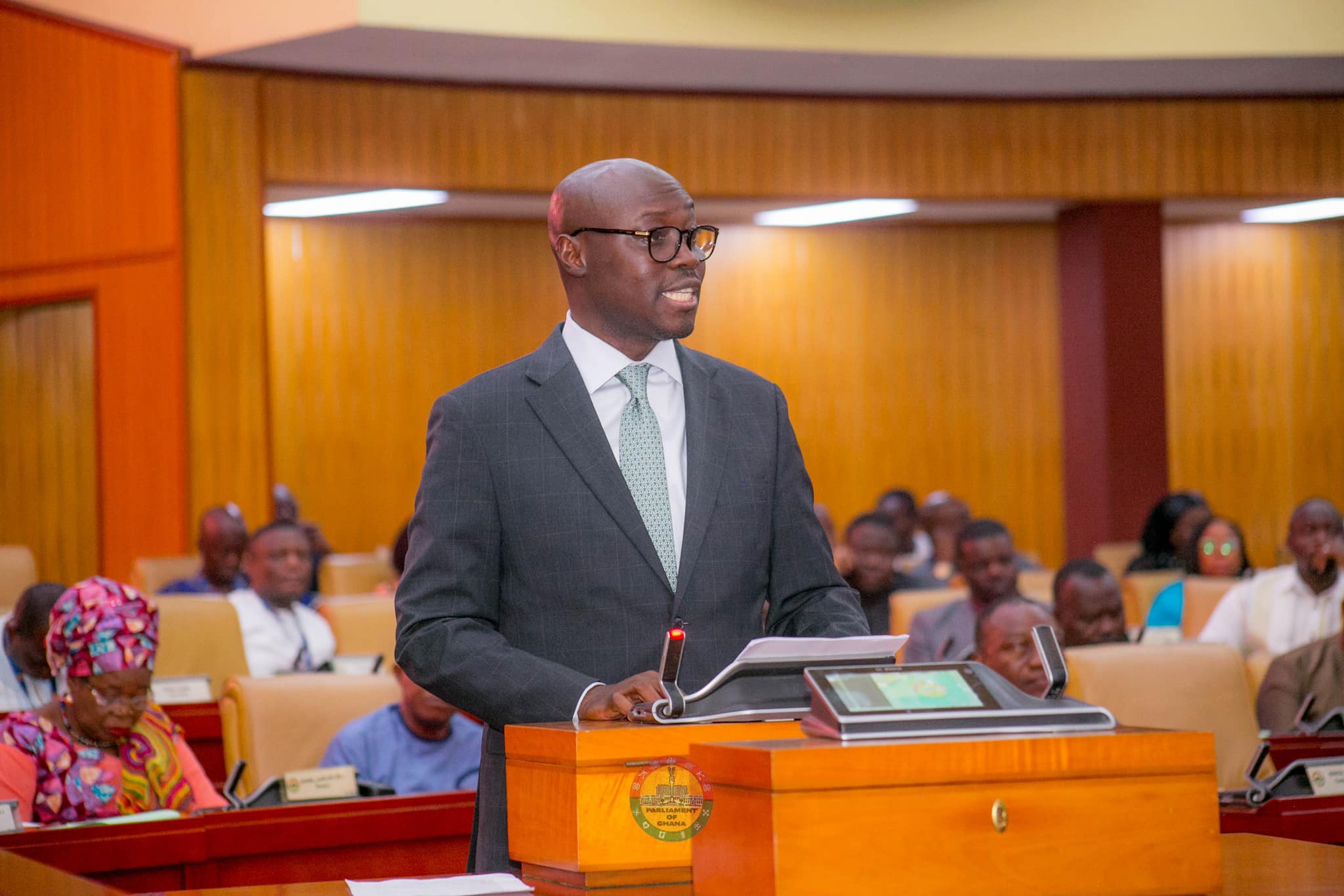

- No Supplementary Budget as Ato Forson Holds Line on Fiscal Discipline
Ghana has chosen restraint over fiscal expansion in its 2026 Mid-Year Fiscal Policy Review, with the government opting not to request a supplementary budget despite mounting demands for higher public spending, emergency infrastructure support and broader relief for households and businesses.
Presenting the review to Parliament on Thursday, Finance Minister Dr Cassiel Ato Forson said the government would maintain the 2026 budget ceiling and instead reallocate resources within existing appropriations, signalling that fiscal discipline remains the administration’s preferred route to sustaining Ghana’s economic recovery.
“The 2026 appropriations remain unchanged,” Dr Forson told lawmakers, adding that government would undertake “a strategic realignment of expenditures within the existing appropriations.”
The decision is politically significant. Mid-year budget reviews in Ghana often become opportunities for governments to revise expenditure, request supplementary funds or reset fiscal assumptions. By declining to do so, the Finance Minister is attempting to project confidence that the economy can absorb emerging pressures without abandoning the discipline that has underpinned recent macroeconomic stabilisation.
Government retained its key 2026 macroeconomic targets, including overall GDP growth of at least 4.80%, non-oil GDP growth of 4.90%, end-year inflation of 8.00% ±2.00 percentage points, a primary fiscal surplus of 1.50% of GDP, and international reserves covering no fewer than three months of imports.
The message to investors is clear: Ghana is prioritising policy continuity over short-term stimulus. The government appears determined to show that the recovery is not an excuse to reopen the spending taps, but a reason to protect hard-won stability.
Yet the decision also raises a difficult question. Can a government facing infrastructure gaps, climate-related disasters, energy-sector obligations and public pressure for relief maintain fiscal discipline without weakening public confidence?
That question became sharper after severe flooding hit parts of Ghana last month, destroying homes, businesses and public infrastructure while claiming lives. Similar flooding across Nigeria, Côte d’Ivoire and Sierra Leone has also underlined West Africa’s growing exposure to climate-related shocks.
Dr Forson announced additional funding for emergency drainage works and dredging projects, while disclosing that the Ministry of Works, Housing and Water Resources has been instructed to prepare a permanent flood mitigation programme. Financing for that programme is expected to be incorporated into the 2027 national budget and the medium-term expenditure framework.
The move suggests that government wants to address urgent flood risks without turning the 2026 mid-year review into a full spending expansion. That approach may please fiscal hawks, but it will test implementation. Flood mitigation requires more than emergency dredging. It demands urban planning enforcement, drainage investment, waste management reform, climate adaptation financing and local government accountability.
Much of the Finance Minister’s presentation was framed around the government’s economic stewardship since taking office in January 2025. Dr Forson argued that Ghana’s recovery should not be attributed solely to the IMF-supported programme or debt restructuring, but to what he described as “superior economic management.”
That claim will be debated. The IMF programme and debt restructuring have clearly played major roles in stabilising expectations, restoring some fiscal order and improving external confidence. But the government is seeking to position its own reforms as the deeper reason Ghana’s economy is regaining credibility.
Among the measures highlighted were expenditure-led fiscal consolidation, amendments to the Public Financial Management Act introducing binding fiscal rules, the creation of a Fiscal Council and Value for Money Office, tighter procurement controls, expanded oversight of state-owned enterprises, and reductions in the size of government through fewer ministries and ministers.
These reforms go to the heart of Ghana’s recurring fiscal problem: weak expenditure control, politically driven procurement, inefficient public investment and poor accountability in state-owned enterprises. If implemented rigorously, they could reduce the structural leakages that have repeatedly undermined budget discipline.
But the test will not be the creation of institutions. It will be whether those institutions are allowed to constrain political behaviour. A Fiscal Council without influence, a Value for Money Office without enforcement power, or procurement controls that are bypassed in practice would do little to alter Ghana’s fiscal culture.
The government also defended its decision to abolish several taxes, including the Electronic Transfer Levy, betting tax, emissions levy, VAT on motor insurance and the COVID-19 Health Recovery Levy. Dr Forson argued that stronger compliance and improved tax administration had offset the revenue impact.
He disclosed that non-oil tax revenue had increased despite the removal of the levies, supported by artificial intelligence-driven customs reforms that reportedly boosted monthly customs collections by roughly 17.00%.
This is one of the more important claims in the review. If Ghana can remove politically unpopular and economically distortive taxes while increasing revenue through compliance, data analytics and customs efficiency, it would mark a major shift in fiscal strategy. It would suggest the state is moving from simply creating new taxes to collecting existing taxes better.
But the revenue gains must prove durable. One-off improvements in customs collections can support a budget year; sustained compliance reform can change the fiscal base. The distinction will matter as government seeks to maintain a primary surplus while financing public services and infrastructure.
The Ghana Gold Board also featured prominently in the government’s recovery narrative. Dr Forson described GoldBod as a major macroeconomic intervention, saying increased formal gold exports had generated an additional US$15.00 billion in foreign exchange inflows, strengthening reserves and supporting exchange-rate stability.
The administration is now targeting reserve accumulation equivalent to 15 months of import cover by 2028 under the Ghana Accelerated National Reserve Accumulation Policy. Agreements with mining companies are also expected to allow government to purchase part of annual gold production for domestic refining.
This ambition is bold. Gold has become central to Ghana’s external-sector recovery, helping to strengthen reserves and support the cedi. But reliance on gold also carries risks. A reserve strategy built heavily on mineral earnings must be transparent, well-governed and protected from quasi-fiscal pressures.
The deeper issue is whether Ghana can convert gold’s current strength into a durable national balance-sheet advantage. That will require strong governance around GoldBod, clear pricing rules, transparent reporting, responsible fiscal treatment and a credible framework for managing mineral-related foreign exchange inflows.
For investors, the mid-year review offers reassurance. Government is not seeking additional appropriations. It is preserving headline targets. It is signalling continuity under the IMF-supported reform path. It is presenting tax administration and gold-sector formalisation as evidence that reforms are beginning to yield results.
For citizens, the message may be more complicated. Fiscal discipline can stabilise the economy, but households judge recovery through jobs, prices, wages, transport costs, school fees, rent, food prices and public services. A budget that looks strong to investors must still deliver visible relief to ordinary people.
That is the political economy challenge facing the government. Stabilisation is not the same as prosperity. Holding the budget intact may strengthen credibility, but it also limits the room for new spending promises. The administration is effectively asking Ghanaians to accept restraint today in exchange for a more durable recovery tomorrow.
Dr Forson’s mid-year review therefore marks a deliberate bet: that Ghana’s recovery will be better protected by fiscal discipline, expenditure realignment and structural reforms than by a fresh spending injection.
It is a defensible bet, but not a risk-free one. If reforms deliver, inflation remains contained, reserves strengthen and growth holds, the government will claim vindication. If cost-of-living pressures rise, flood recovery falters or promised reforms remain mostly administrative, the decision not to expand spending may face sharper criticism.
For now, Ghana’s 2026 budget remains intact. The bigger question is whether the discipline that preserved it will be strong enough to transform recovery into resilience.

