

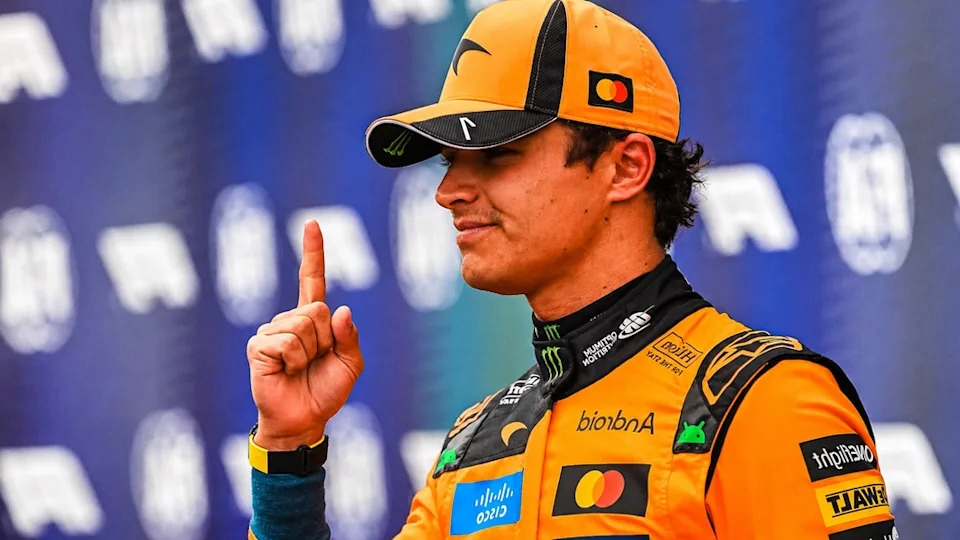

- Norris Targets More Titles After Long-Term Mclaren Deal Strengthens His Influence
Lando Norris says his status inside McLaren has evolved to the point where he can now be “forceful” in pushing the Formula 1 team towards the car, personnel and working environment he believes are required to win, after committing his future to the Woking-based outfit until at least the end of 2030.
The reigning world champion signed a contract extension over the weekend that places him at the centre of McLaren’s long-term plans and includes a multi-year option that could extend the relationship even further. The agreement follows Norris’ maiden world championship in 2025 and comes as his influence over team-mate Oscar Piastri has grown significantly during the 2026 campaign.
For Norris, however, the significance of the new contract goes beyond job security.
The 26-year-old says his eight seasons with McLaren have taught him when to challenge the organisation, how to influence technical direction and how to use the authority that comes with becoming the team’s world champion.
“You learn over the years when you should talk, when you shouldn’t,” Norris told Sky Sports News.
His comments point to the transformation of a driver who joined Formula 1 with McLaren as a 19-year-old in 2019 and has since become the team’s most experienced modern-era reference point.
Norris has now made 163 Grand Prix starts for McLaren, surpassing David Coulthard’s previous team record of 150 appearances, and his progression from highly rated rookie to world champion has changed his position within the organisation.
“In terms of how much power you have as the driver and as an individual, in the first few years, you’re not going to overstep any mark,” Norris said.
But experience, he suggested, has changed the relationship.
“With time, you learn that my role is not simply just driving the car. It’s also how can I be a leader, how can I lead the team, how can I be a voice for all the people that work here, all the guys and girls? How can I push them to do better, to be better?”
That shift is important in Formula 1, where the most successful drivers often exert influence well beyond qualifying laps and race results.
Championship-winning drivers become central reference points for engineering direction, car development, strategic culture and, in some cases, the wider organisational structure surrounding a team.
Norris believes he has now earned the authority to play that role.
“I’ve just learned the power that I can have and influence I can have over directions that we work in as a team,” he said.
“Of course, I never want to abuse that, but at the same time, I know that I’m in a position where I can be forceful to try and get what I want, from a car, from the team, from people around me.”
The comments are particularly notable because McLaren continues to operate with two highly regarded drivers.
Norris won his first world championship in 2025 after an intense season-long contest with Piastri and Red Bull’s Max Verstappen.
Piastri had led Norris by 34 points and Verstappen by 104 points with nine rounds remaining, but his advantage unravelled as the season progressed.
Norris ultimately secured the championship by just two points over Verstappen, while Piastri finished 13 points behind his McLaren team-mate.
The experience appears to have strengthened Norris’ belief in the importance of maintaining pressure deep into a championship campaign.
A difficult opening to 2026 initially appeared to have damaged his prospects of defending the title, but upgrades to McLaren’s MCL40 have helped revive his season, with Norris winning consecutive races in Hungary and the Netherlands. He has drawn parallels with Verstappen’s recovery during the previous championship.
“Just the fact that it’s possible. Just the fact to keep believing, keep working hard, keep motivating the team in all the right ways. That’s the biggest thing,” Norris said.
The comparison, however, also opens a potentially sensitive question inside McLaren.
Norris is now 55 points ahead of seventh-placed Piastri, and his comments about the difference between McLaren’s two-driver fight last year and Verstappen’s more singular championship challenge could be interpreted as a suggestion that the team may eventually have to place greater competitive weight behind one driver.
“There wasn’t anything that we were doing wrong at the time,” Norris said of last year.
“We just had two drivers fighting for our championship. They just had one.”
He added that the situation was now more comparable to Mercedes’ circumstances against him, although he stopped short of explicitly demanding preferential treatment.
For McLaren, that distinction could become increasingly important as the championship develops.
Teams traditionally prefer to allow both drivers to compete while both retain a realistic mathematical chance, but championship pressure can eventually force strategic decisions over pit stops, race positioning, upgrades and team orders.
Norris’ enhanced status means his voice in those discussions will inevitably carry more weight than it did earlier in his career.
McLaren have effectively committed to building a major part of their future around a driver who has already delivered the team’s first drivers’ world championship since Lewis Hamilton’s triumph in 2008.
Norris, in turn, appears comfortable accepting the responsibility that comes with that status.
“And that’s a very important thing,” he said of using his influence. “You’ve got to utilise that, I think, as an athlete, no matter what sport you’re in.”
The relationship therefore appears to be entering a different phase. For much of Norris’ early McLaren career, the central question was whether the team could build a car capable of matching his potential.
McLaren now know Norris can win the title. The challenge is sustaining an environment capable of winning repeatedly — and Norris increasingly sees himself as part of the process of shaping that environment rather than simply driving the car produced for him.
He says he is comfortable with the leadership structure around him and the team’s current work ethic.
“I feel like I’m in a very good place right now with the people I have around me, my team, people we have in different positions, team leaders, all of those things, and the work ethic of the whole team,” he said.
The timing of the extension also removes one potential distraction as Formula 1 approaches the Italian Grand Prix at Monza on September 4-6.
Norris can now pursue his title defence without uncertainty over his longer-term future.
For McLaren, meanwhile, securing its world champion through at least 2030 provides continuity at a time when driver-market movements and major regulation changes can reshape competitive hierarchies quickly.
But the most revealing part of Norris’ latest comments may be less about the duration of his contract than the authority he now believes comes with it.
The teenager McLaren placed in its car in 2019 was expected primarily to prove that he belonged in Formula 1.
Seven years later, he is a world champion, the team’s record appearance holder and one of the individuals helping determine where McLaren goes next.
Norris is no longer merely asking the team to give him a winning car. Increasingly, he believes he has earned the right to help define what that winning team should look like.

