


- Only 7.70% of Ghana’s 2.64 million Businesses Are Formal – GSS
Ghana has entered a decisive period in which the country’s largest youth population in history could become a powerful economic asset or a source of sustained social and fiscal pressure, the Ghana Statistical Service has warned.
About 12 million Ghanaians, equivalent to roughly one in three citizens, were between 15 and 35 years old in 2025. Yet close to two million young people were neither employed nor participating in education or training, with young women accounting for more than 60.00% of that group.
Youth unemployment averaged 32.40% among people aged 15 to 24 during the first three quarters of 2025, compared with 21.90% for those aged 15 to 35 and a national unemployment rate of 12.80%.
The figures were presented at the launch of Ghana in Numbers 2025, the first edition of a new annual publication that brings Ghana’s official population, economic, social, governance and environmental statistics into a single national reference.
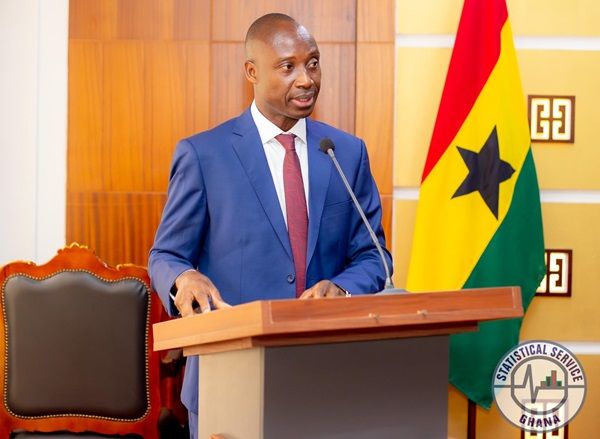
Government Statistician Dr Alhassan Iddrisu said the country’s demographic opportunity would not remain open indefinitely.
“Ghana’s youth window is open, but it is closing. Our choices on schooling, skills and jobs in the next ten years will decide whether it becomes a dividend or a burden,” he said.
The warning goes beyond unemployment. It raises a fundamental question about whether Ghana’s economy is creating enterprises capable of absorbing the growing number of young people entering the labour market.
The first Integrated Business Establishment Survey counted 2,644,363 businesses in 2024. Establishments almost tripled between 2014 and 2024, but the number of people working in them only doubled.
“Businesses are multiplying faster than the jobs inside them,” Dr Iddrisu observed.
Nine in every 10 establishments were micro businesses, while only 7.70% were formal. More than seven in every 10 jobs across the labour market also remained informal.
The figures suggest that enterprise creation alone is not sufficient. Ghana is producing large numbers of small, survival-oriented businesses, but relatively few are growing into productive companies capable of employing significant numbers of people, paying taxes and providing stable incomes.
This places the policy focus on helping viable small businesses formalise, improve productivity and obtain the financing, technology and market access required to expand.
The report presents evidence of significant macroeconomic and social progress, but it repeatedly shows that those gains are uneven.
Inflation declined from 54.10% in December 2022 to 5.40% in December 2025 and stood at 5.20% at the time of the launch.
Nominal gross domestic product per person increased from GH¢4,710.10 in 2013 to GH¢42,501.90 in 2025, equivalent to about US$3,385. The publication cautioned, however, that price changes meant the improvement in purchasing power was considerably smaller than the ninefold increase in the cedi figure suggested.
Multidimensional poverty fell from 31.20% in 2022 to 23.00% across the first three quarters of 2025. Ghana has also produced poverty estimates for all 261 districts, giving policymakers a more precise basis for targeting interventions.
Health and education outcomes similarly improved. Life expectancy increased from 40.3 years in 1960 to 65.1 years in 2021, while deaths among children under five declined from 80 to 40 per 1,000 live births between 2008 and 2022.
Active health-insurance membership rose from 30.00% in 2010 to 66.20% in 2025, while junior high school completion increased from 77.50% to 88.40% over five years.
Governance indicators also recorded progress. The share of citizens who believed they had no influence over government decisions declined from 59.90% in 2013 to 29.70% in 2025.
The proportion of respondents who reported giving money or gifts to public officials also fell from 26.70% in 2021 to 16.80% in 2025.
However, the social picture remains difficult. Food insecurity increased from 37.70% in 2024 to 39.80% in 2025, affecting approximately 13 million people despite continued growth in agricultural production.
Agriculture accounted for 22.80% of Ghana’s gross domestic product in 2025, but public expenditure on the sector amounted to only about 0.20% of GDP in 2024.
The imbalance raises questions about whether national spending priorities adequately reflect agriculture’s importance to employment, food security and rural incomes.
Environmental pressures are also intensifying. Coastal plastic debris rose more than fivefold between 2016 and 2019. Although it declined in 2020, it remained more than four times the 2016 level.
Western North’s share of Ghana’s forest-reserve coverage fell from 19.60% in 1990 to 6.50% in 2021, indicating a marked shift in forest resources and continuing environmental degradation.
Trade statistics revealed another important feature of the economy. Ghana recorded a goods-trade surplus of GH¢148.30 billion in 2025.
However, the country’s first survey of informal cross-border trade found that GH¢38.40 billion worth of goods crossed Ghana’s land borders with Togo, Burkina Faso and Côte d’Ivoire in the year to September 2025. That was about 1.4 times the value of recorded formal trade with those neighbours.
The finding highlights the size of economic activity occurring outside conventional customs and administrative systems. It also suggests that official trade data, tax collection and regional economic policies may not fully capture how businesses and households actually trade.
Dr Iddrisu said Ghana in Numbers was designed to end the fragmentation of official information across different censuses, surveys and institutional reports.
“Ghana in Numbers changes that. It brings the country’s essential statistics into one volume, in plain language,” he said.
The publication presents each major indicator through its current value, its direction of travel and an explanation of what the figure means. A supporting web portal offers district-level breakdowns, interactive maps and downloadable data.
The intention is to create a shared statistical foundation from which Cabinet, Parliament, businesses, civil society, researchers and the media can discuss national policy.
“When Cabinet, Parliament, boardrooms and newsrooms work from the same figures, the debate moves from ‘whose figures are right?’ to ‘what do we do about them?’” Dr Iddrisu said.
Finance Minister Dr Cassiel Ato Forson reinforced the principle in the publication’s foreword, stating: “Good policy is not built on opinion or guesswork. It is built on evidence.”
The Government Statistician urged ministries, departments, district assemblies and Parliament to anchor budgets and programmes in measurable baselines. He also encouraged businesses to treat the employment figures as a market signal and development partners to align assistance with gaps identified by the data.
He asked the media and civil society to report trends and demographic breakdowns rather than relying exclusively on national headline figures.
Dr Iddrisu also called for predictable domestic financing for Ghana’s statistical system. The government allocated GH¢207 million in 2026 for rebasing the Consumer Price Index and GDP, alongside related statistical activities.
He welcomed the allocation but warned that censuses, surveys and national statistical publications should not depend heavily on the changing funding priorities of development partners.
“The numbers a nation budgets with should not rise and fall with external funding cycles,” he said.
He further asked the Finance Minister to champion a proposed Statistics Bill through Cabinet, arguing that a modern data system required legislation that protected institutional independence and strengthened coordination.
The publication’s ultimate value will not be determined by how many indicators it contains, but by whether public institutions use the evidence to change spending, education, employment and investment decisions.
As Dr Iddrisu put it: “A statistic changes nothing until someone acts on it.”

