

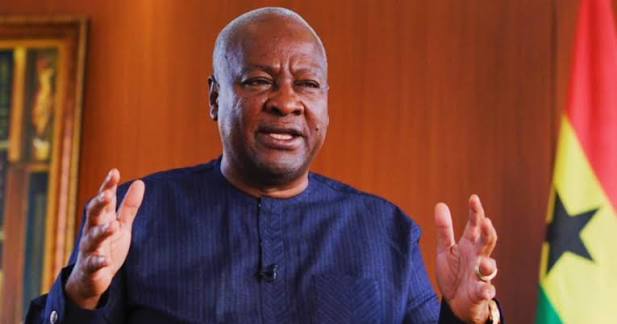

- President Mahama Launches ‘A Sovereign Future for Health’ As Accra Reset Moves from Aid to Self-Reliance
President John Dramani Mahama has called for a fundamental restructuring of global development and health cooperation, arguing that countries in the Global South cannot claim genuine ownership of critical services while financing, production and decision-making remain largely controlled elsewhere.
Speaking at a high-level Accra Reset event on the sidelines of the 81st United Nations General Assembly in New York, Mr Mahama said the initiative was moving from diagnosis to implementation around a model built on national capability, regional production and greater control over development priorities.
The event marked one year since the Accra Reset was launched in New York and culminated in the unveiling of a new report, A Sovereign Future for Health.
The President framed the initiative as a rejection of a development system in which essential health and social programmes remain exposed to changing donor priorities.
He said the Global South continues to face what the Accra Reset describes as geostrategic marginalisation, geopolitical vulnerability and donor dependence, three pressures that cannot be addressed through repeated appeals for external assistance alone.
“We refused to accept that our people’s health, dignity, and future should remain perpetually tied to the shifting political winds of donor magnanimity,” Mr Mahama said.
The argument has acquired greater urgency amid disruption to international health financing and wider geopolitical tensions. A report released alongside the event warns that reductions in external health support are exposing the vulnerability of systems built around programmes financed or administered from outside the countries they serve.
The Accra Reset’s response is to shift the emphasis from how much aid can be mobilised towards how countries can acquire the productive, fiscal and institutional capacity to act on their own terms.
For Ghana, Mr Mahama linked that philosophy directly to his domestic economic programme.
He said the government’s Resetting Ghana Agenda covering fiscal management, governance, industrialisation, local value addition, public health infrastructure and the 24-Hour Economy reflects the same principles being promoted internationally through the Accra Reset.
“You cannot successfully reset a national house if the global architecture around it remains fundamentally flawed,” he said, while warning that global reform would itself be meaningless without stronger discipline and accountability at home.
Health manufacturing sits at the centre of that argument. Mr Mahama said Ghana’s objective should not be to construct hospitals while remaining dependent on foreign donors for vaccines, intravenous fluids and essential medicines, but to build local pharmaceutical capacity backed by predictable state procurement and access to regional markets.
That model seeks to connect health policy with industrial strategy, turning expenditure on medicines and medical supplies into a platform for domestic production rather than treating health purely as a consumption item.
The wider Accra Reset report proposes five political shifts and 10 recommendations aimed at reorganising global health cooperation around what it describes as sovereign national capability, stronger regional functions and genuine global public goods.
The framework argues that international partnerships should help countries build the institutions, financing systems and production networks needed to deliver services sustainably instead of creating parallel structures dependent on external programmes.
Its central proposition is that sovereignty must be measured not by formal political independence alone but by whether governments possess the practical capability to make and execute decisions.
Mr Mahama traced the argument back to the Bandung Conference of 1955 and subsequent development commitments, including the emphasis on “country ownership” that emerged from the 2005 Paris Declaration on Aid Effectiveness.
His criticism is that ownership has often remained rhetorical where governments are responsible for outcomes but lack control over financing, procurement and strategic decisions.
“Today, through the Accra Reset, we declare unequivocally that there can be No Ownership Without Control,” he said.
But the President also turned that challenge inward, cautioning governments in Africa and the wider Global South against interpreting sovereignty as an argument for weaker scrutiny.
Transferring authority from international institutions to national ministries would not automatically produce better outcomes if domestic institutions remain opaque or poorly governed.
“No ownership without control, yes but no control without absolute accountability to our people,” he said, linking greater policy autonomy to tighter fiscal controls, stronger governance and demonstrable stewardship of public funds.
That formulation is important because it attempts to distinguish the Accra Reset from a simple anti-aid or anti-Western platform.
Mr Mahama described the goal as “pragmatic interdependence” rather than isolation, arguing that stronger Southern health systems would ultimately make the global system more resilient.
The initiative is seeking partnerships with institutions in Brazil, India, Indonesia, the Gulf and across Africa to build networks connecting research, regulation, manufacturing and distribution.
The President said the next phase would involve translating the report’s recommendations into country-level compacts involving governments, development finance institutions, global health organisations, philanthropies and the private sector.
The event drew participation from current and former political leaders, international organisations and development actors, with the Presidency previously identifying figures including William Ruto, Mia Mottley, Gordon Brown, Olusegun Obasanjo, Ellen Johnson Sirleaf and Laura Chinchilla among the expected participants.
Maternal and child health will be one of the first areas in which the new approach is tested. Mr Mahama said sub-Saharan Africa continues to account for the majority of global maternal deaths and acknowledged that Ghana remains far above the Sustainable Development Goal threshold.
Initiatives including Mother Africa and the Business United for Mothers, Babies and Youth campaign are intended to bring public policy and private-sector participation together around measurable improvements in maternal and child health.
The focus on health also reflects a wider economic argument about development resilience. Countries unable to manufacture essential medicines, finance core health services or maintain supply chains independently remain vulnerable to political decisions taken abroad, even where domestic governments retain formal responsibility for outcomes.
Building local production therefore becomes part of both health security and industrial policy, particularly for African economies seeking to use the AfCFTA market to support scale.
Ghana is also seeking to carry the agenda into continental policymaking as it prepares to assume the chairmanship of the African Union in 2027, according to Mr Mahama’s remarks.
He said the government would work through African institutions, the Non-Aligned Movement and the G77 plus China to push the reform agenda beyond individual national initiatives.
The stated ambition is to turn the Accra Reset from a Ghana-led platform into a broader coalition around institutional capability and more balanced international cooperation.
The challenge now is execution. Development diplomacy is crowded with declarations, panels and frameworks that generate political attention without materially changing how money, institutions and production systems operate, a risk Mr Mahama himself acknowledged when he warned against allowing the Accra Reset to “die quietly in New York’s diplomatic corridors”.
The initiative will therefore be judged less by the language of sovereignty than by whether countries can actually manufacture more of what they consume, finance more of what they promise and negotiate international partnerships from a stronger economic position.
For Ghana, that makes the domestic side of the argument inseparable from the global one. If Accra is asking international institutions to surrender more control to developing countries, the government must demonstrate that greater national control produces stronger accountability, better procurement, credible fiscal management and improved public services.
The Accra Reset’s most demanding proposition may therefore be the one Mr Mahama directed not at donors but at the Global South itself: sovereignty requires control, but control without accountability merely relocates power rather than reforming it.

