

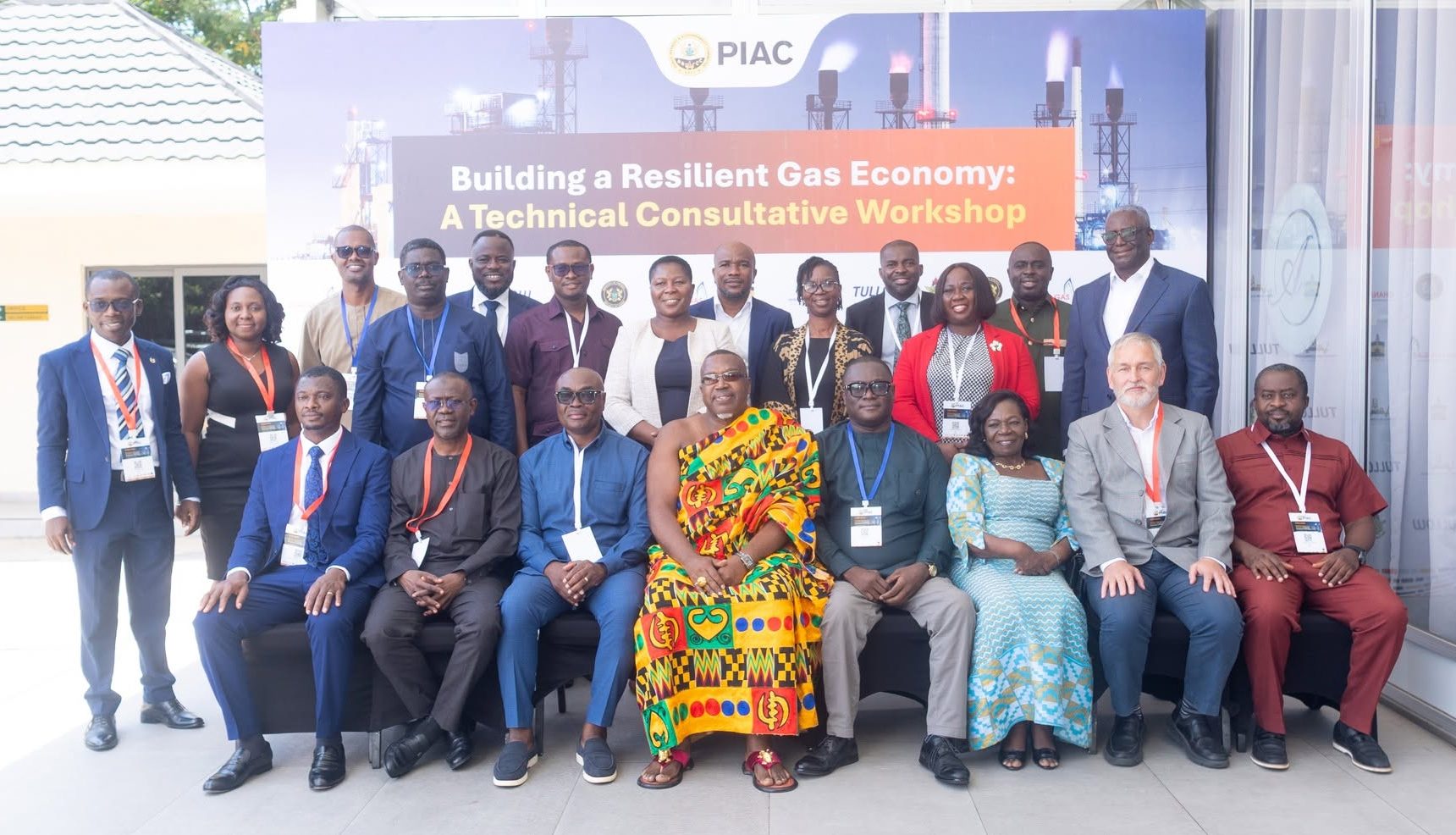

- PIAC Flags Infrastructure and Liquidity Risks in Ghana’s Gas Sector
Ghana’s ambition to build a resilient gas economy is being constrained by infrastructure bottlenecks, weak payment flows and an excessively concentrated domestic market, according to findings from a two-day technical workshop convened by the Public Interest and Accountability Committee.
Stakeholders identified inadequate processing, transportation and compression capacity as critical obstacles to increasing domestic gas supplies, warning that additional production would not automatically deliver reliable or affordable energy.
The workshop brought together representatives from the Ministry of Energy and Green Transition, Ghana National Petroleum Corporation, Petroleum Commission, Ghana Gas, Tullow Ghana and other institutions across the energy value chain.
Their discussions point to an uncomfortable conclusion: Ghana’s immediate gas challenge may no longer be principally geological.
The country has potential incremental supplies from existing fields and could develop additional reserves. But those resources will generate limited economic value unless Ghana can transport gas to demand centres, establish credible pricing arrangements and ensure that suppliers are paid.
The weakness of any one part of that system can undermine the whole chain.
A producer may have gas available, but inadequate compression can restrict its movement. A pipeline may be technically capable of carrying gas, but uncertain demand can make financing difficult. A power plant may require fuel, but weak electricity collections can prevent invoices from being settled.
Ghana’s gas problem is therefore becoming a question of commercial and institutional co-ordination as much as physical supply.
Participants identified midstream infrastructure as one of the most immediate constraints on the delivery of additional gas.
Processing plants, compressors and pipelines connect upstream production to power generators and industrial consumers. Their capacity and reliability determine how much of the gas produced offshore can be used domestically.
If transportation and processing systems cannot accommodate higher volumes, an increase in production may not translate into a comparable increase in usable supply.
Compression is particularly important. Falling pressure in maturing reservoirs or pipelines may require additional equipment to maintain the movement of gas through the system.
A shortage of compression capacity can therefore create a bottleneck even where reserves remain available.
This makes infrastructure planning inseparable from upstream production forecasts. Ghana cannot negotiate additional volumes without simultaneously determining how those volumes will be processed, transported and paid for.
The workshop’s findings suggest that infrastructure investment should be based on an integrated supply-and-demand model rather than developed as a collection of isolated projects.
Stakeholders also raised concern about Ghana’s reliance on externally regulated infrastructure for reverse-flow gas supplies.
Reverse-flow arrangements have helped move gas into areas facing supply constraints. But dependence on infrastructure outside Ghana’s direct operational control introduces a strategic risk.
Technical failures, maintenance decisions or regulatory developments affecting an external pipeline could interrupt supplies even where Ghana has the financial capacity and market demand to receive gas.
That exposure strengthens the case for accelerating the proposed Takoradi-to-Tema gas pipeline.
The project could connect the Western Region’s gas-production and processing infrastructure with major electricity and industrial demand centres in the east.
Its strategic value lies not only in moving additional gas. A domestic east-west pipeline could provide Ghana with greater control over its internal gas-balancing arrangements and reduce its dependence on a limited number of supply routes.
But a pipeline of that scale requires more than political approval.
Financiers will need credible evidence of future demand, reliable anchor customers and a commercial framework capable of generating sufficient revenue to service the project’s debt and operating costs.
Without bankable offtake agreements, the pipeline could become another important infrastructure proposal unable to achieve financial close.
The workshop consequently recommended that development of the Takoradi-Tema link be supported by secured anchor demand and clear financing arrangements.
The stakeholders also identified unresolved exploration rights and uncertainty over gas pricing as potential barriers to the development of non-associated gas reserves.
Much of Ghana’s domestic gas has been produced alongside crude oil. This associated gas can be commercially attractive because part of the development cost is supported by oil production.
Non-associated gas fields are different. Their economics depend primarily on gas revenues, making the price, volume and duration of future sales agreements particularly important.
Developers must be confident that there will be buyers willing and able to purchase gas over a long enough period to recover investment costs.
Uncertainty over exploration rights, tariff structures or the role of state institutions raises the risk attached to such projects and may increase the return demanded by investors.
Ghana’s future gas strategy cannot depend indefinitely on associated gas from existing oilfields. But unlocking dedicated gas reserves will require a bankable market, not merely proof that the resources exist.
That means transparent pricing, predictable regulation and gas-sales agreements supported by credible payment security.
The workshop linked Ghana’s gas-sector difficulties directly to the long-standing liquidity problems in the electricity industry.
Gas supplied to thermal generators is ultimately paid for with revenue collected from electricity consumers. Where distribution companies lose power through theft, defective metering, billing failures or weak collection, less cash moves through the system.
The shortfall can delay payments to generators, gas transporters and upstream suppliers.
This explains why electricity-metering reform is relevant to gas security.
Participants proposed a phased rollout of tamper-proof, remotely monitorable meters, supported by stricter procurement standards.
Such meters could reduce commercial losses, improve consumption data and make unauthorised interference easier to detect.
But technology alone will not resolve the problem. Metering systems must be supported by accurate billing, effective collection and enforcement against illegal connections.
The commercial objective is to convert more of the electricity delivered to consumers into collected revenue.
Unless that happens, the gas value chain will continue to depend on government interventions, payment guarantees or the accumulation of arrears.
Ghana’s domestic gas market remains heavily dependent on electricity generation.
Power plants provide the largest and most established source of demand, but this concentration exposes gas producers and infrastructure operators to the financial condition of a single industry.
When electricity-sector payments weaken, almost the entire domestic gas market feels the effect.
The workshop therefore urged GNPC and Ghana Gas to identify credible non-power customers capable of creating additional demand.
Potential industrial users could include fertiliser producers, manufacturers requiring process heat and businesses capable of deploying combined heat-and-power systems.
Diversifying demand could reduce the gas industry’s exposure to electricity-sector arrears while supporting domestic production and import substitution.
However, industrial demand cannot be assumed into existence.
Manufacturers will require reliable supply, competitive delivered prices and sufficient confidence to invest in gas-dependent equipment. Pipeline access must also extend to industrial locations where meaningful demand can be developed.
The key is to identify customers whose requirements are large and predictable enough to underpin investment.
The workshop also examined Ghana’s reliance on liquid fuels when gas supplies are inadequate.
Diesel and heavy fuel oil can support power generation during gas shortages, but they are generally more expensive and increase exposure to international oil prices and foreign-exchange movements.
Participants argued that liquid-fuel substitution should be treated as a measure of last resort.
The recommendation does not eliminate the need for backup fuel. Thermal plants may require alternative supply arrangements to maintain operations during gas interruptions.
But the system should not routinely depend on expensive liquid fuel because infrastructure deficiencies or commercial disputes prevent available gas from reaching generators.
Power producers were also encouraged to undertake efficiency retrofits that could narrow the cost gap and reduce fuel consumption.
Such investments should be judged against measurable savings. An efficiency programme that lowers the fuel required for each unit of electricity generated could reduce both operating expenditure and pressure on foreign exchange.
The workshop called for clearer commercial responsibilities among Ghana’s state-owned gas and power institutions.
Regulatory overlap and uncertain institutional mandates can slow decision-making and create disputes over pricing, infrastructure ownership and payment obligations.
These uncertainties become particularly damaging when investors are asked to finance assets on the strength of long-term contractual arrangements.
Take-or-pay commitments, for example, require a buyer to pay for an agreed volume of gas whether or not it consumes the full amount. Such contracts can make upstream investments bankable, but they can also create substantial liabilities if demand forecasts prove too optimistic.
Reserve-capacity guarantees present similar challenges. They may improve reliability by paying for infrastructure or supply kept available for emergencies, but the cost must be allocated transparently.
Ghana needs institutions capable of entering and enforcing such arrangements without transferring poorly assessed risks to taxpayers.
The findings from the PIAC workshop ultimately show that building a gas economy requires three systems to develop together: physical infrastructure, commercial discipline and credible regulation.
If Ghana increases production without expanding transportation capacity, gas may remain stranded. If it builds pipelines without securing customers, the assets may become financially burdensome. If it develops supply and demand but fails to collect revenue, the resulting debt will eventually weaken both.
The question is no longer simply whether Ghana has enough gas.
It is whether the country can construct a market in which gas can move reliably from the reservoir to the consumer and money can move with equal reliability in the opposite direction.

