

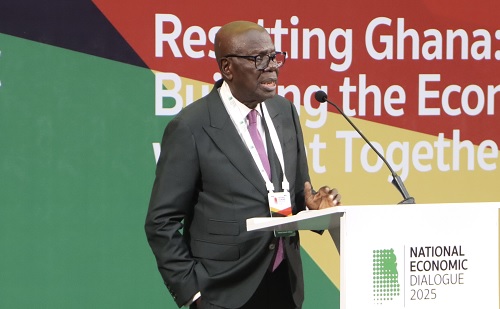

- Policy Coordination Critical to Ghana’s Economic Transformation — Dr Ishmael Yamson
Renowned business leader and economist Dr Ishmael Yamson has called for stronger policy alignment among state agencies, warning that Ghana’s economic transformation agenda will struggle to deliver results if public institutions continue to operate in silos.
His comments come at a time when the government is seeking to consolidate recent macroeconomic gains and shift the economy toward higher productivity, private sector growth, industrialisation and job creation.
Dr Yamson’s concern speaks to one of Ghana’s most persistent governance weaknesses: the gap between policy design and policy execution.
Over the years, successive governments have launched major programmes aimed at transforming agriculture, industry, exports, infrastructure and enterprise development. However, weak coordination among ministries, departments and agencies has often undermined implementation, creating duplication, conflicting mandates and slow delivery.
For Ghana to transform its economy, Dr Yamson argues, public institutions must work from a shared national objective rather than narrow institutional priorities.
That means investment promotion agencies, tax authorities, regulators, infrastructure ministries, trade institutions, financing bodies and local government structures must align their policies around a common transformation strategy.
The call is particularly relevant as Ghana attempts to move beyond stabilisation into growth.
Macroeconomic stability may create the foundation for investment, but it does not automatically produce factories, exports, jobs or productivity gains. Those outcomes require coordinated policy execution, predictable regulation and institutions that understand how their mandates connect to the wider economy.
For businesses, policy misalignment often shows up in practical ways: long approval processes, inconsistent regulatory decisions, overlapping fees, poor coordination between agencies and uncertainty over incentives.
These frictions raise the cost of doing business and weaken investor confidence.
A company may receive encouragement from one state institution to invest, only to face delays, levies or conflicting requirements from another. That kind of institutional disconnect makes transformation harder, even when the broader economic policy direction is sound.
Dr Yamson’s message also places responsibility on the state to treat economic transformation as a delivery project, not merely a policy statement.
If Ghana wants to expand manufacturing, deepen agro-processing, increase exports, grow small businesses and attract long-term investment, state agencies must be measured not only by internal compliance but by their contribution to national outcomes.
That requires clearer targets, stronger inter-agency coordination, better data sharing and a central mechanism for resolving bottlenecks that delay private investment and public projects.
The private sector has long argued that Ghana does not suffer from a shortage of policy ideas. The bigger challenge has been implementation discipline.
Dr Yamson’s call, therefore, reinforces the growing demand for a more joined-up state, one that can move from speeches and strategy documents to execution.
Economic transformation will not happen simply because Ghana has restored stability or secured investor interest. It will happen only when the institutions responsible for regulation, finance, infrastructure, trade and enterprise development are working in the same direction.
Ghana’s next growth phase will therefore depend not only on what policies are announced but also on whether state agencies can align behind them and deliver with urgency.

