

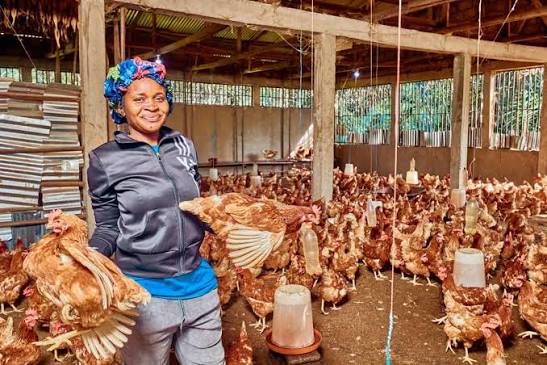

- Poultry Farmers Warn Ghana’s Import-Reduction Dream Needs More Than Shared Birds
Ghana’s ambition to revive local poultry production and reduce dependence on imported chicken is facing an early credibility test, after poultry farmers warned that the government’s Nkoko Nkitinkiti programme could miss its central objective unless serious implementation flaws are corrected.
The warning from the Poultry Farmers Association of Ghana should not be dismissed as routine industry complaint. It goes to the heart of a recurring weakness in Ghana’s agricultural policy: the country often gets the political announcement right, but struggles with the practical systems that make production sustainable.
The Nkoko Nkitinkiti initiative was introduced as one of government’s flagship agricultural interventions to revitalise the poultry industry, increase local production, create investment opportunities and reduce reliance on imported chicken and other poultry products.
On paper, the logic is strong. Ghana has demand for poultry. Local farmers need support. Import dependence weakens domestic production capacity. A well-designed poultry revival programme could create jobs, stimulate feed production, support maize and soya value chains, deepen agribusiness investment and retain more value within the economy.
But poultry farmers are now saying the programme risks falling short because production is being pushed without sufficient attention to markets, beneficiary readiness and public education.
Speaking on Joy FM’s, President of the Poultry Farmers Association, George Dassah, said farmers initially welcomed the initiative as a potentially transformative intervention for the sector, but developments on the ground suggest it may fail unless the Ministry of Food and Agriculture reviews its approach.
His concern came after Agric Minister Eric Opoku reportedly suggested that increased production under the programme had contributed to lower poultry prices. But Dassah challenged that interpretation, arguing that falling prices do not automatically signal improved productivity or sector growth.
“In actual fact, as we speak, the issue has to do with marketing. We are producing, but we, the commercial farmers, are actually not getting a market for what we produce. And because we are unable to sell, if you want to actually sell, you have to reduce your prices,” he said. In a healthy market, lower prices may reflect increased efficiency, improved supply, better feed conversion, lower input costs or stronger competition. But in a weak market, falling prices may simply mean farmers are under pressure, unable to find buyers and forced to sell below sustainable margins.
That is the difference between productivity-driven price reduction and distress-driven price reduction.
If commercial farmers are reducing prices because birds are stuck with them, then the sector is not necessarily becoming stronger. It may be absorbing losses. In poultry, delayed sales can be costly. Birds must be fed. Feed prices are significant. The longer farmers hold mature birds without buyers, the more production costs rise and margins collapse.
This is why marketing is not a side issue. It is central to the success of any poultry intervention.
A government programme that increases birds without solving offtake, processing, cold storage, aggregation, institutional demand and distribution may create a temporary production bump but fail to build a durable industry. Poultry cannot be treated as a simple input distribution exercise. It is a value-chain business.
Dassah’s warning also raises questions about the design of the first phase of the programme. According to him, some households that received birds reportedly consumed them instead of raising them for production and reinvestment. He said this may have reflected insufficient orientation or basic education for beneficiaries.
“We heard that some of the farmers also consumed their birds. We thought that in the first place, maybe there wasn’t enough orientation or basic education for these people,” he said.
If beneficiaries consume the birds rather than rear them, the failure is not only at the household level. It is also a programme design problem. It suggests that some participants may not have fully understood the production objective, lacked the resources to raise the birds, had no real interest in poultry farming, or saw the birds as immediate food support rather than enterprise capital.
Dassah made this point directly when he warned that not every household has the passion or interest to rear birds. “If we think every Ghanaian household has the passion for rearing birds, we will be mistaken,” he said.
That is perhaps the most important lesson from the controversy.
Agricultural transformation cannot be built on assumption. It must be built on targeting. Beneficiaries must be selected based on interest, capacity, space, basic knowledge, access to feed, willingness to reinvest and connection to a market. Giving birds to households that do not want to rear poultry may create political visibility, but it will not reduce imports.
The import-reduction ambition requires a more disciplined model.
Ghana needs commercial farms with scale. It needs smallholder farmers properly organised into clusters. It needs input support tied to training and monitoring. It needs affordable feed. It needs veterinary support. It needs processors and cold-chain operators. It needs schools, hospitals, security services and other public institutions to buy local poultry under structured offtake arrangements. It needs retailers and hotels to trust the reliability of local supply.
Without these systems, poultry farmers may produce birds and still lose money.
The lesson is simple: production without markets is not transformation.
Dassah said the intended goal of the initiative was for beneficiaries to reinvest proceeds from the birds into further production, thereby helping to grow the local poultry sector over time and reduce importation. But he warned that, based on current developments, farmers are not seeing how the objective of reducing importation will be achieved.
“From the look of things, the way things are going from our side, we are not seeing how we are going to achieve the objective of reducing importation,” he said.
This should prompt government to pause and review before scaling up.
The second phase of the programme is expected to focus on commercial farmers, according to the article. That shift may be necessary, but it must not simply move the same implementation weaknesses into a larger structure. Commercial farmers need more than birds. They need predictable demand, working capital, feed support, veterinary systems, processing access and price stability.
The Poultry Farmers Association says it plans to engage the Ministry of Food and Agriculture with proposals before the next phase. Dassah said the mistakes made in the first phase must not be repeated. “Otherwise, we are going to defeat the whole purpose of this all-important policy,” he warned.
Ghana’s poultry sector has suffered for years from high production costs, import competition, weak processing infrastructure and limited access to finance. Reviving it will require more than distributing chicks or birds under a catchy programme name. It will require patient coordination across feed, finance, extension, veterinary care, market access and consumer confidence.
Government must also be careful not to confuse activity with impact.
If thousands of birds are distributed but many are consumed, poorly reared, unsold or sold at distressed prices, the programme may look active while failing economically. The real measures of success should be survival rate, weight gain, cost of production, farmer income, reinvestment rate, local market share, reduction in imports, offtake volumes and sustained commercial production.
Nkoko Nkitinkiti can still become a useful intervention if government listens early and corrects the design. The concerns raised by farmers are not necessarily an argument against the programme. They are an argument for better implementation.
The country should not abandon the poultry revival agenda. Ghana needs it. But it must be executed with the seriousness of an industrial policy, not the looseness of a handout programme.
The poultry industry can support jobs, rural incomes, maize and soya farmers, transporters, processors, cold-chain businesses, retailers and food security. But for that to happen, government must build the entire value chain and not only the visible beginning of it.
The farmers have now placed the warning clearly before policymakers.
If Ghana wants to reduce imported chicken, it must first ensure that locally produced chicken has a reliable market.
Otherwise, Nkoko Nkitinkiti may increase birds without building an industry and that would defeat the purpose of the policy before it has even matured.

