

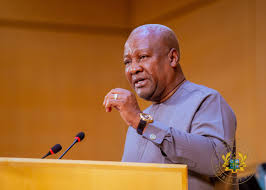

- President Mahama Has Set March 2027 Deadline for First 700 Saglemi Housing Units
President John Dramani Mahama has set March 2027 as the deadline for completing and commissioning the first 700 housing units under the Saglemi Affordable Housing Project, with government targeting a total of 1,500 completed units by the end of 2027.
The announcement marks another attempt to bring the long-delayed project into active use after years of inactivity, unfinished infrastructure and controversy over how one of Ghana’s most prominent affordable housing schemes was managed.
President Mahama disclosed the timelines during a tour of the project on Thursday, August 20, 2026, as construction and infrastructure works continue across the site.
The immediate priority is to complete enough of the estate to begin occupation rather than leave already-built structures deteriorating further.
“When the portal is open, those who want to move to the beautiful home should register,” Mr Mahama said, signalling that an application process will eventually be opened for prospective residents.
The challenge, however, extends beyond finishing individual housing units. The viability of Saglemi depends heavily on the supporting infrastructure required to turn a collection of buildings into a functioning residential community.
Kojo Aduhene, Chief Executive Officer and Chairman of LMI Holdings, the property developer, said underground electrical cabling, vegetation clearing and water infrastructure were among the works currently under way.
“We’re doing all the underground cabling, clearing the weeds, and water will not be a problem because we’ve got a water plant ready in the Dawa Industrial Area and it’s enough to supply water for all the units,” Mr Aduhene said.
He added that internet connectivity would also be provided across the estate. That focus on infrastructure is significant because incomplete utilities have been one of the barriers to making large public housing projects immediately habitable.
A completed housing shell has limited value if residents cannot rely on water, electricity, roads, drainage, security and communications infrastructure.
Government is also confronting the consequences of prolonged inactivity at the site.
President Mahama referred to the theft of electrical cables and other infrastructure and said measures were being taken to prevent a recurrence.
That problem illustrates another cost of delayed housing delivery. Unoccupied projects are not static assets. Buildings, fittings and external infrastructure can deteriorate, while theft and vandalism can increase the eventual cost of completion.
The longer such projects remain dormant, the more public and private resources may be required simply to restore them to the condition initially intended.
Saglemi has become a particularly important test because Ghana continues to face a substantial housing deficit while completed and partly completed public housing stock has remained unused.
The country needs considerably more affordable homes, yet delays in financing, infrastructure provision, legal disputes and project execution have prevented some existing developments from becoming part of the usable housing stock.
Delivering the first 700 units by March would provide an early indication of whether the revived project can finally move from repeated policy announcements into actual occupation.
The planned 1,500 units by the end of 2027 would represent a larger contribution, although still only a modest share of Ghana’s broader housing shortage.
The bigger issue is whether the Saglemi model can become financially and operationally sustainable.
Affordable housing projects must balance construction costs with the incomes of intended beneficiaries.
If completed homes are priced too high, they risk serving households already capable of accessing private-sector housing rather than the lower- and middle-income groups most affected by the deficit.
If prices are held artificially low without a sustainable financing model, government may be forced to absorb substantial subsidies or create future maintenance problems.
The structure of financing and allocation will therefore become as important as the completion timetable.
The eventual opening of the registration portal will also require transparency. Demand is likely to exceed the initial number of available units, making eligibility criteria, pricing, mortgage arrangements and allocation processes important to public confidence.
For prospective homeowners, clarity will be required on whether units will be sold outright, financed through mortgages, rented or made available through a combination of arrangements.
The project’s location along the Accra-Aflao corridor also raises questions around transport and commuting.
Housing affordability is not determined only by the purchase price of a home. The cost and time required to travel between residential areas and major employment centres can significantly affect the economic value of a property to households.
For Saglemi to develop into a sustainable community, transport connections and nearby social infrastructure will matter almost as much as the quality of the houses themselves.
The involvement of LMI Holdings potentially provides a route to addressing some of those infrastructure gaps through a more integrated development approach.
Mr Aduhene’s reference to water supply from the Dawa Industrial Area suggests part of the broader infrastructure surrounding the corridor could support the housing development.
Reliable utilities would strengthen the project’s prospects considerably. Yet the government will also need to demonstrate that renewed construction does not simply complete physical structures while postponing the harder questions of affordability, maintenance and long-term estate management.
Ghana has seen housing projects struggle after completion because common areas, drainage, roads and public infrastructure lacked durable maintenance arrangements.
A successful revival of Saglemi would require those responsibilities to be clearly assigned from the outset.
For the construction industry, the renewed project could also provide economic benefits.
Large housing developments create demand across cement, steel, electrical equipment, plumbing, transport, furniture and professional services, while generating employment during construction.
The wider impact becomes more significant when projects move quickly enough to avoid capital being trapped indefinitely in unfinished developments.
Capital tied up in unused housing cannot provide the social or economic return for which it was originally committed. Bringing Saglemi into occupation would therefore recover some value from an asset that has remained largely dormant despite Ghana’s continuing demand for housing.
The March 2027 deadline will now provide a clear benchmark. Seven hundred units in roughly seven months represents a measurable target against which progress can be assessed.
The subsequent ambition of 1,500 units by the end of the year will require construction momentum to be sustained while water, electricity, digital connectivity and other essential infrastructure are delivered alongside the homes.
If government and the developer meet those deadlines, the project could finally begin closing the gap between Ghana’s housing need and one of its most visible stocks of unfinished residential infrastructure.
But completion alone will not settle the Saglemi question. The real test will come when the homes are allocated and occupied. At that point, success will be measured not by the number of buildings commissioned, but by whether ordinary Ghanaian households can actually afford to live in them, whether the estate functions as a community and whether the infrastructure supporting it remains reliable.
For now, the revived project has something it has lacked for years: a defined delivery timetable. The next seven months will determine whether that timetable becomes another promise or the beginning of Saglemi’s long-awaited transition from stalled project to functioning neighbourhood.

