


- President Mahama Warns Transport Deficit Is Undermining AfCFTA’s Promise
President John Dramani Mahama has warned that inadequate roads, disconnected railway systems and underdeveloped ports are preventing African countries from realising the full benefits of the African Continental Free Trade Area.
The agreement has created the legal framework for a continental market, but the physical infrastructure required to move goods efficiently between African countries remains fragmented.
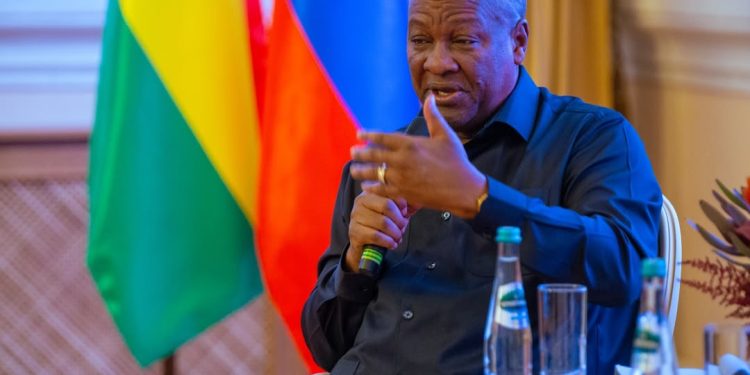
Speaking in Moscow ahead of a bilateral meeting with Russian President Vladimir Putin, President Mahama said tariff liberalisation alone would not generate the expected expansion in intra-African trade.
“Even though we have passed what we call the African Continental Free Trade Area, which makes the whole of Africa one market, we cannot get the full potential of the AfCFTA because we do not even have the infrastructure for trading amongst ourselves,” he said.
“The roads between countries are bad, there are no railways, and many countries don’t have ports that are in any good shape to receive goods from other countries.”
President Mahama identified Russia as one potential partner that could help Africa address its transport and infrastructure deficit, citing Moscow’s historical support for anti-colonial and anti-apartheid movements.
His comments draw attention to a fundamental weakness in Africa’s integration project: the continent is attempting to create one market across transport networks that were not designed to connect African economies.
The AfCFTA seeks to bring together more than 50 countries into a market in which goods, services, investment and business activity can move more freely.
Removing tariffs and harmonising trade rules can lower some costs, but a product cannot benefit from preferential market access if it cannot reach the intended customer reliably and affordably.
Manufacturers need predictable delivery schedules for raw materials and components. Agricultural exporters require cold storage, dependable roads and efficient border crossings. Retailers need distribution networks that can move goods across several countries without repeated delays.
In many parts of Africa, these systems remain weak or disconnected.
The continent has an average of approximately 204 kilometres of road per 1,000 square kilometres, compared with a global average of about 944 kilometres. Only around one-quarter of Africa’s roads are paved, while more than half of roads globally are paved.
Transport costs in some African markets are estimated to be several times higher than in Europe and North America. These expenses are eventually passed to consumers or absorbed by businesses through reduced margins.
A tariff reduction can therefore be overwhelmed by poor road conditions, multiple checkpoints, expensive freight services, port congestion and unpredictable customs processes.
President Mahama has previously argued that Africa’s transport systems were designed mainly to move raw materials from mines and farms to coastal ports for export outside the continent.
Railway lines frequently connect mineral-producing areas to ports but do not link neighbouring countries or important regional markets. Road networks often follow similar patterns.
“We were not meant to trade among ourselves. We were meant to trade with our colonisers, and so the logistics were not there,” President Mahama said in February 2026.
He cited the difficulty of moving goods by road from Ghana towards Senegal and Morocco as an example of the missing connections between African markets.
That structure has survived political independence. African economies continue to export many commodities through routes established for external trade while importing manufactured goods through the same ports.
The AfCFTA requires a different infrastructure model one organised around regional production systems, industrial centres and consumer markets within Africa.
This means developing east-west transport corridors as deliberately as the traditional inland-to-port routes. It also requires connecting landlocked countries to several trade gateways rather than leaving them dependent on one congested corridor.
Africa has invested substantially in expanding seaports, but additional port capacity will not automatically improve continental trade.
A port may have modern cranes and deep-water berths, yet remain inefficient if containers spend several days waiting for clearance or if the roads outside the terminal are congested.
Ports must connect to inland dry ports, industrial zones, warehouses, railway terminals and border corridors. Customs systems must also allow goods to move electronically and predictably.
For Ghana, the Tema and Takoradi ports could support expanded trade with Burkina Faso, Mali and Niger. Realising that opportunity requires reliable northern transport corridors, faster border procedures and secure transit arrangements.
Ghana’s position as the host country of the AfCFTA Secretariat gives it visibility, but geography and institutional status alone will not guarantee commercial leadership. Local companies must be able to produce competitively and move their goods to neighbouring markets at reasonable cost.
If transport remains expensive, businesses in Ghana may lose opportunities to suppliers located farther away but served by more efficient shipping and logistics networks.
President Mahama’s emphasis on railway connectivity is especially important for bulk commodities and manufacturing.
Road transport remains indispensable, particularly for short distances and final delivery. However, relying almost entirely on trucks increases freight costs, damages highways and contributes to congestion and accidents.
Regional railways could move minerals, agricultural produce, fuel, machinery and containerised cargo more efficiently over long distances.
The difficulty is that national railway projects are often planned independently. Countries may use different technical standards, investment models and route priorities. A railway ending at a border without a compatible connection on the other side cannot support continental trade.
Africa therefore needs corridor-level planning. Governments sharing a trade route must agree on technical standards, border facilities, operational rules and financing structures before construction begins.
Projects should be selected according to expected freight demand and economic value, rather than political visibility. Building expensive railway lines without sufficient cargo volumes can leave governments with debt and underused assets.
Physical construction is only one part of the solution.
A well-paved highway loses much of its value when trucks remain at a border for days because agencies demand repetitive documents, conduct multiple inspections or operate incompatible computer systems.
AfCFTA implementation requires one-stop border posts, electronic certificates, coordinated inspections, harmonised vehicle standards and effective transit-guarantee systems.
Women and young people engaged in small-scale cross-border trade are particularly vulnerable to delays, unofficial payments and harassment. Large companies may absorb administrative costs or employ customs specialists, but smaller traders cannot.
Improving border governance would therefore make AfCFTA benefits more inclusive while reducing incentives for smuggling and informal trade.
Transport, customs, payments and trade information must operate as one system. A continental market cannot function efficiently if each component is reformed independently.
Building the required networks will demand substantial public and private investment.
President Mahama called for stronger international partnerships and identified Russia as a possible development partner. Russia has indicated interest in African transport, agriculture, energy and mining projects.
Africa should welcome competition among financing partners, but every project must be assessed on commercial viability, debt sustainability and public value.
Historical solidarity should not replace financial scrutiny. Whether the financing comes from Russia, China, Europe, multilateral lenders or private investors, governments must disclose borrowing terms, repayment obligations, guarantees and procurement arrangements.
Transport projects frequently generate broad economic benefits but limited direct revenue. A road may improve trade and employment without generating enough toll income to service its construction debt.
Governments must therefore distinguish projects suitable for public financing from those capable of attracting private investment through user charges.
Regional projects also require fair cost-sharing. One country may bear the expense of infrastructure that creates large benefits for neighbouring states. Regional development banks and dedicated AfCFTA financing mechanisms could help distribute costs more equitably.
Africa’s infrastructure debate often concentrates on new projects while neglecting existing assets.
Roads deteriorate because maintenance funds are inadequate or released late. Railway equipment becomes unusable because spare parts and technical capacity were not included in long-term planning. Port systems underperform because routine upgrades are postponed.
Maintenance must be treated as a core economic investment rather than a residual expenditure.
Governments should assess the full life-cycle cost of projects before construction begins. Procurement decisions must consider durability, local maintenance capability and access to replacement equipment.
It is economically inefficient to commission new highways while allowing existing trade corridors to collapse.
Research suggests that additional transport infrastructure investment could raise African exports by a further 11.5 per cent and increase gross domestic product by approximately 2 per cent compared with implementing the AfCFTA without complementary transport improvements.
Inadequate road, rail and port facilities can add between 30 and 40 per cent to the cost of goods, weakening the competitiveness of African businesses even after tariffs are removed.
Better connectivity could encourage companies to organise production across several countries. A manufacturer could source inputs from one state, process them in another and distribute the finished product across the continent.
Such regional value chains are central to the AfCFTA’s development potential. The objective is not simply to increase the exchange of existing commodities but to encourage industrial specialisation, larger-scale production and value addition.
Without efficient logistics, firms will continue favouring suppliers outside Africa whose goods can arrive more predictably despite travelling longer distances.
President Mahama’s warning identifies the difference between signing a trade agreement and building a trading economy.
The AfCFTA has lowered an important legal barrier by creating a framework for continental commerce. The next stage must connect that framework to physical and digital infrastructure.
Africa needs cross-border roads that remain usable throughout the year, interoperable railways, efficient ports, competitive freight services and customs systems capable of processing goods rapidly.
It must also invest in electricity, digital connectivity, storage and industrial capacity. Transport can open access to markets, but businesses still need reliable production systems to supply them.
The success of the AfCFTA will ultimately be measured by whether an African producer can sell across the continent as easily as competitors from outside it.
Until goods can move quickly, safely and affordably between African countries, the continent’s single market will remain more advanced in law than in commercial reality.

