

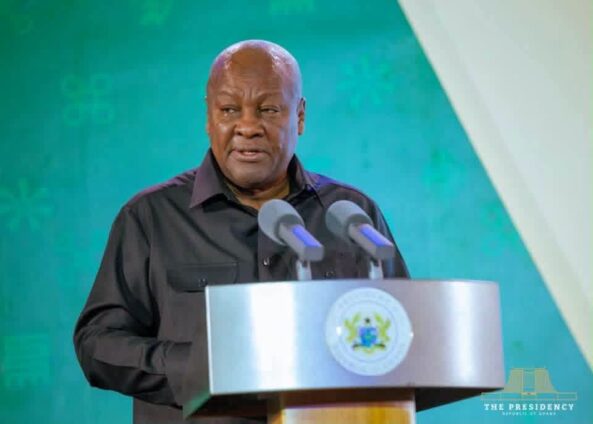

- President Mahama Woos Investors For US$10bn New Economy Programme
President John Mahama has invited local and foreign investors to participate in a US$10 billion New Economy Programme intended to mobilise investment across eight priority sectors between 2027 and 2030.
The pitch is ambitious; its credibility will depend on how quickly it becomes a pipeline of financed projects, operating businesses and sustained jobs.
Speaking at the maiden Invest Ghana Summit, Mahama positioned the private sector as central to manufacturing, employment and economic transformation.
The programme is expected to attract investment into strategic sectors as the government seeks to accelerate industrialisation and widen economic opportunities.
The distinction between mobilising US$10 billion and spending US$10 billion is important. The announcement describes an investment target across four years; it does not say the government will provide the full amount from public funds.
Investors will therefore want clarity on how much capital is expected from government, how much from private sources, and what instruments will help move projects from interest to financial close.
That is not a minor detail. A headline investment target can attract attention, but investors make decisions project by project. They will need to understand the commercial case, the role of public support, the rules governing investment and the risks they are expected to carry.
The announcement sets out the broad ambition, while the practical proposition for each investor will depend on the programme’s design and execution.
At the summit, Trade, Agribusiness and Industry Minister Elizabeth Ofosu-Adjare outlined opportunities in garment manufacturing, pharmaceuticals, automotive components, sugar production and oil-palm processing.
Four projected garment factories, she said, are expected to generate about 36,000 direct jobs when operating at full capacity.
That jobs figure gives the programme a tangible dimension, but the qualification matters: the factories are projected, and the employment total is associated with full capacity.
The number is not a count of jobs already created. Its eventual contribution will depend on whether projects are built, whether they secure markets and whether operations reach the scale on which the estimate is based.
The sectors named also suggest that the government is seeking investment beyond basic construction or short-term activity. Garment production, pharmaceuticals, vehicle components, sugar and oil-palm processing can connect industrial investment with local suppliers and workers.
Yet the announcement gives no sector-by-sector breakdown of the US$10 billion target, nor does it specify how the eight priority sectors are divided. Investors will need those details to judge where opportunities are most advanced and how the programme’s priorities will be sequenced.
The appearance of Dangote Group founder Aliko Dangote at the summit reinforced the programme’s emphasis on building domestic industry and processing raw materials within African economies.
He called for stronger local investment and industrial capacity, linking production to the ability to retain more value in the region.
That message aligns with the programme’s industrial focus: attracting capital is only part of the objective. The larger question is what the capital will produce and how much of the resulting value will remain in Ghana.
Factories can create jobs and support supply chains, but those benefits are not automatic. They depend on the depth of local sourcing, the skills developed among workers and the ability of local firms to participate as suppliers and partners.
For investors, policy predictability and project readiness will be just as important as market size. A programme spanning 2027 to 2030 will need a visible pipeline, clear implementation responsibilities and reliable information about project costs, infrastructure needs and expected returns.
The summit’s broad sector list may help start conversations, but investment decisions require more than an invitation.
The four-year timeframe also makes delivery discipline essential. Projects that take years to prepare can lose momentum if approvals, financing or infrastructure are delayed.
If the US$10 billion is to be mobilised, government and private investors will need to move from general interest to defined projects with funding structures and timelines.
The announcement does not yet provide a schedule for project launches or a method for tracking the amount actually mobilised.
That creates an accountability question for the programme. Progress will need to be measured not only by the value of announced investments, but by capital committed, projects reaching construction and operations, jobs created and the extent to which local businesses are integrated into production.
Those measures would help distinguish investment pledges from investment that has changed economic activity.
The private sector’s central role also raises the question of risk-sharing. Government can help make projects possible, but investors will want to know which risks the state is prepared to address and which remain with businesses.
That clarity can influence whether capital is committed, especially in projects that require large upfront investment and time to generate returns.
Mahama’s appeal presents a vision of growth driven by investment in productive sectors. The opportunities identified at the summit from garment factories to processing industries show how the programme could connect capital with manufacturing and employment.
But the US$10 billion figure is a mobilisation ambition, not proof that the resources have been secured or deployed.
The programme’s test will be whether it can convert the investment pitch into a credible sequence of projects and then convert those projects into productive capacity.
Ghana is asking investors to look beyond short-term returns towards a broader industrial transformation. Investors, in turn, will look for bankable opportunities, dependable rules and evidence that projects can operate at scale.
The summit has opened that conversation. The next phase will determine whether the New Economy Programme becomes a portfolio of functioning businesses or remains an attractive number attached to a broad ambition.

