


- Rising Inflation Raises Questions Over Recovery, Lending Rates and BoG’s Next Move
Ghana’s inflation story has shifted from rapid disinflation to renewed price pressure, setting the stage for a critical public policy conversation ahead of the Bank of Ghana’s 131st Monetary Policy Committee meeting, which is expected to end with a policy decision announcement on Wednesday, July 22, 2026.
After falling sharply from 5.40% in December 2025 to 3.80% in January 2026, inflation eased further to 3.30% in February and 3.20% in March, giving the central bank room to continue its policy-easing cycle. But the trend changed from April, when inflation rose to 3.40%, before climbing again to 3.70% in May and then rising more sharply to 5.30% in June.
The June figure remains below the Bank of Ghana’s medium-term target band of 8.00% ± 2.00%, but the three consecutive monthly increases have changed the policy conversation. The issue is no longer only that inflation is low by recent historical standards. The issue now is whether the upward movement signals a temporary normalisation into the target band or the beginning of renewed pressure that could complicate the central bank’s easing path.
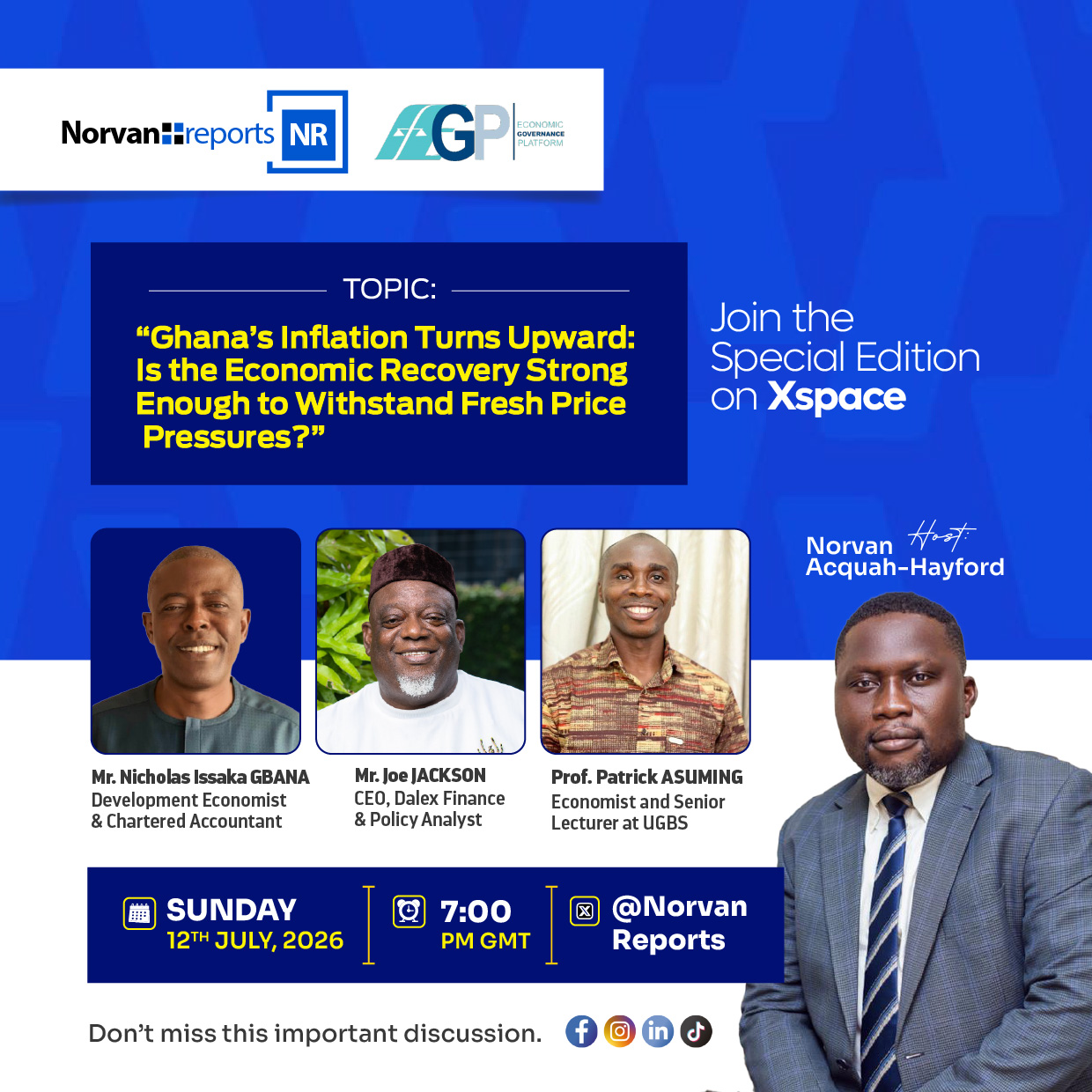
It is against this background that NorvanReports, in partnership with the Economic Governance Platform, will host a Special Edition on Xspace on Sunday, July 12, 2026, at 7:00 PM GMT, under the theme: “Ghana’s Inflation Turns Upward: Is the Economic Recovery Strong Enough to Withstand Fresh Price Pressures?”
The discussion will bring together Mr Nicholas Issaka Gbana, Development Economist and Chartered Accountant; Mr Joe Jackson, CEO of Dalex Finance and Policy Analyst; and Prof Patrick Asuming, Economist and Senior Lecturer at the University of Ghana Business School. The session will be hosted by Norvan Acquah-Hayford on the @NorvanReports X handle.
The conversation comes at a decisive moment for monetary policy. In January, the Bank of Ghana’s MPC cut the policy rate by 250 basis points to 15.50%, citing significantly improved macroeconomic conditions, a sharp decline in inflation, anchored expectations, stronger growth and a shift in policy focus towards consolidating stability while supporting real-sector recovery.
At the time, the central bank said inflation had declined faster than anticipated and was expected to remain broadly within the medium-term target, barring spillover risks from utility adjustments and commodity market volatility. The decision reflected confidence that tight monetary policy, fiscal consolidation and reserve accumulation had helped restore stability.
By March, the MPC eased again, cutting the policy rate by another 150 basis points to 14.00%. The Committee noted that headline inflation had fallen to 3.30% in February, from 5.40% in December 2025, with core inflation also declining and inflation expectations remaining broadly anchored.
But even in March, the Bank of Ghana was already flagging the risk that external shocks could affect the inflation outlook. The MPC pointed to the Middle East conflict, crude oil market volatility and possible tightening in global financing conditions as risks that could force central banks to reassess their policy stance.
Those risks became more pronounced by May. Although inflation remained far below the lower end of the target band, the MPC decided to hold the policy rate at 14.00%, rather than cut further. The Bank said inflation had inched up to 3.40% in April from 3.20% in March, marking the first increase since December 2024. It also noted that inflation expectations had edged up marginally, even though they remained broadly anchored.
The May decision marked a clear shift in tone. After two consecutive rate cuts in January and March, the central bank paused further easing as it assessed the balance between supporting recovery and guarding against renewed inflation risks.
That balance has become even more delicate after the June inflation print of 5.30%. The increase means inflation has risen by 2.10 percentage points from its March low of 3.20%. It also narrows the gap between current inflation and the lower end of the Bank of Ghana’s target band, raising the question of how quickly price pressures could move back into the target range.
For businesses, the answer matters because it could affect lending rates, investment decisions and working capital costs. For households, it matters because lower inflation has not necessarily translated into a lower cost of living, and fresh price pressures could weaken purchasing power. For investors, it matters because inflation expectations influence interest rates, Treasury yields, currency expectations and confidence in the macroeconomic recovery.
The Bank of Ghana’s May statement had already warned that inflation was expected to trend upward into the medium-term target band, largely due to base drift effects related to exchange rate movements, food supply conditions and transport fares. The central bank also identified upside risks from a protracted Middle East crisis, crude oil prices, domestic petroleum price pass-through, transport costs and utility tariff adjustments.
That warning now sits at the centre of the July policy debate.
The MPC could decide to maintain the policy rate at 14.00%, especially if it views the June inflation increase as consistent with its earlier forecast that inflation would move back towards the target band. A hold would signal caution and give the central bank more time to observe whether price pressures are temporary or persistent.
A further cut, however, would now be harder to justify unless the Committee is confident that underlying inflation remains contained, the cedi remains stable, and fiscal discipline continues to anchor expectations. Cutting too quickly while inflation is rising could raise questions about the central bank’s commitment to price stability.
A rate increase appears less likely at this stage, given that inflation is still below the lower end of the target band and the recovery remains important. But the upward trend could make the MPC’s communication more hawkish, even if the policy rate is left unchanged.
This is why the upcoming NorvanReports Xspace is timely. The discussion will examine whether Ghana’s economic recovery is strong enough to withstand fresh price pressures, and whether the central bank should continue supporting growth or pause further easing to protect the gains made in inflation control.
The conversation will also focus on how the inflation rebound affects lending rates. Banks have faced pressure to reduce lending rates as inflation and money market rates declined. The Bank of Ghana noted in May that the average bank lending rate had fallen to 16.30% in April 2026 from 27.40% a year earlier, while private-sector credit had rebounded strongly.
But if inflation continues to rise, banks may become slower to reduce borrowing costs further. That could weaken the transmission of monetary easing to businesses and households, raising concerns that the recovery may remain uneven despite improved macroeconomic indicators.
The July 12 Xspace will therefore serve not only as a public discussion, but as a pre-MPC policy conversation for businesses, households, students, economists, market watchers and journalists seeking to understand the choices before the central bank.
The Bank of Ghana has scheduled the 131st MPC meeting for July 20 to July 22, 2026, with the meeting expected to conclude on July 22 with the announcement of the policy decision.
Ahead of that decision, the key questions are clear: Has inflation merely normalised from unusually low levels, or is Ghana entering another cycle of price pressure? Should the Bank of Ghana hold the policy rate at 14.00% to assess the risks, or is there still room for cautious easing? Will banks continue cutting lending rates if inflation rises further? And are households and businesses feeling the benefits of recovery strongly enough to absorb another round of price increases?
These questions will shape Sunday’s discussion.
NorvanReports and the Economic Governance Platform are inviting the public to join the Special Edition on Xspace on Sunday, July 12, 2026, at 7:00 PM GMT via @NorvanReports.
With inflation rising again and the central bank approaching another critical policy decision, the conversation is expected to provide timely analysis on the state of Ghana’s recovery, the direction of monetary policy and the real impact of fresh price pressures on households and businesses.

