


- OSP Needs Constitutional and Financial Independence to Fight Corruption Effectively — Agyabeng
Ghana must constitutionally entrench the Office of the Special Prosecutor, provide it with greater financial independence and strengthen the country’s asset-recovery laws if the fight against corruption is to move beyond institutional ambition to sustained enforcement, Special Prosecutor Kissi Agyabeng has warned.
Mr Agyabeng said five years of practical experience leading the Office of the Special Prosecutor had provided sufficient evidence of the structural weaknesses limiting Ghana’s anti-corruption institutions, arguing that political commitment alone would not produce the results expected from agencies tasked with investigating politically and economically powerful interests.
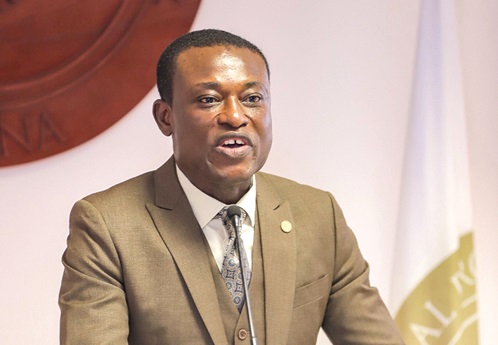
Speaking at the National Anti-Corruption Dialogue, the Special Prosecutor said the OSP had reached a point where it could distinguish between reforms that appeared attractive in theory and measures capable of working in practice.
“After five years in office as the Special Prosecutor, at least we can say, if for nothing at all, we know what we are doing now,” he said. “And by knowing what we are doing, we can say we know what works and what doesn’t work.”
Mr Agyabeng’s assessment was not framed as criticism of the government’s intentions. He acknowledged what he described as genuine commitment from the administration since January 2025, pointing to cooperation involving the OSP, CHRAJ and government under the country’s anti-corruption framework.
“The government means well,” he said, adding that the administration deserved commendation for attempting to strengthen the fight against corruption.
But he argued that goodwill could not overcome institutional weaknesses embedded in the legal and financial architecture of anti-corruption bodies.
“What doesn’t work is the state of the anti-corruption institutions at the moment,” Mr Agyabeng said, identifying their statutory framework and financing as the principal problems.
His most significant proposal is constitutional entrenchment of the OSP.
“If we do not write into the Constitution the office of the Special Prosecutor, however it is called, we are going nowhere,” he said.
The argument reflects concern that an institution created solely through ordinary legislation remains vulnerable to future political intervention, restructuring or changes to its mandate. Constitutional protection would provide a stronger legal foundation and potentially make it more difficult for successive governments to weaken the institution through ordinary legislative changes.
Mr Agyabeng said discussions with government had included an examination of institutional models used in other jurisdictions, with the conclusion that stronger constitutional guarantees were necessary.
Financial independence, he argued, must accompany constitutional protection. “If you do not grant it financial independence,” he said, the anti-corruption system would remain vulnerable to the limitations created by dependence on annual public budget allocations.
The Special Prosecutor said proposals were already before Parliament for a dedicated funding formula for anti-corruption institutions, including the OSP and CHRAJ.
Such arrangements could have significant implications for agencies undertaking complex financial investigations.
Cases involving politically exposed persons, cross-border transactions, offshore structures, forensic accounting and sophisticated asset tracing are costly and require specialist expertise. Even where an institution has statutory authority, insufficient funding can effectively limit its ability to investigate and prosecute complex cases.
Mr Agyabeng therefore wants anti-corruption bodies financed through dedicated mechanisms that provide greater insulation from ordinary budgetary pressures.
Asset recovery formed the second major pillar of his intervention.
The Special Prosecutor argued that Ghana’s existing framework remains too dependent on criminal convictions before authorities can effectively target assets linked to suspicious or unexplained wealth.
He advocated stronger legislation for non-conviction-based asset recovery, allowing the state, subject to legal safeguards, to pursue property suspected to represent illicit enrichment even where a criminal conviction has not first been secured.
“If we do not stamp that firmly in the pieces of legislation, we are going nowhere,” he said.
Mr Agyabeng also proposed a reverse-onus provision built around a presumption of corruption in circumstances where an individual cannot adequately explain wealth that appears substantially disproportionate to lawful income.
“The presumption of corruption should be instituted where it is very clear that a person is unable to explain their wealth as much to their lawful sources of income,” he said.
He argued that such a framework would not amount to abandoning due process, but would instead require individuals confronted with significant unexplained wealth to demonstrate how those resources were lawfully acquired.
The proposal is closely linked to lifestyle audits, which examine whether a person’s assets and standard of living can reasonably be supported by declared income.
“This is lifestyle audit: show that you are able to afford these things that you claim you have,” Mr Agyabeng said.
Such reforms could materially strengthen Ghana’s ability to target illicit enrichment, but they would also require careful constitutional safeguards.
Reverse-onus provisions and non-conviction-based confiscation must be designed to protect legitimate property rights, establish clear evidentiary thresholds and maintain judicial oversight. Expanding investigative powers without those protections could generate legal challenges and weaken public confidence in enforcement.
Mr Agyabeng ultimately reduced his prescription to four central reforms: constitutional independence, financial independence, a reverse-onus presumption of corruption and non-conviction-based asset recovery.
“If we do not commit to these things,” he said, “it won’t work.” His intervention shifts Ghana’s anti-corruption debate from whether institutions exist to whether those institutions have been designed and resourced to succeed.
The country already has agencies charged with investigation, prosecution, auditing and asset recovery. The more difficult question is whether they possess sufficient independence, funding and legal authority to confront powerful interests and convert investigations into recoveries, prosecutions and meaningful deterrence.
Without structural reform, Mr Agyabeng’s warning is that Ghana risks maintaining an elaborate anti-corruption system whose ambitions consistently exceed its capacity.
After five years at the OSP, he says the country now has enough experience to know what does not work. The political test is whether Ghana is prepared to act on that evidence.

