

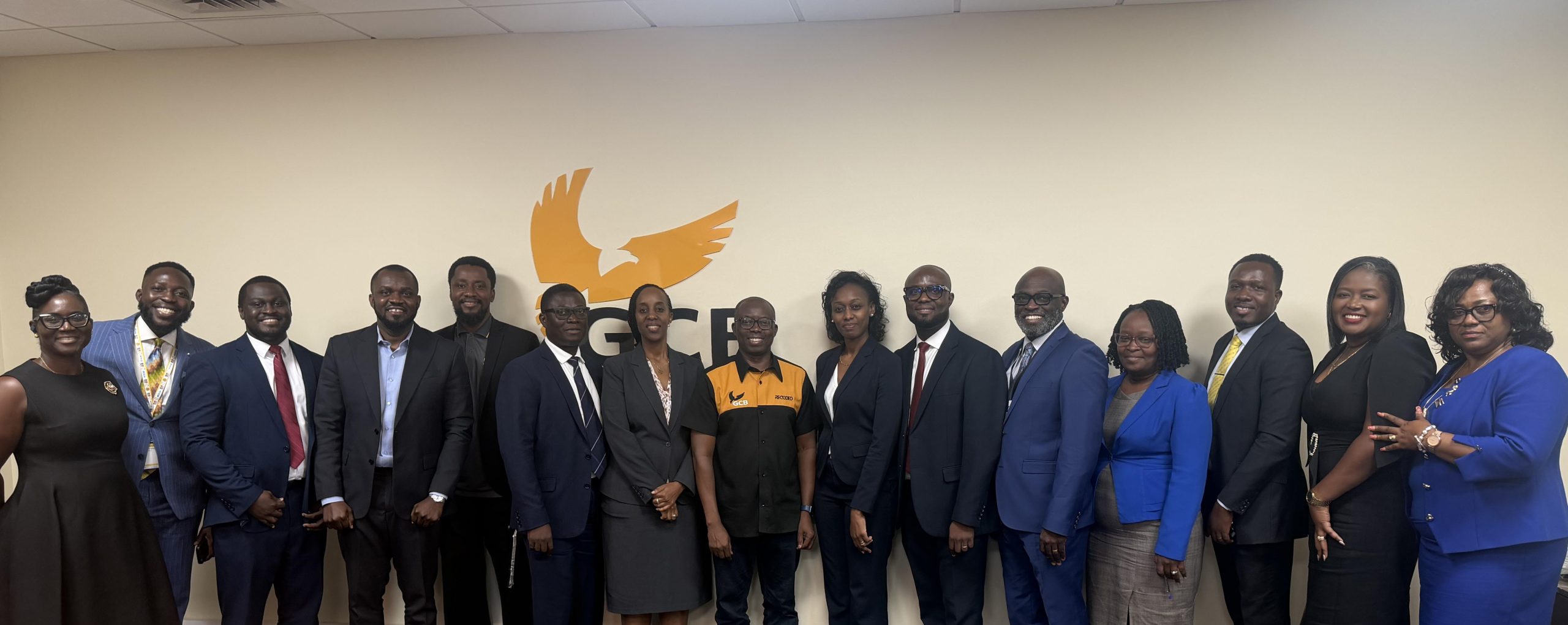

- GCB Bank Hosts Bank of Uganda Delegation to Deepen Financial Market Cooperation
GCB Bank has hosted a high-level delegation from the Bank of Uganda as part of efforts to deepen financial market collaboration, strengthen institutional knowledge exchange and support the development of more efficient capital and treasury markets across Africa.
The engagement brought together officials from Uganda’s central bank and members of GCB Bank’s Wholesale and Investment Banking team, who shared practical insights into Ghana’s financial market ecosystem.
Discussions focused on how government securities are auctioned in Ghana, how institutional and retail investors participate in the market, how trades are settled, and how banks support the functioning of the country’s fixed income and treasury markets.
The visit also provided a platform for both institutions to exchange views on broader issues shaping African financial markets, including transparency, operational efficiency, risk management, settlement systems and the need for stronger regional partnerships.
Speaking during the engagement, Abdulsalam Alhassan, Executive Director for Wholesale and Investment Banking at GCB Bank, said African financial institutions must work more deliberately together if the continent is to build deeper, more resilient and more trusted markets.
“Building stronger financial markets across Africa requires deliberate collaboration among institutions. By sharing expertise and practical experiences, we can develop more efficient financial systems that support businesses, attract investment and contribute to sustainable economic growth,” he said.
The meeting comes at a time when African economies are increasingly seeking to deepen domestic capital markets and reduce overdependence on external financing.
Across the continent, governments, central banks and commercial banks are under pressure to improve market infrastructure, broaden investor participation and build more transparent systems for trading and settling financial instruments.
Ghana’s fixed income market has grown significantly over the years, with government securities remaining a major part of domestic financial activity. Treasury bills, notes, bonds and other fixed income instruments continue to serve as important tools for government financing, liquidity management and investment portfolio allocation.
For Uganda, the visit offered an opportunity to study Ghana’s market experience and understand the practical systems that support auction execution, investor participation, treasury operations and settlement flows.
For GCB Bank, the engagement reinforced its role as one of Ghana’s most important domestic financial institutions and a key participant in the country’s treasury and capital markets.
The bank’s Wholesale and Investment Banking team shared experience in fixed income trading, foreign exchange operations, treasury settlement systems, auction processes and reconciliation procedures.
These are core areas in the functioning of modern financial markets.
Efficient auction systems help governments raise funding in a structured and transparent manner. Strong settlement systems reduce operational risk. Effective reconciliation protects market integrity. And active participation by banks helps connect issuers, investors and regulators.
The discussions also highlighted the importance of building financial markets that are not only large, but also trusted.
Market confidence depends on clear rules, predictable processes, accurate information and strong institutional coordination. Without these, investors demand higher risk premiums or avoid participation altogether.
This is why knowledge sharing among African institutions matters.
Although African economies differ in size, structure and market depth, many face similar financial sector challenges. These include limited secondary market liquidity, narrow investor bases, settlement inefficiencies, currency risk, debt management pressures and the need for stronger domestic savings mobilisation.
By sharing practical lessons, institutions can avoid repeating mistakes and accelerate reforms that make markets more attractive to investors.
The engagement between GCB Bank and the Bank of Uganda also reflects the broader push toward African financial integration.
The success of the African Continental Free Trade Area will depend not only on goods crossing borders, but also on efficient financial systems that support trade, payments, investment and risk management.
As trade links deepen, African countries will need stronger capital markets, reliable settlement systems and institutions capable of financing cross-border business activity.
Regional cooperation among banks, central banks and market participants will therefore be central to Africa’s next phase of economic transformation.
The visit also strengthened institutional ties among GCB Bank, the Bank of Uganda and the Bank of Ghana, underscoring the value of cross-border engagement in building resilient and integrated financial markets.
Such cooperation is especially important as African markets navigate a complex global environment marked by higher financing costs, currency volatility and rising demand for domestic resource mobilisation.
For Ghana, hosting the delegation also allows the country to showcase aspects of its financial market development and position its institutions as sources of practical market expertise.
For GCB Bank, the engagement fits into a wider strategy of supporting financial market development, innovation and stronger partnerships across the continent.
As Ghana’s leading bank, GCB Bank said it remains committed to initiatives that promote knowledge exchange, deepen market infrastructure and support the development of financial systems that can serve businesses, governments and investors more effectively.
The Bank of Uganda visit therefore goes beyond a courtesy call.
It represents a practical step toward building stronger African financial markets through shared experience, technical learning and institutional cooperation.
In a continent where markets are often too fragmented and shallow to fully support growth ambitions, such engagements could help lay the foundation for more transparent, efficient and connected financial systems.

