



- Resilience Under Pressure: Egypt’s Economy Defied Expectations
Egypt entered the latest period of regional conflict in a stronger macroeconomic position than during previous episodes of external stress. Policy reforms undertaken under the IMF-supported program had strengthened growth, put inflation on a downward path, and helped rebuild international reserves and improve banks’ foreign asset positions. These stronger buffers, combined with a swift policy response, have enabled Egypt to absorb one of the region’s largest recent shocks, as discussed in more detail in the recently published Seventh Review under the EFF and Second Review under the RSF.
The Egyptian authorities responded quickly. Exchange rate flexibility absorbed external pressures, while energy price adjustments in the wake of higher international oil prices, spending restraint, and expanded targeted support helped preserve policy discipline.
Financial markets reacted sharply. Nonresident holdings of local-currency government debt fell from US$39.1 billion in February to US$22.2 billion in early April, while the Egyptian pound depreciated by about 14–17 percent. As pressures eased, portfolio inflows resumed, non-resident holdings returned to near pre-conflict levels, and the pound recovered much of its initial losses.
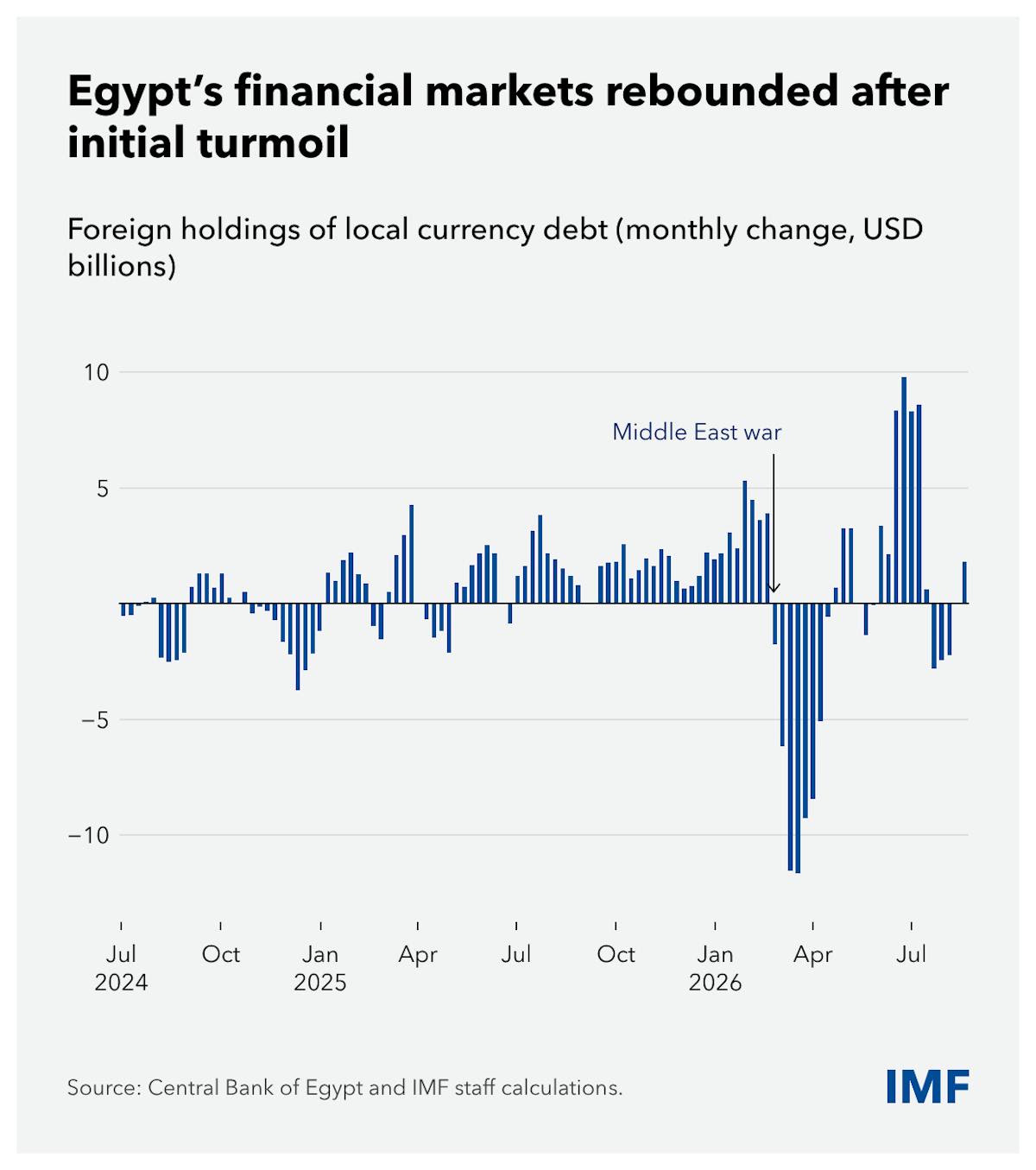
Chart showing Egypt’s financial markets rebounding after initial turmoil
Economic spillovers were limited
Yet the financial shock did not spill over into a broader economic downturn. Growth remained strong, reaching 5.0 percent in the third quarter of FY2025/26, while tourism stayed resilient, remittances surged to record highs, and Suez Canal activity continued its gradual recovery following some temporary disruption amid the regional turmoil. Fiscal pressures were also contained through revenue mobilization and expenditure restraint. Inflation rose in response to the currency depreciation and energy price adjustments, but the increase proved less severe than expected, although the path back to the inflation target was pushed back by a year. Crucially, international reserves remained comfortably above adequate levels despite initial capital outflows, reflecting exchange rate flexibility in absorbing external pressures—a key difference from past episodes.
Investor confidence also strengthened as market pressures eased. Sovereign spreads narrowed to below pre-war levels, and Egypt returned successfully to international capital markets. A US$1 billion Social Eurobond issued in May was five times oversubscribed, followed by a US$500 million Samurai bond in June. By August, Egypt’s sovereign risk premium had fallen to its lowest level since 2014
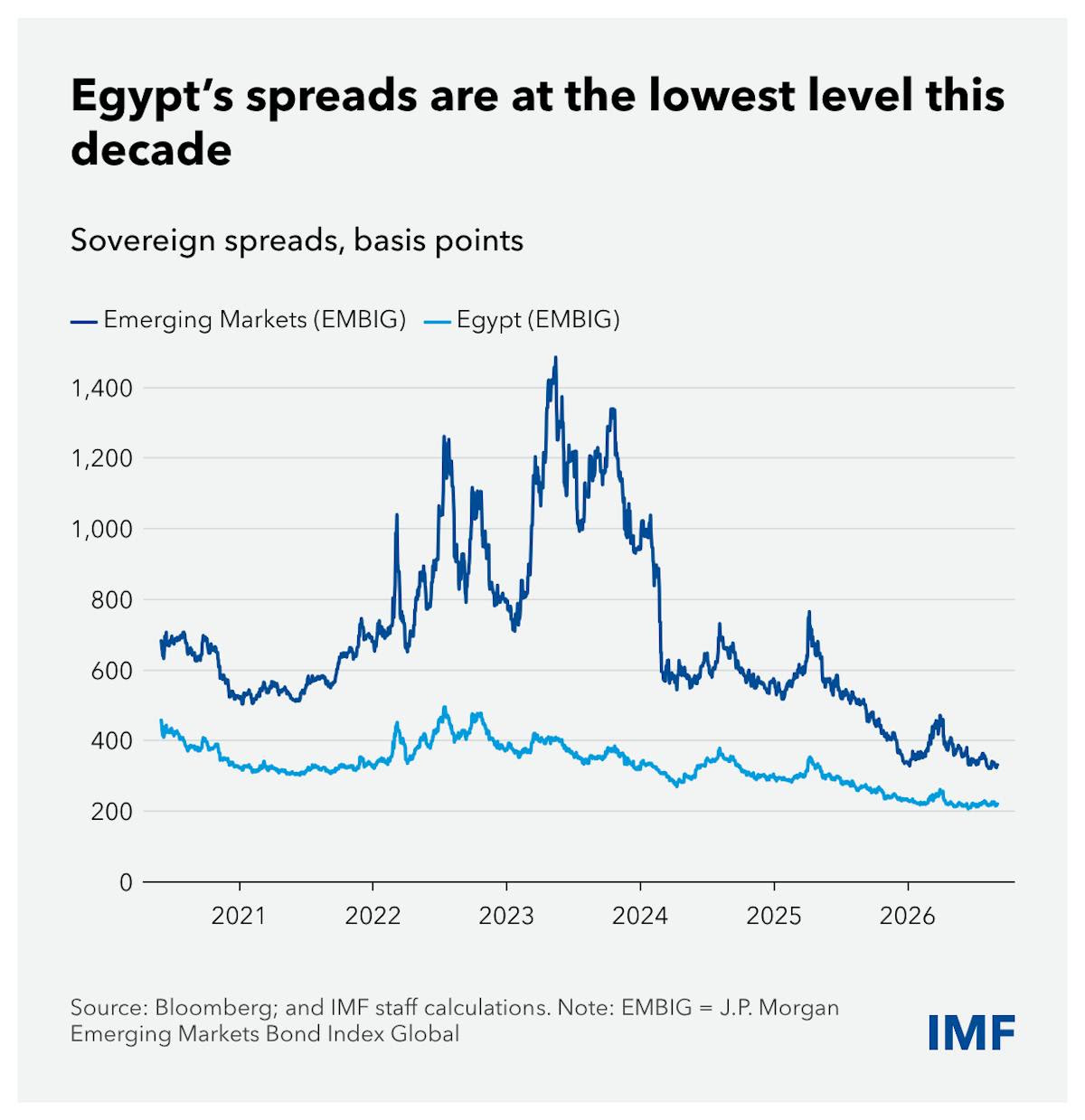
Chart showing Egypt’s spreads are at the lowest level this decade
Resilience is not enough to sustainably reduce vulnerabilities
The latest shock demonstrated Egypt’s improved resilience, but significant vulnerabilities remain. Public debt and gross financing needs are still high, financing relies heavily on short maturities, and banks’ exposure to the government remains elevated. Gross financing needs are expected to remain around 40 percent of GDP in the near term and decline only gradually to below 30 percent by 2030. More broadly, the state footprint in the economy remains excessively high.
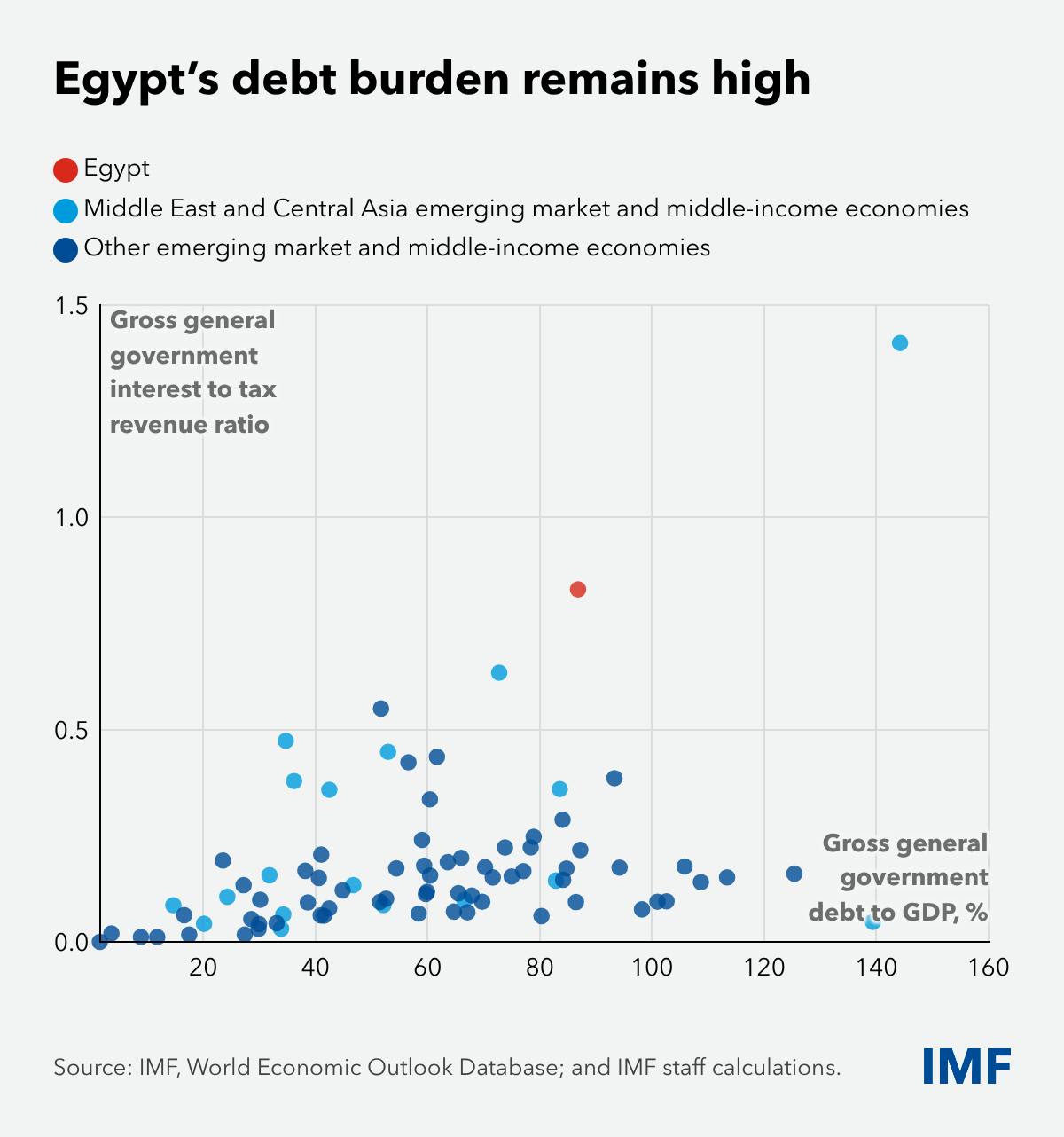
Chart showing Egypt’s debt burden remains high
These vulnerabilities—particularly amid heightened global uncertainty—leave Egypt exposed to shifts in global financing conditions and renewed external shocks, while reinforcing the sovereign-bank nexus and increasing the risk of fiscal dominance. Large government financing needs can also crowd out private sector credit and investment.
Building on the progress achieved will require preserving macroeconomic stability through exchange rate flexibility, an appropriately tight monetary policy, and fiscal prudence, while accelerating reforms that address remaining vulnerabilities.
Reducing public debt and high gross financing needs will require stronger debt management, with a shift toward longer-term, market-based financing, a broader investor base, and deeper domestic debt markets to reduce refinancing risks and strengthen debt sustainability.
Most importantly, more decisive implementation of the State Ownership Policy and divestment program, stronger governance of state-owned enterprises, and greater competition will be critical to reducing the state’s footprint and creating the conditions for stronger private sector led growth.

