


- Responsible Economic Reporting Critical to Cedi Stability — BoG
The Bank of Ghana has urged the media to exercise greater responsibility in reporting foreign exchange developments, warning that poorly contextualised coverage of daily cedi movements can create fear, fuel speculative demand and heighten market volatility.
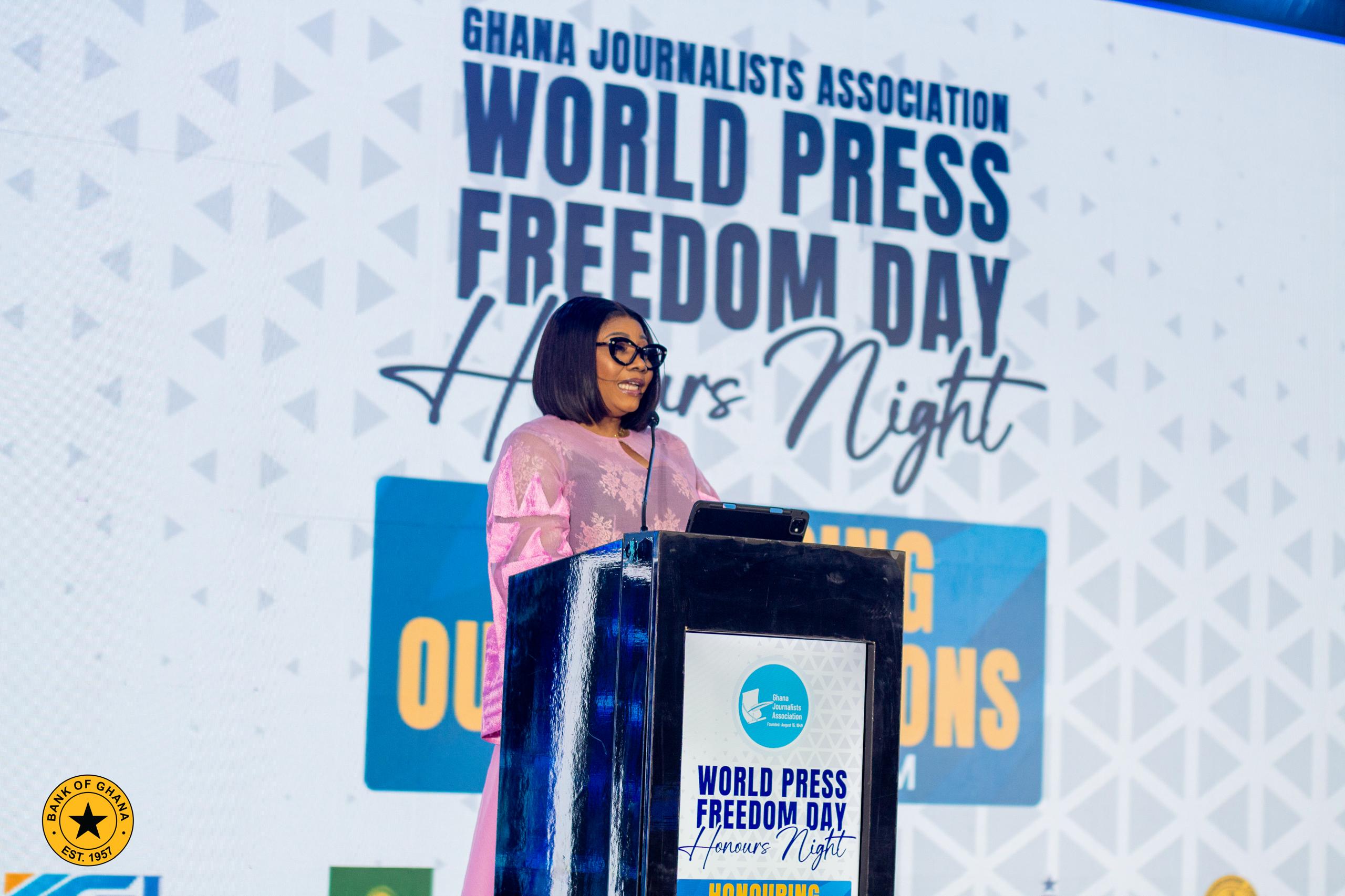
Speaking at the World Press Freedom Honours Night 2026 in Accra, the Second Deputy Governor of the Bank of Ghana, Mrs Matilda Asante-Asiedu, said Ghana’s managed floating exchange rate regime means daily appreciation and depreciation of the cedi are normal features of market activity and should not automatically be reported as signs of crisis.
“Ghana operates a managed floating exchange rate regime. In such a system, daily movements both appreciation and depreciation are normal. They reflect market activity, not necessarily crisis conditions,” she said.
She cautioned that when such movements are reported without proper context, they can trigger unnecessary fear among businesses, households and investors.
“When these movements are reported without proper context, they can trigger unnecessary fear, leading to speculative demand for foreign currency and heightened volatility,” she said.
“In such situations, sentiment not fundamentals can temporarily drive market behaviour.”
Mrs Asante-Asiedu said currency stability has direct consequences for ordinary people and businesses, including import prices, transport costs, food prices, rent, medicines, household savings and business planning.
“Let me be clear: currency stability has real economic consequences,” she said.
“When the cedi stabilises, import prices become more predictable; transport costs moderate; essential goods such as food, rent, and medicines stabilise; businesses can plan with greater certainty; households can preserve the value of income and savings.”
The Second Deputy Governor said protecting the value of the currency is not the responsibility of the central bank alone, but a shared national duty involving policymakers, businesses, households and the media.
Her remarks come at a time when Ghana’s economy has seen improved macroeconomic indicators, including lower inflation and relative exchange rate stability, even as policymakers remain alert to external shocks and speculative pressure in the foreign exchange market.
Mrs Asante-Asiedu said Ghana had made commendable macroeconomic progress, with recent data pointing to improved growth prospects while monetary policy remains appropriately calibrated to manage inflation risks and support broader stability.
“Going forward, the Bank will continue to implement a prudent policy mix to sustain stability. That stability remains the foundation for sustainable growth and long-term prosperity,” she said.
She added that the Bank remains vigilant in safeguarding the gains made in restoring confidence in the financial sector.
The Second Deputy Governor also used the platform to draw a strong link between press freedom, media credibility and economic stability.
According to her, the media remains a vital pillar of Ghana’s democracy, but the growing threat of misinformation and disinformation has become a major risk to public trust and national development.
She noted that Ghana’s media landscape remains one of the most vibrant in Africa, with the country improving to 39th out of 180 countries in the latest World Press Freedom Index by Reporters Without Borders, up from 52nd in 2025.
However, she warned that the improvement should not obscure persistent structural challenges facing the sector.
“Even as we welcome this progress, we must also confront persistent structural challenges, particularly misinformation and disinformation, the economic sustainability of media institutions, and declining public confidence,” she said.
Mrs Asante-Asiedu said misinformation and disinformation are no longer peripheral concerns, citing the World Economic Forum’s Global Risks Report, which ranks them among the most severe global risks.
“Credibility is the currency of journalism; once spent recklessly, it is difficult to regain,” she said.
She argued that because Ghana’s media landscape is largely privately owned, credibility is not only a professional value but also an economic asset. It influences audience trust, ratings and advertising revenue.
“In this context, trust has become journalism’s most valuable asset,” she said.
“Any erosion of that trust creates a double jeopardy: loss of credibility and loss of revenue, with the attendant risk of declining influence and relevance.”
Drawing a parallel between journalism and central banking, Mrs Asante-Asiedu said trust underpins the media system in the same way confidence underpins the financial system.
“A bank can absorb temporary losses if confidence remains intact; a media organisation can withstand financial pressure if public trust is preserved. But when both confidence and trust erode, recovery becomes significantly more difficult,” she said.
She said this is why responsible journalism matters even to monetary policy.
According to her, monetary policy decisions are complex, transmitted indirectly and do not always produce immediate results. How those decisions are communicated and interpreted, she said, shapes expectations, confidence and economic behaviour.
“For this reason, we rely heavily on a free and responsible press to help explain our work, anchor expectations, and support national development through our mandate of price and financial stability,” she said.
The Bank of Ghana, she noted, has adopted a deliberate strategy of knowledge-sharing, capacity-building and continuous dialogue with the media to strengthen understanding of monetary and financial policy.
She said this approach is not merely an engagement strategy but a deliberate intervention to reduce misinformation and promote informed public discourse.
“In today’s fast-moving digital economy, the press is not just a communicator of policy it is a critical partner in shaping how policy is understood by the public,” she said.
The Second Deputy Governor also highlighted initiatives undertaken by the Bank to deepen media engagement, including regular media training programmes, post-Monetary Policy Committee briefings, enhanced MPC transparency and the establishment of a Regional Press Corps.
She said the Bank had also introduced the publication of individual MPC members’ policy submissions as part of efforts to promote greater transparency and accountability.
Other initiatives include dedicated WhatsApp communication platforms for two-way engagement with journalists and the Economic and Financial Journalist of the Year Award, launched in partnership with the Ghana Journalists Association.
The Bank of Ghana was among institutions recognised at the event for its contribution to press freedom and public engagement.
Mrs Asante-Asiedu said the recognition was deeply appreciated, adding that the Bank would continue to work with the media to strengthen economic reporting and public understanding of policy.
“As I bring my comments to a close, let me emphasise that across the world, economies have been either strengthened or weakened by the way economic information is communicated,” she said.
She urged journalists to choose the path that builds trust, strengthens stability and advances Ghana’s development.
“A responsible press informs without inflaming, questions without prejudging, and reports without distorting,” she said.

