



Revitalising Ghana’s Tomato Value Chain With a ‘Seed‑to‑Shelf’ Strategy
On Feb 14, 2026, Islamist militants ambushed a truck of Ghanaian tomato traders near Titao in northern Burkina Faso. The attackers separated the men from the women, opened fire and set the vehicle ablaze. Seven Ghanaian men were killed and three injured, three other women on board escaped unharmed. A fourth injured victim later died, bringing the death toll to eight. Bodies were burnt beyond recognition. Ghana’s Ministry of the Interior confirmed the incident and said the Embassy in Ouagadougou is working with Burkinabè officials to identify victims. The tragedy echoes earlier militant attacks on cross-border traders, heightening fears for Ghana’s regional food supply chain.
The Government of Ghana strongly condemned the attack as a “senseless act of terror” and expressed solidarity with Burkina Faso. President Mahama and officials conveyed condolences to victims’ families and ordered an immediate air evacuation of injured traders to Accra. The Ministry of Foreign Affairs issued travel advisories. Ghanaians in high-risk areas were urged to register with Ghana’s embassy, limit movements and carry IDs for consular aid. On the political front, MPs demanded urgent briefings by the Defence and Foreign Ministers. In parliament, an opposition MP urged a high-level Ghana–Burkina Faso meeting to verify facts and secure guarantees for future trader safety. Deputy Agriculture Minister stated that Ghana is engaging Burkinabè authorities to provide security escorts or ‘security aid’ for tomato traders crossing the border, while still pressing to expand domestic production. The Foreign Minister paid a working visit to Burkina Faso the following week and signed several trade and security deals with his Burkinabe counterpart. Largely, Accra has vowed close monitoring of the situation, military coordination with Burkina Faso, and updated travel warnings for traders.
Ghana’s own tomato output is far below national demand. Domestic production has fluctuated around 350–370 thousand metric tons per year in recent years, whereas annual consumption is estimated at 800,00-1.4 million tonnes. The Ghana Export-Import Bank reports a yearly demand of 800 kt, but supply is only 300–400 kt. A World Bank report notes only 34 % of Ghana’s roughly 1.4 Mt tomato consumption is met locally. In short, Ghana produces at most about one‑third of its tomatoes, forcing reliance on imports. The Chamber of Agribusiness Ghana estimates this ‘tomato‑dollar flight’ costs Ghana GH¢5.7 billion/yr, about 1.2 % of GDP.
Tomato production in Ghana is highly seasonal. Most Ghanaian tomatoes ripen in the rainy seasons (main crop June–July; minor crop September–October) when prices are low. During the dry winter/spring (October–May) output collapses because few farms have irrigation facilities. Burkina Faso’s harvest peaks from December through May, and Ghanaian traders routinely cross the border to buy tomatoes from there. Imports from Burkina Faso can reach 100,000 tonnes each year. These imports historically fill Ghana’s ‘hungry season.’ As one analysis notes, ‘domestic production is supplemented by imports from Burkina Faso during the December–May harvest season, estimated as high as 100,000 tons per year.’ In short, Ghana’s off-season tomato supply is largely imported from Burkina. Ghana’s 2023 trade data show fresh tomato imports of 108 tonnes from Burkina Faso, but the shortfall is met by larger informal trade and processed imports not fully captured in official data.
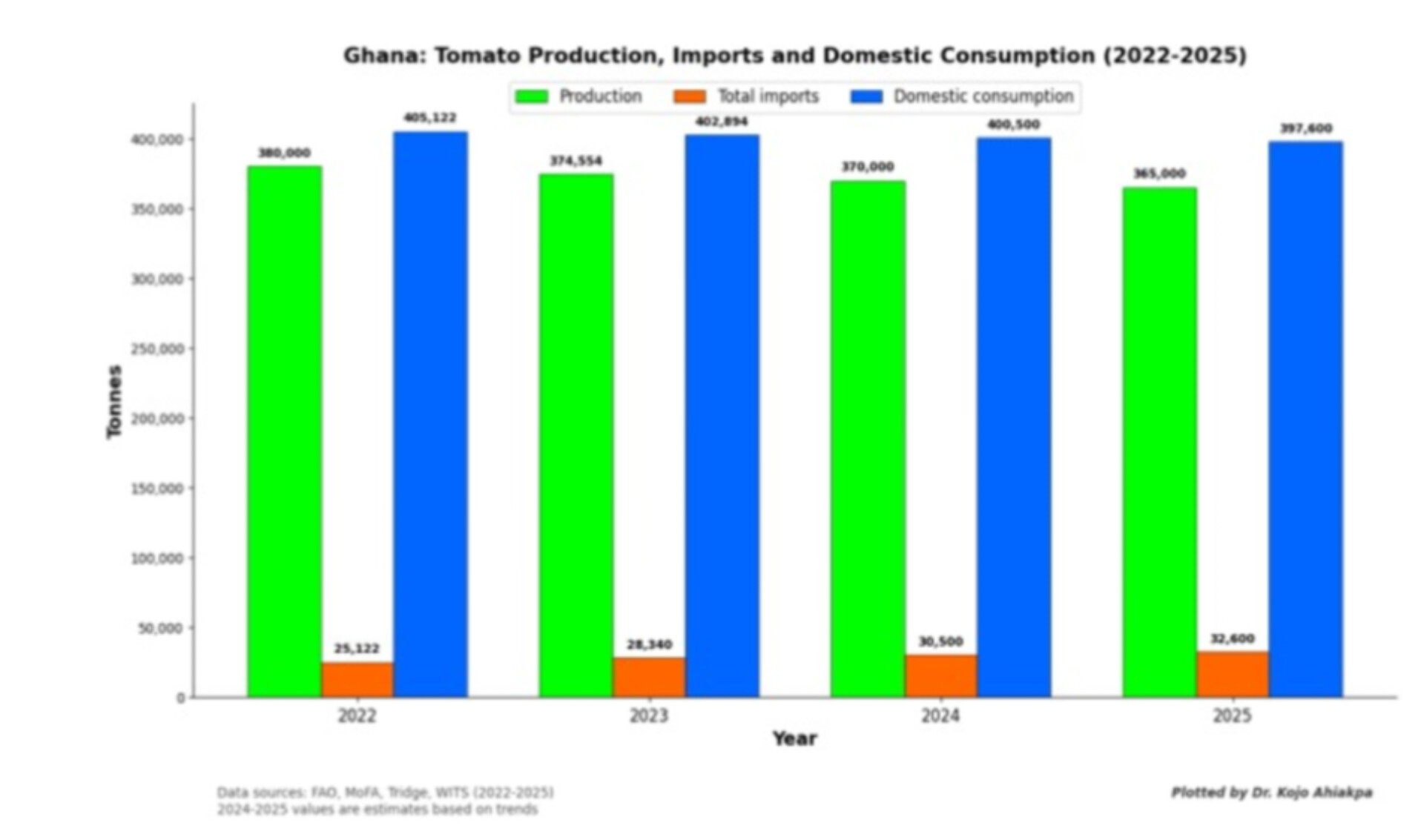
Farm yields in Ghana are very low by world standards. Data by FAO indicate average tomato yields around 7–8 t/ha. Under ideal practices and inputs, yields of 15–20 t/ha are achievable. For example, the Ministry of Food & Agriculture estimates potential yields 20 t/ha with improved varieties and management (versus the current 8 t/ha). The gap reflects multiple challenges; namely most farmers still plant unimproved local varieties (poor colour, low sugar content), irrigation is scarce as most production is rainfed, and input use (fertiliser, seed quality) is limited. Pests, diseases and erratic rainfall further suppress yields.
Ghana’s tomato value chain also suffers massive post-harvest losses. Researchers find that 20–60 % of fruits can decay before reaching market. Inadequate storage, poor roads and the lack of cold chains mean large volumes rot (estimate cites a 30–45 % loss rate worth GH¢175–250 million annually). Harvest gluts drive prices to rock-bottom in season, then severe shortages spike prices when imports also run thin. With no functional national processing industry, most private commercial processing factories sit idle. Traders and analysts agree that quality losses and waste are rampant, which discourages farmers from scaling up production and keeps Ghana dependent on imports.
Key actions include the following:
- Invest in breeding and distributing high-yielding, disease-resistant tomato varieties suited to Ghana’s climates. The government and private breeders should expand hybrid and open-pollinated varieties to replace low-performing local types.
- Scale up irrigation infrastructure (dams, boreholes, drip systems) so that farmers can cultivate during the dry season. Ghana’s World Bank–backed resilience programme (FSRP) demonstrates that dry-season farming with quality inputs can yield 10–15 t/ha, reducing the seasonal gap. Government programmes (e.g. Feed Ghana) should prioritise tomatoes for dry-season support.
- Recruit and train more agricultural extension officers to reach tomato growers. Experts note Ghana’s farmers need up-to-date advisory on agronomy, pest/disease management and input use. Coupled with subsidised credit or input vouchers, better extension can help farmers adopt best practices and new technologies.
- Develop local tomato processing plants (puree, paste, sauces) to absorb surplus and stabilise prices. Ghana is currently the world’s second-largest importer of tomato paste. Public–private partnerships (involving companies like Dangote and Pioneer Foods) should be encouraged to create a domestic market for excess produce. This ‘anchor demand’ will motivate farmers to expand output.
- Invest in cold-storage hubs and improved road networks linking farms to markets. Reducing the 30–45 % post-harvest loss reported in Ghana will directly increase effective supply. Mobile processing units and pack-houses as piloted in some districts can also cut waste.
- Negotiate a bilateral security protocol for tomato traders. For example, Ghana could collaborate with Burkina Faso authorities to establish escorted ‘cargo convoys’ or dedicated travel passes for traders. The Deputy Minister has already proposed talks on providing ‘security aid’ so merchants can move safely across the border. These measures should be formalised with funding and joint planning.
- Deploy mixed patrol teams in flashpoint areas (e.g. Loroum Province near Titao). Ghana and Burkina Faso with ECOWAS support should exchange real-time intelligence on extremist threats. A regional ‘rapid response’ arrangement under the G5 Sahel or ECOWAS defence pact could monitor routes. The recent Ghana–Burkina high-level conference on security emphasised just such collective action.
- Maintain up-to-date travel advisories and emergency contact networks for cross-border traders. Ghana’s MFA has issued guidance to contact missions before travel. This should be extended to compulsory registration of tomato convoys, hotlines, and possibly a security helpline specifically for agricultural traders.
- Ghana’s government should demand stronger anti-terror efforts from Burkina Faso’s military government, especially in border regions where traders operate. A joint ministerial meeting (defence and foreign affairs) could develop a Burkina Faso Tomato Trade Security Accord, similar to agreements for other commodities. Ghana’s parliamentarians have already called for such high-level diplomacy; this should translate into immediate bilateral negotiations.
- Empower groups like the Ghana National Tomatoes Traders & Transporters Association (seven members were among the victims) to participate in policy fora. These associations can organise bulk input purchases, shared transport, and safety protocols for members. They should be represented on a national Tomato Sector Task Force to guide interventions.
- Involve domestic processors and retailers in planning. Dangote and other investors planning processing facilities should be fast-tracked with incentives including tax breaks, and guaranteed offtake of local tomatoes. This ensures a reliable market for increased production.
- The Ghana Private Road Transport Union (GPRTU) and others can coordinate convoy operations, insurance or even armed escorts for bulk tomato shipments. Training and sensitising drivers on security best practices will also help.
- Elevate the issue to the regional level. ECOWAS should integrate food-trade security into its agenda, as Ghana has urged. Joint donor programmes (e.g. from World Bank, FAO, IFAD) could fund cross-border infrastructure and security. A regional ‘Red Gold’ initiative could link Ghana, Burkina, Mali and Niger in a partnership to develop tomato value chains (mirroring efforts for cocoa).
- Continue highlighting the human and economic cost of inaction. As the Chamber of Agribusiness has done, public campaigns can pressure lawmakers to invest in tomato resilience. Civil society groups and the press should demand that the government report back on efforts to protect traders and farmers. Ultimately, reinforcing Ghana’s food security will require sustained political will, backed by the concerted action of farmers, businesses, security forces and regional partners.
By combining these measures, scaling up production at home and securing safe trade routes abroad, Ghana can stop bleeding foreign exchange and lives over tomatoes. Strengthening seed systems, irrigation and processing will raise yields (currently 8 t/ha) toward their 20 t/ha potential. At the same time, formalised security cooperation with Burkina Faso will protect traders who currently risk their lives to fill Ghana’s tomato shortage. A coordinated public–private effort, with farmers, traders and processors at the table, can turn this crisis into an opportunity making Ghana self-sufficient in ‘red gold’ and less dependent on imports that now cost hundreds of millions of dollars and, tragically, Ghanaian lives.

