

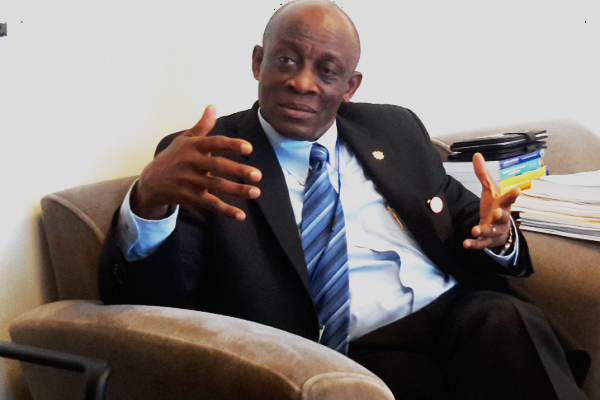

- Seth Terkper Proposes Distressed Asset Fund to Revive Viable Ghanaian Businesses
As Ghana gradually emerges from one of its most severe macroeconomic crises in decades, policymakers are beginning to shift attention from restoring fiscal stability to protecting the productive sector that must ultimately drive sustainable growth.
It is within this context that Presidential Economic Adviser Seth Terkper has proposed the creation of a Non-Performing Assets Trust Fund, a specialised financial vehicle designed to rescue fundamentally viable businesses facing temporary financial distress rather than allowing them to collapse.
The proposal, unveiled during the launch of the Business Ready (B-READY) Report, reflects a broader policy debate over how Ghana can complement fiscal consolidation with measures that strengthen private sector resilience. While recent reforms have restored investor confidence, lowered inflation and stabilised the cedi, many businesses continue to grapple with elevated borrowing costs, constrained access to credit and weakened balance sheets following years of economic turbulence.
Mr. Terkper argued that Ghana currently lacks an institutional framework capable of intervening when otherwise healthy firms become distressed because of temporary liquidity shocks or deteriorating loan quality.
“We need to establish a Non-Performing Assets Trust Fund to support viable businesses that are facing distress,” he said.
According to him, such a mechanism would purchase, restructure or manage distressed assets, allowing businesses with strong long-term fundamentals to recover instead of being forced into insolvency.
The proposal represents a notable evolution in Ghana’s economic policy thinking. Historically, government interventions have focused primarily on stabilising financial institutions, as witnessed during the banking sector clean-up between 2017 and 2020. Terkper’s proposal instead shifts attention towards preserving productive enterprises whose survival directly supports employment, tax revenues and domestic investment.
Commercial banks continue to carry elevated levels of non-performing loans despite improvements in asset quality over the past two years. Distressed corporate borrowers often tie up bank capital, restrict new lending and weaken financial intermediation. A professionally managed asset trust could remove impaired assets from banks’ balance sheets, improve liquidity and create room for fresh lending to productive sectors.
Countries including Malaysia, South Korea and Ireland established asset management companies following financial crises to acquire distressed loans, restructure indebted firms and restore confidence within financial systems. Rather than serving as permanent bailouts, these institutions functioned as temporary stabilisation mechanisms designed to maximise asset recovery while preserving economic value.
For Ghana, however, implementation would require careful institutional design.
Without strong governance, transparent valuation procedures and strict eligibility criteria, any rescue fund could expose taxpayers to moral hazard by encouraging excessive risk-taking among borrowers or politically connected firms seeking preferential treatment. International experience suggests that distressed asset funds succeed only when commercial discipline remains at the centre of decision-making.
Ghana’s economy has begun recording encouraging macroeconomic improvements under the ongoing IMF-supported programme. Inflation has eased considerably from crisis levels, the cedi has demonstrated greater stability and fiscal consolidation has strengthened investor confidence. Yet these gains have not fully translated into improved financing conditions for businesses, particularly small and medium-sized enterprises.
Many firms continue to face high financing costs, reduced working capital and cautious lending by commercial banks that remain focused on protecting asset quality.
The challenge therefore is shifting from macroeconomic recovery to microeconomic resilience.
While governments can restore fiscal stability through disciplined budgeting and debt restructuring, sustainable growth ultimately depends on businesses investing, hiring workers and expanding production. If financially viable firms fail because temporary liquidity problems become insolvency crises, the broader economy risks losing productive capacity that may take years to rebuild.
Mr. Terkper underscored this broader policy objective by stressing that improving Ghana’s investment climate extends beyond attracting new investors.
“The country must also create mechanisms that help businesses survive periods of financial stress,” he indicated.
That observation aligns closely with the World Bank’s Business Ready framework, which increasingly measures not only how easily firms can enter markets but also how effectively regulatory and financial systems support businesses throughout their lifecycle.
The government’s 24-Hour Economy strategy, export-led industrialisation agenda and manufacturing expansion plans all depend on the survival and competitiveness of domestic enterprises. Allowing economically viable companies to collapse because temporary financing constraints remain unresolved would undermine these long-term development objectives.
The proposal has yet to clarify the size of the proposed fund, its financing structure or whether participation would involve public resources, multilateral development finance or private institutional investors. Policymakers would also need to determine which sectors qualify for support, the conditions attached to restructuring and the mechanisms for ensuring accountability.
For investors, the proposal signals an important shift in Ghana’s policy conversation.
Rather than focusing exclusively on macroeconomic stabilisation, attention is increasingly turning towards preserving productive investment, protecting employment and strengthening corporate resilience. If carefully designed, a Non-Performing Assets Trust Fund could become a vital complement to banking reforms by improving credit allocation while preventing unnecessary business failures.
Ultimately, Terkper’s proposal recognises a central lesson from financial crises worldwide: economic recovery is not measured solely by stronger fiscal balances or lower inflation. It is equally determined by whether businesses remain capable of investing, employing workers and generating long-term value.
A credible corporate rescue framework could therefore become one of the missing institutional pillars needed to transform Ghana’s recent macroeconomic recovery into broad-based and durable private sector growth.

