

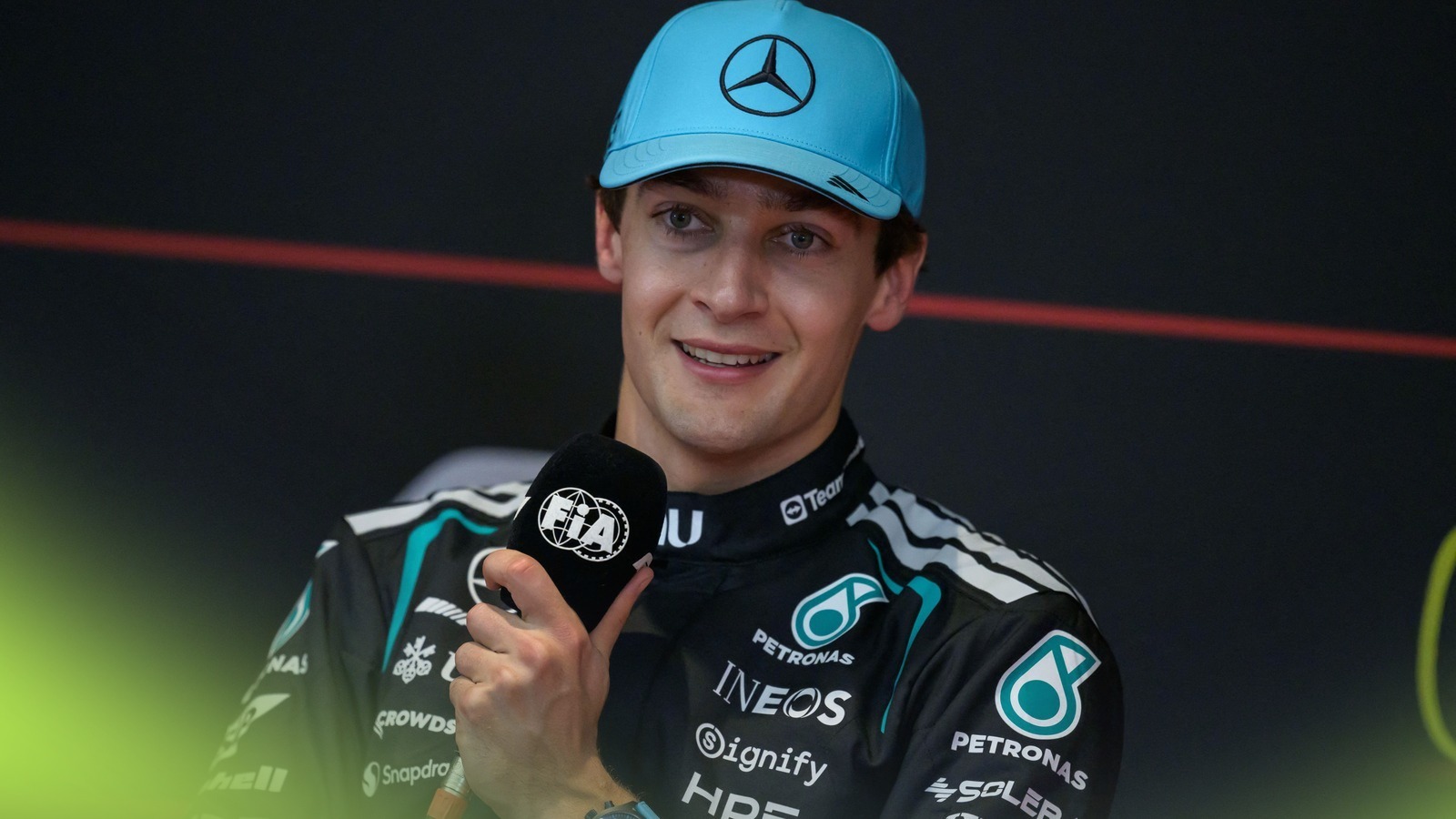

- Russell Turns the Tables on Antonelli to Claim Qatar Pole
George Russell delivered a timely response to a difficult week by beating Mercedes team-mate Kimi Antonelli to pole position for the Qatar Grand Prix, putting the two Mercedes cars at the front of the grid for Sunday’s race.
Russell set a fastest lap of 1:21.695 at Lusail, 0.128 seconds ahead of Antonelli. The result was his first pole since the Azerbaijan Grand Prix in September and came after a qualifying session in which he outpaced the newly crowned world champion in all three stages.
The Mercedes one-two was consistent with the team’s pace through practice. The surprise was the order. Antonelli had led all three practice sessions and arrived as the apparent favourite, but Russell found his rhythm in qualifying and steadily built an advantage.
He was more than a tenth faster in Q1, stretched the margin to almost three tenths in Q2 and finished ahead in the final shootout.
That performance gave Russell a result to answer the renewed attention around his rivalry with Max Verstappen. The tension had intensified after Verstappen’s victory in Las Vegas, where he dismissed Russell as being “far below” his level.
Russell’s pole in Qatar does not settle that dispute, but it gives him the strongest possible position from which to make his case on track.
The first challenge, however, may come from inside his own garage. Antonelli was visibly unhappy with Mercedes’ decision to send the cars out early in the final qualifying segment.
He had wanted to run at the back of the pack, where he expected to benefit from a tow and later track evolution. Instead, the team prioritised getting both cars across the line in time for their final attempts.
Antonelli questioned the call over team radio and said afterwards that he had asked to be the last car out. Mercedes team principal Toto Wolff said the team chose an earlier run to avoid the risk of being caught out by the timing of the session.
He acknowledged that Antonelli was dissatisfied, while defending the team’s decision as a practical one.
Neither Mercedes driver improved on their second Q3 attempt, leaving the first runs to determine the front row. Russell had already built a gap of nearly two tenths.
The episode leaves a small but important question for Sunday: whether the qualifying disagreement becomes a distraction, or whether the team can turn its strong pace into a controlled one-two.
Behind them, McLaren secured the second row. Lando Norris qualified third, 0.480 seconds behind Russell, with Oscar Piastri fourth, 0.550 seconds off the pole time.
Their late improvement pushed McLaren ahead of Red Bull as Mercedes’ closest challengers, although the gap to Russell suggests the team will need more than a clean start to challenge for victory.
Red Bull’s Isack Hadjar qualified fifth, ahead of Verstappen in sixth. Hadjar’s lap put him 0.041 seconds ahead of the four-time champion, while Verstappen ended the session 0.637 seconds off pole.
The result gives Hadjar a notable advantage over his team-mate, but Verstappen will start close enough to the leading group to remain a factor if the race’s strategy or tyre limits create opportunities.
Ferrari endured a difficult session. Charles Leclerc qualified seventh, while Lewis Hamilton was ninth, behind Racing Bulls’ Arvid Lindblad. Team principal Frédéric Vasseur described it as Ferrari’s worst qualifying of the season.
Liam Lawson completed the top ten, giving Racing Bulls two cars among the leading ten.
The order at the front will not be the only factor shaping Sunday. Pirelli has imposed a maximum of 27 laps for each set of tyres because of high degradation at Lusail.
The limit is expected to force teams into two-stop strategies, reducing the scope for a one-stop race and making tyre management and pit timing central to the outcome.
The restriction matters especially for drivers starting near the front. Russell and Antonelli will need to protect their track position through the opening stint while avoiding excessive tyre wear.
McLaren’s Norris and Piastri will have the chance to apply pressure if Mercedes’ pace fades or if a well-timed stop allows them to gain ground. A two-stop requirement also raises the possibility of the race being decided by execution rather than qualifying order alone.
There were penalties further down the grid. Haas driver Rafael Camara, who qualified 15th while standing in for Esteban Ocon ahead of his full rookie campaign next year, received a three-place penalty for impeding Gabriel Bortoleto.
Sergio Perez was handed a five-place penalty, further reshaping the back of the field.
For Russell, pole is both a sporting opportunity and a statement. He has not won the championship battle with Antonelli, who secured the title with four rounds to spare, and one qualifying session cannot reverse that season-long outcome.
But it does show that the champion is not guaranteed to control every contest within the team.
Mercedes now has the cleanest possible starting position, yet its internal disagreement has introduced an element of uncertainty.
Russell must convert his speed into a clean launch and manage the two-stop race ahead. Antonelli, meanwhile, will start alongside him with a clear incentive to show that the team’s decision in qualifying did not determine the result.
The Qatar Grand Prix is therefore set up as more than a test of Mercedes’ pace. It will show whether Russell can turn a strong Saturday into a decisive Sunday, whether Antonelli can challenge from the front row despite his frustration, and whether McLaren or Red Bull can take advantage if the leaders falter. Pole gives Russell the first move. The race will decide what it means.

