

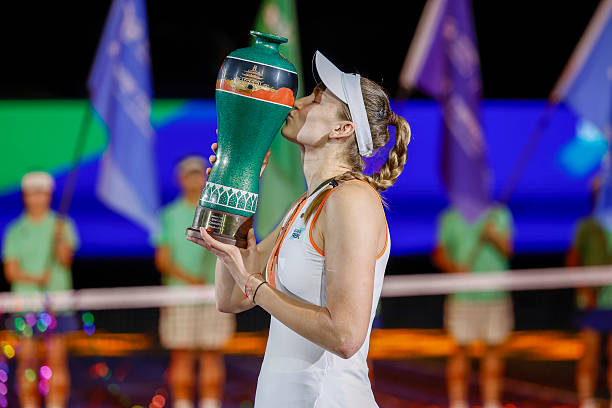

- Rybakina Retains Ningbo Title with Statement Victory Over Fernandez
Elena Rybakina’s successful defence of the Ningbo Open was more than another trophy in a remarkable season. Her 6-2, 6-2 victory over Leylah Fernandez was a reminder that the world number one can turn a final into an exhibition of controlled power when her serve, return and groundstrokes operate in harmony.
The Kazakh needed only two sets to dismiss the unseeded Canadian, retain the title she won in 2025 and collect a tour-leading fourth trophy of the season. It was her 15th career singles title and her first championship since ascending to the top of the women’s rankings.
That last distinction gives the result additional significance. Becoming number one changes the terms under which a player competes. Every defeat is magnified, every opponent arrives with freedom and every tournament becomes an examination of whether the ranking reflects enduring authority. Rybakina answered that question emphatically in Ningbo.
Her performance was built around the familiar weapons that have made her one of the most difficult opponents in the sport. She struck forcefully from both wings, denied Fernandez time to construct points and repeatedly converted neutral exchanges into situations in which the Canadian was defending simply to remain in the rally.
The opening set remained competitive until Rybakina broke in the fifth game. Once she established that advantage, the contest accelerated away from Fernandez. A fierce crosscourt backhand helped consolidate the break, and Rybakina completed the set in 38 minutes with the momentum firmly under her control.
Fernandez began the second set with greater urgency, attempting to take the ball earlier and disrupt Rybakina’s rhythm. The response showed why the champion’s game has matured beyond raw power. Rybakina absorbed the pressure, waited for the shorter ball and broke for a 2-1 lead. From there, the result became increasingly inevitable.
The scoreline reflected not merely superior shot-making but a tactical mismatch. Fernandez thrives when she can redirect pace, use angles and make opponents uncomfortable through movement and variation. Against Rybakina, however, she was denied the time required to impose those patterns. Her service games were placed under constant pressure, while the Kazakh protected her own court position with depth.
For Rybakina, the title also repairs momentum after an uneven period following her ascent to number one. She suffered a surprising opening defeat in Beijing and withdrew from Wuhan with a foot problem. Those setbacks raised reasonable questions about her condition and rhythm entering the decisive weeks of the season.
Ningbo provided the required answer. Defending a title carries a different psychological burden from winning it initially. The player returns with points to protect, memories to manage and opponents measuring themselves against the champion. Rybakina navigated that pressure while rebuilding confidence and sharpening her game.
Her route to the trophy was not entirely effortless. In the semi-final, sixth seed Diana Shnaider tested her with left-handed patterns and forced difficult moments before Rybakina prevailed 6-3, 7-5. That match demanded patience and resilience; the final rewarded her with the opportunity to play more freely.
The victory strengthens Rybakina’s effort to finish 2026 as the year-end world number one. That honour would provide statistical confirmation of a season already defined by exceptional achievements. She won the Australian Open, added the US Open and reached the summit of the rankings after overcoming Aryna Sabalenka in New York.
The year-end ranking remains valuable because it rewards consistency across the entire calendar rather than brilliance at isolated events. Rybakina’s four titles, including two majors, give her a formidable claim. Her Ningbo points increase the pressure on her closest rivals and allow her to approach the remaining tournaments from a position of strength.
Her next assignment is the Pan Pacific Open in Tokyo, after which she will defend her WTA Finals title. Ningbo therefore served as a competitive rehearsal.
The WTA Finals will demand repeated victories against the strongest players in the field, with limited recovery time and little room for a slow start. Rybakina’s ability to finish points efficiently could become especially valuable in that format. Shorter matches preserve physical resources and reduce exposure to the minor injuries that can determine late-season outcomes.
Fernandez, meanwhile, should not allow the severity of the final defeat to erase the progress represented by reaching it. The world number 30 arrived unseeded and defeated Marie Bouzkova 6-3, 7-5 in the semi-final. Her run followed her Singapore Open victory in September, indicating that she is rediscovering consistency at the end of the year.
The challenge is developing responses for opponents who overwhelm her serve and restrict her ability to change direction. Against the tour’s most powerful players, she needs greater protection behind her first delivery and more reliable ways of preventing returners from immediately controlling the centre of the court.
Sunday’s final ultimately demonstrated the widening range of Rybakina’s authority. Earlier in her career, victories were often explained primarily through aces and explosive hitting. Her current success rests equally on improved point construction, emotional composure and the ability to raise her level at precisely the moment an opponent threatens to gain confidence.
Ningbo has become a productive setting for her. Two appearances have produced two titles, creating the sort of familiarity that can turn a tournament into a personal stronghold. Rybakina described the city as special after the victory, and the results support that affection.
The message, however, extends beyond one venue. Rybakina arrived carrying questions about injury, form and the demands of her new ranking. She leaves with another trophy, valuable ranking points and renewed momentum before the season’s final examination.
Fernandez reached the final through determination and quality, but Rybakina made the championship match look uncomplicated. That is often the clearest sign of dominance: not simply winning, but removing doubt so quickly that the opponent’s possible routes back into the contest disappear.
As the tour turns towards Tokyo and Indian Wells, the world number one has restored the most intimidating feature of her game the sense that once she moves ahead, the court becomes smaller, the rallies become shorter and resistance becomes increasingly futile.

