



- Ghana’s Fixed-Income Market Records GH¢2.69 billion in Trading Volume as DDEP Bonds Dominate Activity
Ghana’s secondary fixed-income market recorded an aggregate trading volume of GH¢2.69 billion on Friday, November 20, 2026, with securities issued under the Domestic Debt Exchange Programme (DDEP) accounting for nearly two-thirds of activity as investors continued to concentrate transactions in government debt instruments.
Official trading data from the Ghana Fixed Income Market (GFIM) show that 317 transactions were executed during the session, with DDEP bonds contributing GH¢1.71 billion, representing 63.74% of total reported volume.
Sell/buy-back transactions involving government securities accounted for another GH¢695.70 million, equivalent to 25.89%, while Treasury bills contributed GH¢278.21 million, or 10.35%.
Corporate bonds recorded GH¢476,000 across a single transaction, highlighting the substantial difference in trading activity between government securities and instruments issued by corporate entities.
The figures reinforce the continuing dominance of sovereign debt instruments in Ghana’s fixed-income market, where government bonds and short-term Treasury securities remain the principal sources of trading activity.
GFIM trading summary — November 20, 2026
Total reported volume – GH¢2.69bn
Total transactions – 317
DDEP bond share – 63.74%
Treasury bill transactions – 215
Trading volume by instrument GH¢ million, November 20, 2026
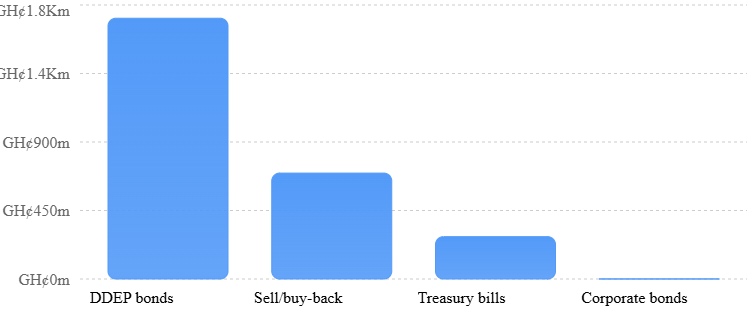
Reported GFIM volume, not independently calculated transaction consideration.
The distribution reveals an important distinction between the volume of securities traded and the number of transactions recorded.
Although DDEP bonds generated the largest aggregate volume, the category accounted for only 19 transactions, representing 5.99% of the day’s total deal count.
Treasury bills, by contrast, recorded 215 transactions, equivalent to 67.82% of all deals, despite accounting for just 10.35% of volume.
This divergence suggests that DDEP trading was concentrated in relatively large transactions, while Treasury bills attracted a substantially greater number of smaller trades.
Average reported DDEP volume was approximately GH¢90.16 million per transaction, compared with GH¢1.29 million for Treasury bills.
The concentration of activity in larger DDEP transactions provides insight into the structure of Ghana’s secondary debt market.
Institutional investors typically manage substantial fixed-income portfolios, making larger bond transactions important for portfolio rebalancing and liquidity management.
However, the trading report does not identify individual counterparties, meaning the figures cannot establish whether the day’s largest transactions were executed by banks, pension funds, insurance companies or other institutional investors.
The most actively traded DDEP security was the government bond maturing on February 11, 2031, which recorded GH¢617.31 million in volume across three transactions.
That represented approximately 36.04% of total DDEP trading for the session.
The bond carried a reported yield of 14.50% for the largest-volume segment and a closing price of approximately 82.82.
The substantial volume concentrated in this security demonstrates the importance of individual benchmark instruments in influencing overall market activity.
It also suggests that liquidity within the DDEP market remains unevenly distributed, with particular maturities attracting considerably more trading interest than others.
Nevertheless, a single session cannot establish whether the concentration reflects a sustained investor preference or temporary portfolio adjustments.
The second-largest component of market activity involved sell/buy-back transactions.
These trades accounted for GH¢695.70 million across 82 transactions, representing 25.87% of the session’s deal count.
Such transactions are commonly associated with short-term liquidity management, involving the sale of securities alongside an agreement for their subsequent repurchase.
Their prominence illustrates the role of government securities not only as investment assets but also as instruments supporting liquidity arrangements among financial market participants.
The most active security in this category was the government bond maturing on February 12, 2030.
It recorded GH¢302.00 million in volume across 34 transactions, accounting for 43.41% of all sell/buy-back volume.
The security carried a yield of 13.60% and a weighted average closing price of approximately 87.71.
Other notable sell/buy-back activity included the February 11, 2031 bond, which generated GH¢151.71 million across seven transactions, and the February 10, 2032 bond, which recorded GH¢131.81 million across 16 trades.
The concentration of transactions within these maturities reinforces the importance of DDEP instruments to Ghana’s domestic money and capital markets.
Taken together, outright DDEP bond trading and sell/buy-back transactions accounted for GH¢2.41 billion, equivalent to 89.63% of the day’s aggregate volume.
However, these categories represent different transaction types and should not be interpreted as entirely equivalent measures of outright investment demand.
Treasury bills remained the most frequently traded securities.
The segment recorded GH¢278.21 million in volume from 215 transactions, with the largest-volume security being the bill maturing on June 28, 2027.
That instrument attracted GH¢90.74 million across 27 trades, with a reported yield of approximately 7.13% and a closing price of 95.87.
Treasury bills remain relevant for investors seeking shorter-duration government securities, particularly when managing cash requirements and exposure to changes in interest rates.
Their relatively high transaction count also points to broader trading activity across smaller positions compared with the concentration observed in longer-dated government bonds.
However, the significance of the reported yield must be assessed within the context of the specific security’s remaining maturity and the market’s pricing methodology.
Different yields across instruments cannot automatically be interpreted as differences in risk without considering maturity, coupon structure and market conventions.
The corporate debt segment remained comparatively subdued.
Only one corporate bond transaction was recorded, involving a Ghana Cocoa Board security maturing on August 28, 2028.
The transaction generated GH¢476,000 in volume, with the instrument closing at approximately 102.31.
Corporate bonds consequently accounted for less than 0.02% of total market volume.
No transactions were recorded in commercial paper, green and sustainable bonds, newly issued government notes and bonds, or the old government securities category.
The limited corporate activity highlights a persistent structural issue within Ghana’s domestic capital market: the significant disparity between sovereign debt trading and the development of an active secondary market for private-sector debt instruments.
A more diversified fixed-income market could provide companies with additional financing options beyond conventional bank lending.
Corporate bonds and commercial paper can allow qualifying businesses to raise financing from institutional investors, potentially broadening the sources of capital available for investment and expansion.
However, a deeper corporate debt market requires credible issuers, transparent financial reporting, suitable investor protections and sufficient secondary-market liquidity.
Without these conditions, investors may continue concentrating on government securities, particularly when sovereign instruments offer established trading mechanisms and relatively familiar credit characteristics.
The November 20 figures also illustrate the importance of distinguishing trading activity from changes in investor confidence.
A high volume of DDEP bond transactions may indicate active portfolio management or improved liquidity, but it does not independently establish that investors are becoming more optimistic about Ghana’s debt outlook.
A fuller assessment would require comparisons with previous sessions, movements in yields, bid-ask spreads and trading volumes across several maturities.
Similarly, the presence of substantial sell/buy-back activity does not necessarily indicate financial stress.
These transactions can form part of normal institutional liquidity management.
The central message from Friday’s trading is that Ghana’s fixed-income market remains heavily dependent on government securities, while corporate debt continues to play a marginal role in secondary-market activity.
For policymakers and market operators, the challenge is to deepen liquidity across a wider range of instruments while maintaining investor confidence in sovereign debt markets.
For institutional investors, the distribution of activity reinforces the importance of assessing liquidity alongside yields when managing fixed-income portfolios.
For corporate issuers, the limited secondary-market activity demonstrates the need for stronger market participation and more diversified funding channels.
As trading resumes on Monday, November 23, attention will turn to whether the substantial activity in DDEP bonds continues and whether Treasury bills maintain their dominance in transaction numbers.
The direction of yields across frequently traded government maturities will also offer useful indications of market pricing conditions.
Ultimately, the November 20 session presents a picture of a market generating substantial trading volume but remaining concentrated in sovereign debt.
The longer-term test for Ghana’s fixed-income market will be whether that liquidity can support the development of a broader, more diversified capital market capable of financing both government obligations and productive private-sector investment.

