

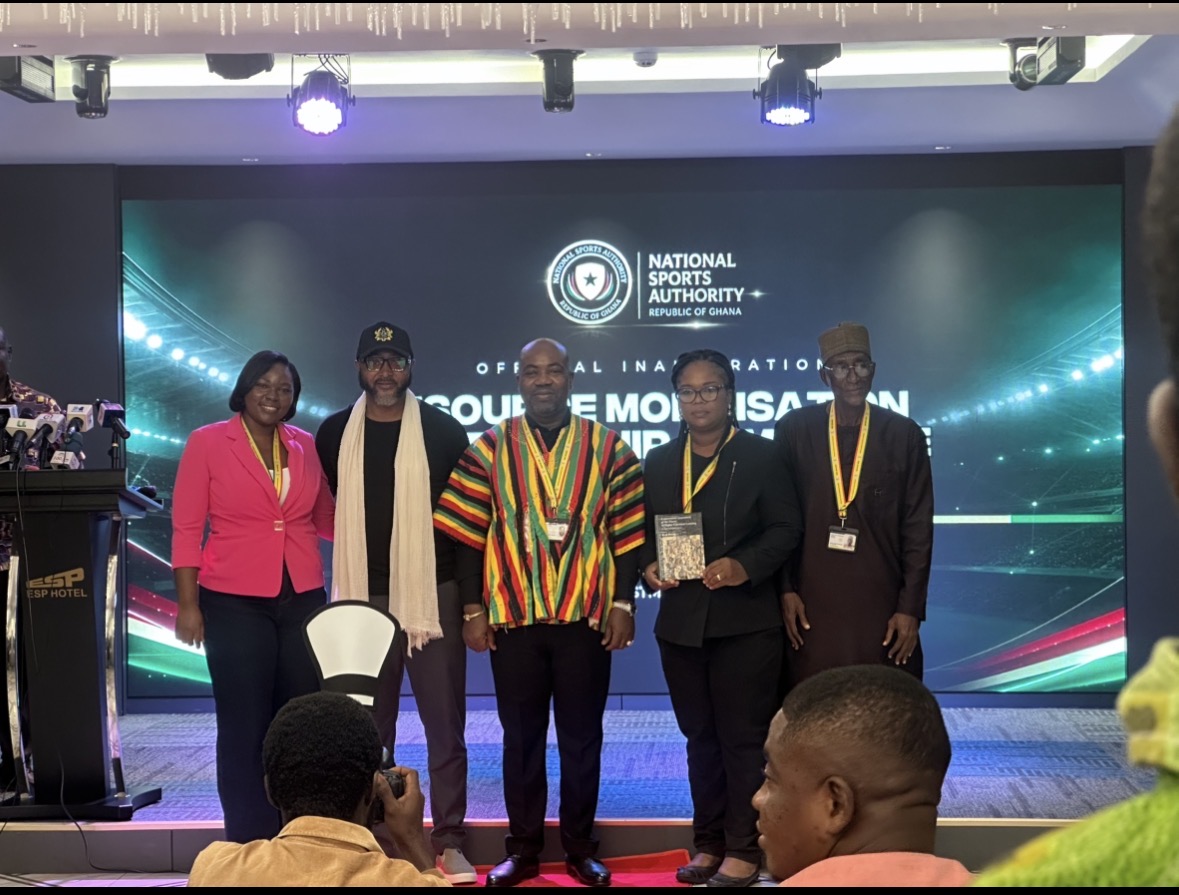

- Samson Deen Chairs New NSA Committee Tasked with Unlocking Sustainable Sports Funding
Ghana’s National Sports Authority has inaugurated a Resource Mobilisation and Partnership Committee as part of an effort to broaden the financing base of sport, placing greater emphasis on corporate partnerships and alternative sources of funding at a time when public resources alone are increasingly insufficient to meet the sector’s infrastructure and athlete-development needs.
The committee will be chaired by Samson Deen, President of the African Paralympic Committee and Ghana Paralympic Committee, who also serves on the governing board of the National Sports Authority. His appointment places an administrator with experience in building institutional partnerships and mobilising support for para sport at the centre of the NSA’s latest funding initiative.
The move speaks to one of the most persistent weaknesses in Ghanaian sport: a heavy dependence on government financing.
National teams, sports federations, infrastructure maintenance, athlete preparation and international competition frequently compete for limited public funds, leaving many disciplines struggling to secure predictable resources.
A properly functioning resource mobilisation structure could begin to alter that model by developing partnerships with companies, development institutions, foundations and other organisations willing to invest in sport.
Ghana’s sports sector is often treated primarily as a social or entertainment activity, but the NSA’s own leadership has previously argued that sport should be positioned as an industry capable of creating jobs, attracting investment and contributing more directly to national economic development.
Government will remain important, particularly for national infrastructure and international representation, but sustainable sports development cannot depend entirely on annual budget allocations or emergency funding requests ahead of major competitions.
Sponsors are more likely to commit long-term resources when sports organisations can demonstrate credible governance, measurable audiences, professional administration and clear commercial value. That means the new committee’s challenge will extend beyond simply asking companies for money.
It will need to make Ghanaian sport investable. Corporate organisations typically regard sponsorship as a commercial partnership rather than charity. They want brand visibility, audience engagement, social impact and measurable returns.
Sports administrators must therefore be able to package competitions, athletes, facilities and development programmes into propositions that businesses can understand and support.
Mr Deen’s own experience in para sport provides one example of what stronger institutional organisation can achieve.
He has previously argued that moving away from fragmented individual appeals towards properly structured organisations helped Ghana’s Paralympic movement gain greater respect from institutions and attract support. Speaking during preparations for the 2026 Commonwealth Games, he said sponsors had become more willing to engage because they were dealing with an organisation rather than individual athletes seeking assistance.
For years, many Ghanaian sports disciplines have struggled because sponsorship mobilisation begins only when an international competition is approaching. That produces a cycle of emergency appeals rather than long-term commercial relationships.
The Resource Mobilisation and Partnership Committee could help change that if it develops multi-year partnerships tied to athlete development, competitions, facilities, community programmes and talent identification.
The approach could also help diversify funding beyond football. Ghana’s sporting landscape includes athletics, boxing, swimming, weightlifting, para sport and numerous other disciplines that often receive far less commercial exposure despite producing internationally competitive athletes.
Recent para-sport performances demonstrate the potential. Ghana secured historic representation in para swimming at the 2026 Commonwealth Games, while para-athlete Zinabu Issah won silver in Glasgow. Those achievements followed sustained efforts to strengthen structures and secure support for athletes.
There is therefore an opportunity for the NSA to connect sporting performance more deliberately with sponsorship and investment. Success can attract corporate attention, but funding is often needed before the success occurs.
The committee will have to solve that sequencing problem by persuading partners to invest in preparation, talent development and infrastructure rather than only attaching themselves to athletes after medals have already been won.
Ghana’s sports facilities require substantial resources for maintenance, rehabilitation and modernisation. Public funding alone may not be sufficient to keep facilities commercially viable and properly maintained.
Private partnerships could potentially support naming rights, facility management, advertising, hospitality, event hosting and other commercial arrangements capable of generating recurring revenue.
But such partnerships will require transparent contracting and clear governance. Corporate Ghana is unlikely to commit large amounts of long-term capital if there is uncertainty over how funds will be managed or whether commercial agreements will be respected.
That makes accountability central to the committee’s work. The NSA’s resource mobilisation push should therefore be seen not simply as a fundraising exercise but as part of a broader attempt to professionalise Ghana’s sports economy.
If structured properly, the committee could help create a system in which sports organisations generate revenue from sponsorship, events, media, merchandising, facilities and partnerships while government concentrates its resources on areas where public intervention remains indispensable.
The current NSA board, chaired by Dr Fred Awaah, has publicly signalled an ambition to move sport from what it described as a “social entertainment enterprise” towards an activity that contributes more directly to national economic development.
Resource mobilisation will be one of the clearest tests of that ambition. A sports industry cannot develop sustainably if its institutions remain financially dependent on last-minute government interventions.
The appointment of Samson Deen to chair the committee therefore carries a clear responsibility: translate the language of sports commercialisation into actual partnerships and recurring resources. The eventual measure of success will not be how many companies the committee meets.
It will be how much sustainable financing it unlocks, how widely those resources are distributed across sporting disciplines and whether Ghanaian athletes begin to receive more predictable support long before they arrive at international competitions.
If the NSA can establish that model, the new committee could become an important step towards shifting Ghanaian sport from a largely state-financed activity into a more commercially organised sector. That would be the real breakthrough: not simply raising money for the next tournament, but creating a financing system capable of supporting Ghanaian sport year after year.

