

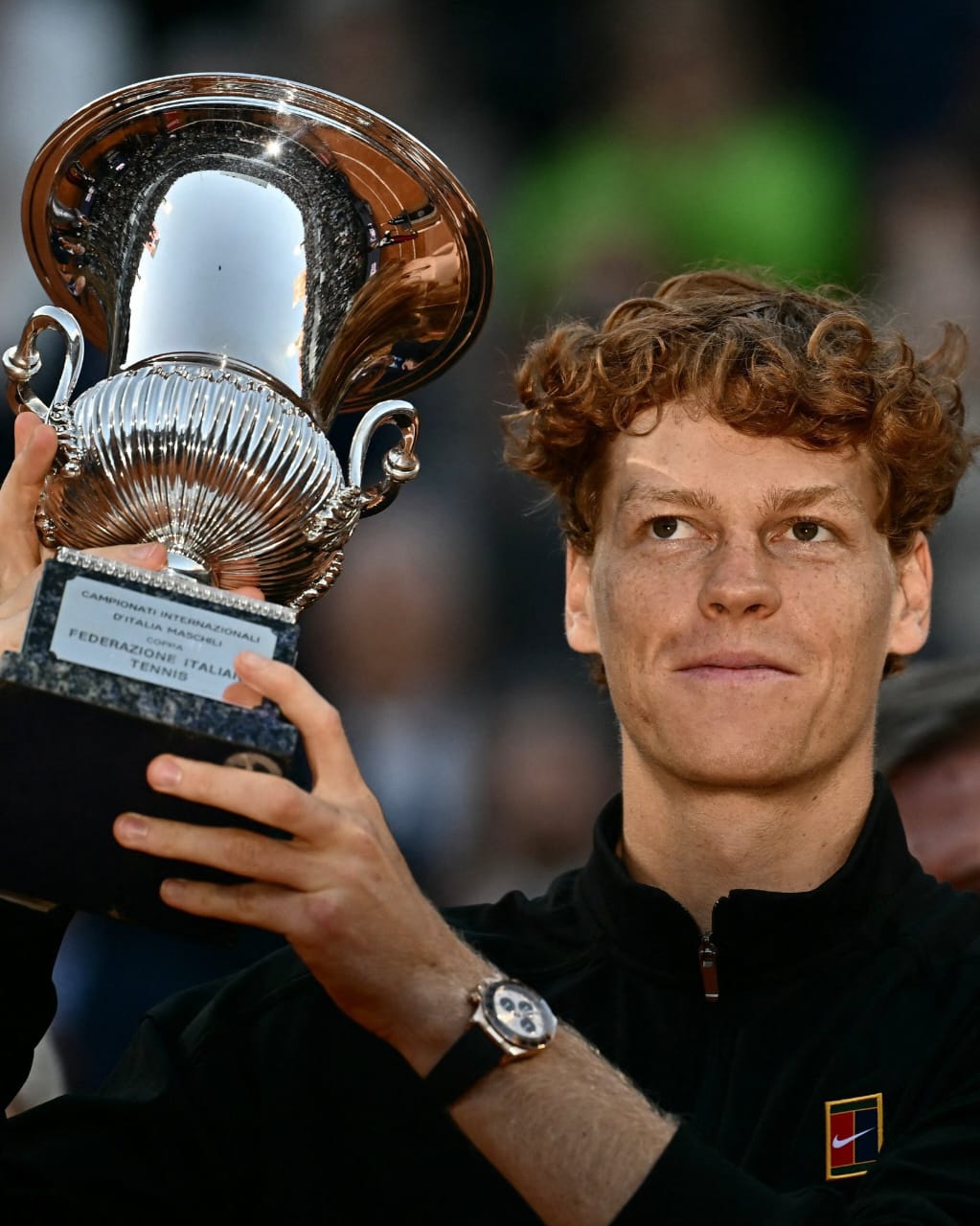

- Sinner Joins Djokovic in Tennis History After Winning All Nine ATP Masters 1000 Titles
World No. 1 Jannik Sinner wrote a new chapter in tennis history on Sunday after becoming only the second player ever to complete the Career Golden Masters, following his victory at the Internazionali BNL d’Italia in Rome. The Italian star defeated Casper Ruud in the final at the Foro Italico, securing his first Rome Masters title and completing victories at all nine ATP Masters 1000 tournaments.
The achievement places Sinner alongside Serbian legend Novak Djokovic as the only men in the Open Era to conquer every Masters 1000 event since the series was introduced in 1990.
For Sinner, the triumph was not merely another title. It was a defining moment in a career that has moved from promise to dominance with remarkable speed.
The 24-year-old began his Masters 1000 journey in 2023, when he captured his maiden title in Toronto with a straight-sets victory over Alex de Minaur. That breakthrough made him only the second Italian to win a Masters 1000 crown after Fabio Fognini, who triumphed in Monte-Carlo in 2019.
What followed was a rapid ascent to the summit of men’s tennis.
In 2024, Sinner climbed to World No. 1 for the first time and added Masters titles in Miami, Cincinnati and Shanghai, winning all three finals without dropping a set. His Shanghai success was particularly symbolic, as he defeated Djokovic in the final and went on to secure the ATP Year-End No. 1 ranking.
By the time he entered the 2026 season, Sinner was no longer simply one of the sport’s leading contenders. He had become the player around whom the men’s tour was increasingly being measured.
His form over the past six months has only reinforced that status.
Sinner claimed titles in Paris, Indian Wells and Miami, again without losing a set in any of those finals. That level of control in elite tournaments has turned his Masters 1000 record into one of the most dominant runs in recent tennis history.
Heading into the clay-court season, only three Masters titles were missing from his collection: Monte-Carlo, Madrid and Rome.
The questions were clear. Could Sinner translate his hard-court dominance onto clay? Could he overcome the physical and tactical demands of the surface? Could he win at home in Rome, where Italian expectation can be both inspiration and burden?
He answered all three emphatically.
Sinner defeated longtime rival Carlos Alcaraz in the Monte-Carlo final, then overcame Alexander Zverev in straight sets in Madrid. That Madrid triumph made him the first player to win five consecutive Masters 1000 titles.
Then came Rome.
In front of home fans, Sinner completed the set, becoming the first Italian men’s singles champion at the tournament since Adriano Panatta won the title in 1976.
The symbolism was powerful. Nearly five decades after Panatta’s famous Rome success, Italy again had a homegrown champion at the Foro Italico — this time a World No. 1 reshaping the boundaries of what an Italian player can achieve in the modern game.
Sinner now owns 10 Masters 1000 titles and is on a stunning 34-match winning streak at that level. Even more remarkably, he has not dropped a set in any Masters 1000 final he has won.
That statistic underlines the clinical nature of his dominance. Sinner has not only been winning the biggest titles below Grand Slam level; he has been controlling finals with a rare blend of power, precision and composure.
His game has matured into one of the most complete on tour. The baseline aggression remains, but it is now supported by improved movement, better point construction, stronger serving patterns and a level of emotional discipline that allows him to absorb pressure without losing tactical clarity.
Yet Djokovic’s shadow remains part of the historical comparison.
The Serbian still holds the record for the most Masters 1000 titles with 40 and remains the only player to complete the Career Golden Masters twice. That record gives context to Sinner’s achievement: he has entered elite company, but the summit of Masters history still belongs to Djokovic.
Still, Sinner’s latest success changes the conversation around his place in the game.
By winning Monte-Carlo, Madrid and Rome in the same season, he has also joined Rafael Nadal as one of the few players to sweep the three clay-court Masters 1000 tournaments in a single year.
That is no small feat. Nadal built much of his legend on clay-court supremacy. For Sinner to match that particular milestone speaks to how far his game has evolved on the surface.
His Rome victory also puts him within touching distance of Djokovic’s single-season record of six Masters 1000 titles, set in 2015. With his current form, that benchmark no longer looks unreachable.
For Italian tennis, Sinner’s achievement is historic. For the ATP Tour, it is a warning. The World No. 1 has moved beyond consistency into control. He is collecting titles across surfaces, beating elite rivals and turning finals into statements.
The Career Golden Masters is one of the rarest achievements in men’s tennis. Djokovic made it the ultimate symbol of all-surface mastery. Sinner has now joined him, not as a future prospect, but as a present force.

