

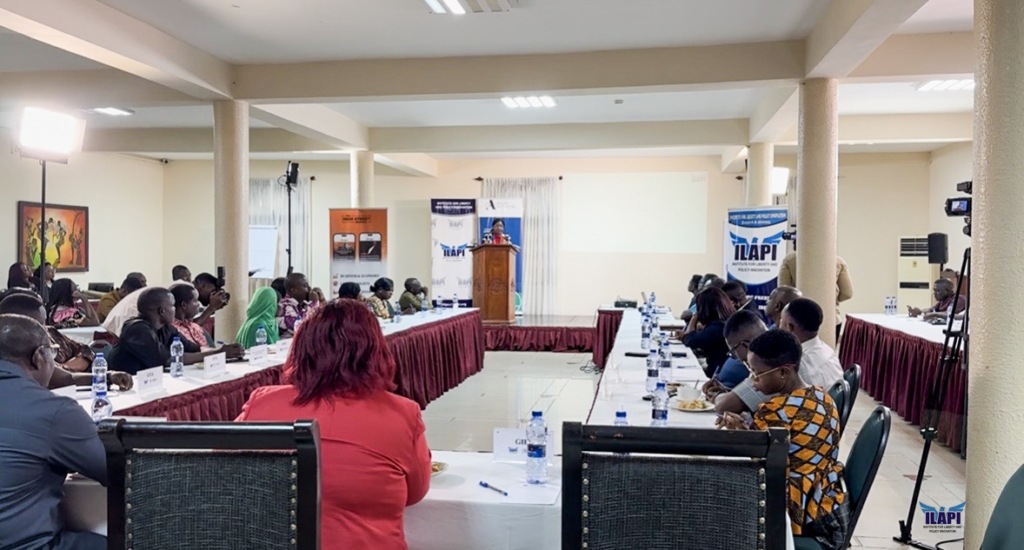

- Small Businesses Lose Scarce Capital to Permits, Licences and Regulatory Duplication — ILAPI
Ghana’s regulatory system is absorbing scarce capital from micro, small and medium-sized enterprises through registration fees, permits, licences and complex compliance procedures, potentially weakening the very businesses policymakers expect to drive investment, employment and economic transformation.
A 2026 study by the Institute for Liberty and Policy Innovation found that overlapping institutional mandates, excessive documentation, unclear procedures, inconsistent enforcement and lengthy approval processes are increasing the cost of operating formally. The research surveyed 600 MSMEs in manufacturing, information and communications technology and tourism between September 2024 and July 2025.
The scale of the problem extends well beyond the companies surveyed. ILAPI estimates that MSMEs account for about 92.00% of businesses in Ghana and contribute nearly 70.00% of gross domestic product, making the regulatory conditions under which they operate important to the wider economy.
“The regulatory burden discouraged formalisation, restricted business expansion, and diverted scarce capital from productive investment,” Stephen Dansu, Senior Research and Policy Analyst at ILAPI, said in presenting the findings.
The financial costs identified by the study may appear modest when viewed from the perspective of a large corporate balance sheet, but they are considerably more significant for enterprises established with only a few thousand cedis.
Businesses surveyed spent an average of GH¢1,030 on registration, while permits issued by Metropolitan, Municipal and District Assemblies cost an average GH¢1,275. Licensing expenses averaged GH¢1,600, with some respondents reporting payments of as much as GH¢3,000.
For a small manufacturer, trader or technology start-up, those costs compete directly with inventory, equipment, salaries and working capital. A regulatory payment is therefore not merely an administrative expense; it represents capital that cannot simultaneously be invested in expanding the business.
That distinction matters because Ghanaian SMEs already face significant financing constraints. Businesses that struggle to secure affordable bank credit are particularly sensitive to upfront compliance expenses, making the cumulative cost of registration, permits, licensing and certification an additional barrier to expansion.
ILAPI said the effect was particularly severe for micro and start-up enterprises, which have smaller financial buffers and less administrative capacity to navigate multiple regulatory institutions.
Ghana wants more enterprises to formalise so that they can access finance, employ workers formally, comply with standards and contribute to domestic revenue mobilisation. Yet if the cost and complexity of entering the formal system are too high, entrepreneurs may make the economically rational decision to remain outside it.
That creates what could become a formalisation trap: authorities seek to broaden the tax and regulatory base, but the structure designed to bring businesses into that base simultaneously raises the cost of participation.
The implications extend into public finance. Ghana’s efforts to strengthen domestic revenue mobilisation ultimately depend on growing the number and profitability of formal businesses, meaning regulatory reform could increase compliance more effectively over time than simply adding new charges to enterprises already inside the system.
The findings also complicate the debate around Ghana’s improving macroeconomic conditions. Lower inflation, currency stability and declining interest rates can create a better environment for investment, but businesses experience economic policy not only through national indicators but through the institutions they interact with every day.
A company may welcome lower inflation and still postpone expansion because obtaining permits takes too long, multiple agencies demand similar documentation or licensing costs consume the capital needed to purchase machinery.
Regulatory reform therefore offers government a potentially powerful way to improve the business environment without relying primarily on expensive tax incentives.
Reducing duplicated approvals, publishing clear requirements and simplifying licensing processes may require institutional coordination rather than large fiscal expenditure. For government, the return could come through higher business formation, investment and ultimately a broader tax base.
ILAPI is consequently calling for a comprehensive review of Ghana’s regulatory framework to eliminate duplication, harmonise permits and introduce compliance requirements proportionate to the size and risk profile of individual businesses.
It has also proposed a unified digital platform through which companies could apply for several licences and approvals without repeatedly navigating separate government institutions.
Time itself is a business cost. Every day an entrepreneur spends moving between agencies, correcting documentation or waiting for approvals represents time that cannot be devoted to customers, production, innovation or market expansion.
Digitisation could also improve transparency by displaying official fees, documentation requirements and processing timelines, reducing uncertainty over what businesses are expected to pay and how long applications should take.
If several institutions continue demanding overlapping permits, creating a digital portal may simply allow businesses to encounter the same duplication electronically. Effective reform therefore needs to begin by determining which regulations are genuinely necessary before deciding how they should be digitised.
There is also an important case for proportionality. A micro enterprise with two employees should not necessarily face the same compliance architecture as a large corporation if the underlying regulatory risks are substantially different.
Simplified licensing regimes, lower-cost registration and risk-based inspections could reduce barriers for small firms while maintaining standards in areas such as safety, consumer protection and environmental compliance.
The objective should not be deregulation for its own sake. Businesses benefit from credible standards because regulation can improve consumer confidence, product quality and access to export markets.
The problem arises when the cost of compliance becomes disconnected from the public benefit the regulation is supposed to produce.
ILAPI’s findings therefore point towards a broader question about Ghana’s development strategy. If MSMEs are expected to create jobs, strengthen domestic production and drive industrialisation, the state must consider not only how to provide them with finance but also how much capital its own regulatory system removes from them before they begin operating.
For thousands of small businesses, the difference may be only a few thousand cedis. But aggregated across an economy in which MSMEs constitute the overwhelming majority of enterprises, those costs can become economically significant.
Ghana’s challenge is consequently not to choose between regulation and enterprise. It is to build a regulatory system in which legitimate public protections are delivered with the least possible administrative and financial burden.
That distinction could determine whether scarce MSME capital is spent navigating another permit or invested in the equipment, technology, inventory and workers capable of generating Ghana’s next stage of growth.

