


- South Africa Opens Digital Visa System to China, India, Indonesia and Mexico
South Africa has launched an Electronic Travel Authorisation system for eligible travellers from China, India, Indonesia and Mexico, marking a significant shift from paper-heavy visa processing towards a digital immigration model designed to support tourism, investment and tighter border security.
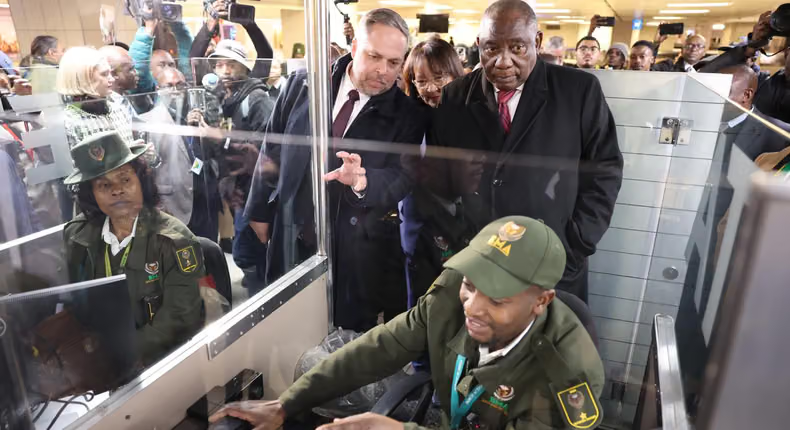
President Cyril Ramaphosa formally launched the system at OR Tambo International Airport on Wednesday, August 12, saying the reform was intended to make legitimate travel into South Africa faster and more predictable while giving authorities stronger tools to screen arrivals before they reach the border.
“The Electronic Travel Authorisation system is about making South Africa more open to opportunity, more welcoming to legitimate travellers, more secure for our citizens and more competitive in the global economy,” Mr Ramaphosa said.
Under the initial rollout, eligible travellers requiring visas from the four participating countries can submit their information online, pay digitally and receive travel authorisation electronically. The platform uses biometric verification, facial recognition, machine learning and an upgraded electronic movement-control system as part of the screening process.
The four-country launch follows an earlier pilot conducted during South Africa’s G20 presidency. China, India, Indonesia and Mexico have now become the first markets incorporated into the wider system for eligible short-term travel, although the government intends to extend the platform to additional countries and visa categories.
For South Africa, the significance extends beyond administrative convenience. Visa processing can become an economic competitiveness issue when delays, complicated applications or uncertainty discourage tourists, investors and business travellers from choosing one destination over another.
Ramaphosa said the ETA would “make travel to South Africa easier, faster and more predictable”, while supporting tourism, trade, investment and the movement of skills and knowledge. At the same time, he said digitisation would strengthen the integrity of South Africa’s borders and improve migration management.
The economic opportunity is particularly important because the first four markets include some of the world’s largest populations and major sources of outbound travellers and investment. Reducing administrative friction for legitimate visitors could strengthen South Africa’s attempt to compete more aggressively for tourism expenditure, conferences, business travel and international capital.
The reform also illustrates how immigration policy is increasingly becoming part of industrial and investment strategy. A country may offer attractive tourism assets or investment opportunities, but difficult entry procedures can impose an additional transaction cost on people attempting to access them.
Digitisation seeks to reduce that cost without necessarily weakening screening.
South African authorities will be able to assess information before a traveller departs, while biometric checks at the border can help determine whether the person arriving is the same person whose information was submitted during the application process.
That distinction is central to the government’s argument. Faster immigration does not have to mean less secure immigration if more of the verification process can be completed digitally and before passengers arrive at airports.
The Department of Home Affairs has also linked the new system to efforts to reduce visa fraud and improve the integrity of immigration administration. South Africa has been pursuing broader digital reforms intended to connect visa processing, biometric identity verification and border-management systems more closely.
Technology, however, will ultimately be judged by the experience of applicants rather than its sophistication on paper. Digital immigration systems can still become cumbersome if websites are unreliable, documentation requirements remain unclear or applications are subjected to lengthy manual review after being submitted online.
The economic benefits therefore depend on whether the ETA actually shortens processing times and provides greater certainty to travellers.
For tourism businesses, that predictability can influence bookings. Travellers making decisions between competing destinations may be reluctant to commit to flights and accommodation when they cannot confidently determine how long a visa will take or whether the application process will require repeated physical visits.
Business travellers face similar costs. Executives, investors and technical specialists often operate within tight schedules, making immigration delays potentially important when choosing where meetings, investments and projects take place.
South Africa’s new system therefore forms part of a broader attempt to make the country more competitive as a destination for tourists, investors, businesspeople and skilled professionals while retaining greater government visibility over cross-border movements.
The initial country selection also provides the government with an opportunity to test the technology before wider deployment. China and India in particular could generate substantial application volumes, making them useful markets through which authorities can evaluate processing capacity and system reliability.
Expansion will nevertheless be important if the reform is to materially transform South Africa’s immigration architecture. A platform limited to four countries would remain a targeted intervention rather than a comprehensive replacement for the traditional visa system.
Government has indicated that additional countries will eventually be incorporated and that the ETA will expand beyond its current short-term travel scope into other visa categories.
The reform highlights a wider policy challenge facing African economies seeking larger shares of international tourism and investment. Governments frequently spend heavily promoting destinations abroad while leaving prospective visitors to navigate slow and complicated entry systems once interest has been created.
Digital travel authorisation can help close that gap by treating immigration processing as part of the visitor and investor experience rather than merely an administrative checkpoint.
South Africa is attempting to achieve that while simultaneously strengthening border controls through digital identity verification and pre-screening.
The balance will determine whether the ETA becomes primarily a technological upgrade or a meaningful competitiveness reform.
For now, travellers from China, India, Indonesia and Mexico provide the first major test. If the system can genuinely deliver faster approvals, predictable processing and stronger verification, South Africa could have a model capable of expanding well beyond four markets.
The larger objective is clear: make it easier for legitimate visitors to enter while making it harder for fraudulent or improperly documented travellers to do so.
For an economy competing for tourists, investment and skills, that combination could turn immigration reform from a bureaucratic exercise into an economic policy tool.

