

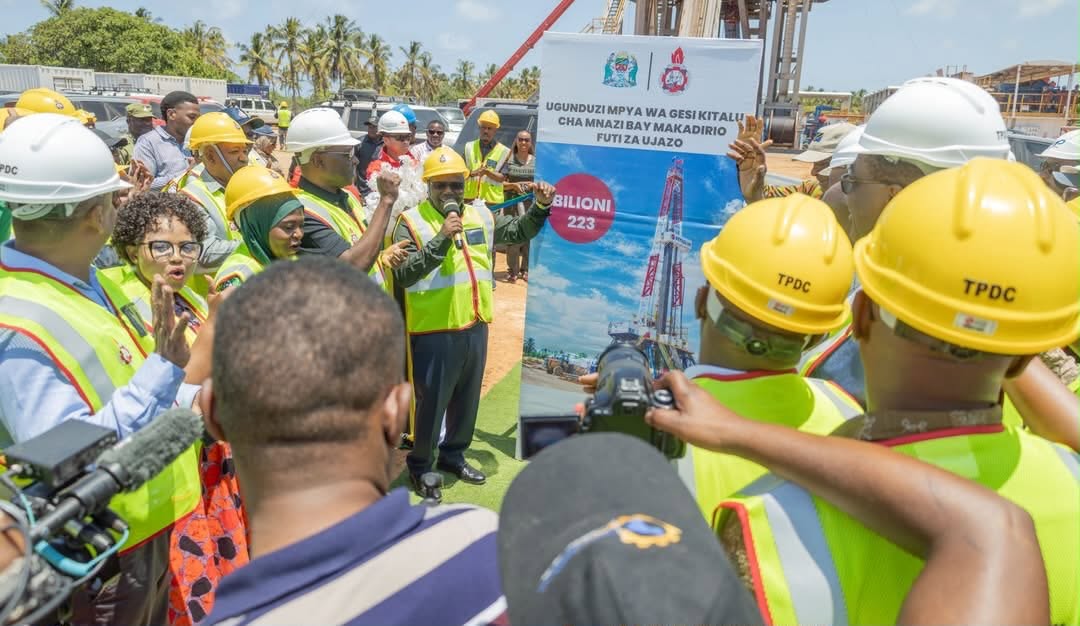

- Tanzania Announces 223 Billion-Cubic-Foot Gas Discovery at Mnazi Bay
Tanzania has announced its first natural gas discovery in more than a decade, identifying an estimated 223 billion cubic feet of gas at the Kasa-1X ST2 well in the country’s southern Mnazi Bay area.
The discovery could strengthen domestic energy security, support electricity generation and create new opportunities for industrial development. Its ultimate economic value, however, will depend on the volume of commercially recoverable gas, sustained well performance and Tanzania’s ability to expand infrastructure and demand.
The Kasa-1X ST2 well was drilled by state-owned Tanzania Petroleum Development Corporation in partnership with French oil and gas company Maurel & Prom.
The exploration well formed part of a three-well drilling campaign that included the MB-5 and MS-2 development wells. Energy Minister Juma Homera said the programme would increase gas availability as demand grows across Tanzania’s power, industrial and transport sectors.
Maurel & Prom has indicated that production from Kasa could begin as early as November 2026.
Although the government has announced an estimated discovery of 223 billion cubic feet, the figure should not yet be treated as a fully certified recoverable reserve.
Maurel & Prom earlier reported that Kasa-1X had confirmed a gas reservoir with encouraging characteristics and estimated approximately 200 billion cubic feet of gross gas volumes. That translates into about 120 billion cubic feet attributable to the company’s 60 per cent interest.
The company did not publicly classify the estimate as a proved reserve, contingent resource or gas initially in place. The difference between its approximately 200 billion-cubic-foot estimate and the government’s 223 billion-cubic-foot announcement has also not been fully explained.
The estimates should therefore be regarded as preliminary until appraisal work confirms the reservoir’s size, pressure, productivity and commercially recoverable volume.
This distinction matters because the presence of gas underground does not automatically mean that every cubic foot can be produced profitably. Reservoir characteristics, operating costs, infrastructure capacity and the availability of long-term buyers will determine the project’s commercial viability.
Nevertheless, the discovery is significant because it is located close to an established producing field and existing processing and pipeline infrastructure. That could allow development to proceed faster and at a lower cost than an isolated frontier discovery.
The Kasa well is expected to produce approximately 30 million cubic feet of gas daily for at least 10 years, according to the government. Maurel & Prom has provided a higher estimate of gross production potential, placing it at about 50 million cubic feet per day.
The variation reinforces the need for sustained production testing before firm conclusions are reached.
The two development wells drilled alongside Kasa are already improving output from Mnazi Bay. MB-5 and MS-2 have reportedly increased production by more than 65 million cubic feet per day, lifting current field output to approximately 130 million cubic feet daily.
Maurel & Prom estimates that the existing wells have combined production potential approaching 200 million cubic feet per day, although processing facilities have reportedly been tested at approximately 150 million cubic feet daily.
These figures show that Tanzania may need additional processing and transmission capacity if production rises towards the field’s full potential.
Increasing upstream output without expanding downstream infrastructure could create bottlenecks. Tanzania must therefore coordinate field development with investment in processing plants, transmission pipelines, distribution networks and storage.
More than 80 per cent of the gas produced at Mnazi Bay is used for electricity generation at Tanzania Electric Supply Company plants in Mtwara and Dar es Salaam.
Additional domestic gas could improve the reliability of electricity supply while reducing exposure to imported petroleum products and volatile international energy prices.
Natural gas also provides a useful complement to hydropower. During periods of drought, when water levels decline and hydroelectric production becomes constrained, gas-fired generation can help stabilise the power system.
However, relying too heavily on a single fuel presents its own risks. Tanzania will need a balanced energy mix incorporating gas, hydropower, solar, wind and other sources.
Gas can serve as a transition fuel and support industrialisation, but investment decisions must consider the global shift towards lower-carbon energy and the possibility that international financing for fossil-fuel projects will become more restrictive.
The strongest economic case for the discovery may therefore lie in using the gas domestically to improve power reliability, lower industrial costs and support productive activity.
Beyond electricity generation, Tanzania could use the gas to develop industries that create more value than the simple sale of raw energy.
Natural gas can support fertiliser, petrochemical, cement, steel, ceramics and food-processing industries. It can also provide cleaner fuel for commercial vehicles and public transportation through compressed natural gas systems.
The country has already encouraged the conversion of vehicles to dual-fuel systems, particularly in Dar es Salaam. Locally produced compressed natural gas could reduce fuel-import expenditure and provide motorists with a cheaper alternative to petrol and diesel.
TPDC is also negotiating with four investors interested in small-scale liquefied natural gas projects, three of which could be developed in Mtwara.
Small-scale LNG could allow gas to reach industrial consumers and communities located beyond the existing pipeline network. It may also support heavy transport, mining and commercial operations that cannot connect directly to fixed infrastructure.
Yet Tanzania must avoid building supply capacity without first securing reliable customers. Long-term gas-purchase agreements will be necessary to justify investment and provide predictable revenue.
Tanzania raised TPDC’s interest in the Mnazi Bay Block from 20 per cent to 40 per cent in 2024. Maurel & Prom retains a 60 per cent operating interest.
The larger state participation gives Tanzania greater exposure to project earnings and a stronger role in strategic decisions. It also increases the government’s financial and operational responsibilities.
The discovery could generate public revenue through taxes, production-sharing arrangements and TPDC’s direct participation. Local authorities in Mtwara may also benefit from employment, procurement and community investment.
The government said approximately 200 Tanzanians obtained work through local companies involved in the drilling programme, while 35 contracts valued at more than 20 billion Tanzanian shillings were awarded to domestic firms.
Local participation should extend beyond short-term construction and support services. Tanzania should use the development to train engineers, geoscientists, technicians and commercial specialists capable of assuming senior responsibilities across the gas value chain.
Before the new discovery, Tanzania’s gas resources were estimated at approximately 57.54 trillion cubic feet. Against that total, 223 billion cubic feet represents less than half of one per cent.
The discovery is therefore unlikely to transform the country’s overall resource position. Its importance lies instead in its location, proximity to established infrastructure and potential for rapid connection to domestic markets.
Most of Tanzania’s existing gas resources are found in deep offshore fields that require enormous investment and complex LNG infrastructure before they can be commercialised.
Progress on the country’s proposed large-scale LNG export project has been slow, reflecting negotiations over fiscal terms, investment conditions and project economics.
Kasa offers a different proposition. As an onshore discovery near an operating field, it may be developed more quickly and with lower capital requirements.
Tanzania’s first new gas discovery in more than 10 years is an encouraging development, but the announcement is only the beginning of the commercial process.
The government and project partners must complete appraisal, certify recoverable reserves and establish a credible development plan. Processing and pipeline capacity must be aligned with production, while buyers must be secured before significant new expenditure is committed.
Transparency will also be important. Publishing technical assessments, revenue arrangements, production volumes and local-content outcomes would help Tanzanians evaluate whether the resource is being managed effectively.
If developed carefully, the Mnazi Bay discovery could improve power reliability, lower industrial energy costs and generate additional government revenue.
Its success should ultimately be measured not by the volume announced at the wellhead, but by whether the gas delivers affordable energy, productive employment and lasting economic value for Tanzania.

