

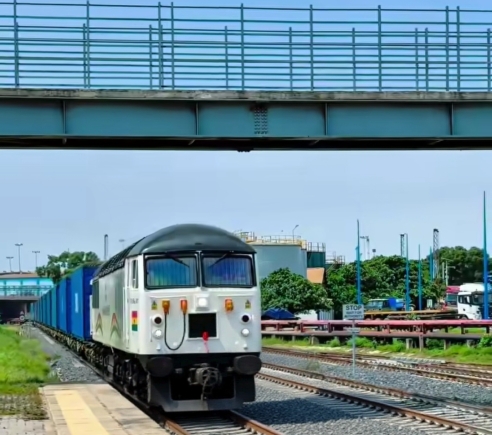

- Tema-Mpakadan Rail Freight Push Gets Boost with Two Locomotives, 20 Wagons
The Ministry of Transport has defended government’s acquisition of two diesel locomotives and 20 freight wagons, insisting the assets are technically fit for purpose and will support Ghana’s push to develop a structured rail freight business.
The response follows public criticism after videos of the newly acquired locomotives and wagons circulated on social media, with some commentators describing the equipment as old and outdated.
In a statement issued on Thursday, July 2, 2026, the Ministry dismissed the criticism as inaccurate and technically unfounded, arguing that locomotives are not assessed merely by age, but by structural integrity, refurbishment quality, reliability, maintainability, route compatibility, spare parts availability and commercial performance.
According to the Ministry, the two British Rail Class 56 locomotives underwent extensive refurbishment in the United Kingdom before being imported into Ghana. The refurbishment covered complete overhauls of the diesel engines, traction motors, electrical traction equipment, bogies and braking systems, as well as the installation of modern railway communication and safety systems.
The locomotives were also tested and certified before export and are backed by a five-year warranty against operational defects. With routine maintenance, the Ministry said, the locomotives are expected to remain operational for at least 15 years before requiring major overhauls.
The Ministry also rejected concerns over maintenance and spare parts availability, noting that Class 56 locomotives remain in active commercial freight service in the United Kingdom and Hungary.
It said the Ghana Railway Development Authority has secured supplier commitments to maintain a five-year stock of essential spare parts, while specialised engineers have begun training GRDA technicians and engineers to build local maintenance capacity.
The two freight locomotives and 20 container wagons were purchased for approximately US$3.18 million. The Ministry contrasted this with the previous administration’s procurement of two PESA Diesel Multiple Unit passenger trains for about US$14.67 million, but stressed that the two transactions should not be treated as like-for-like comparisons because they serve different purposes.
“While the PESA trains were designed for passenger transport, the newly acquired Class 56 locomotives are intended for heavy freight operations and the establishment of Ghana’s first structured container rail freight business,” the Ministry said.
The Ghana Railway Development Authority took delivery of the two locomotives and 20 freight wagons in June, 11 days ahead of schedule, with preparations underway for technical commissioning, driver evaluations and final fit-to-run assessments before the equipment enters service on the railway network.
The Ministry also dismissed claims that the Tema-Mpakadan railway lacks cargo handling equipment. It said GRDA already has two reach stackers and five heavy-duty forklift machines to load and offload containers, while plans are underway to procure two gantry cranes to strengthen long-term terminal operations.
On commercial viability, the Ministry said freight demand along the Tema-Mpakadan corridor had been established through feasibility studies conducted before the railway was constructed.
It disclosed that GRDA is finalising commercial off-take agreements, one of which is expected to generate approximately US$3.5 million in annual revenue.
Based on projected earnings, the Ministry estimated that revenue from freight operations would allow the investment in the locomotives and wagons to be recovered within two years, while providing several more years of productive service.
The Tema-Mpakadan rail corridor is designed to provide a safer and more efficient transport link for cargo operators serving northern Ghana. A major component of the project is the development of a container terminal at Mpakadan in the Asuogyaman District to integrate rail and lake transport, creating a logistics corridor from Tema Port to northern Ghana through the Volta Lake.
The Ministry said the new freight assets would help reduce logistics costs, ease pressure on Ghana’s roads, support industrialisation and generate sustainable revenue.
It also linked the acquisition to government’s broader vision of positioning rail transport as a key pillar of the 24-hour economy.
The latest defence of the locomotive deal underscores the sensitivity around Ghana’s rail modernisation agenda, particularly at a time when the country is seeking to reduce overdependence on road haulage and strengthen multimodal transport infrastructure.

