


- Ten Mini Stadia Planned as Government Expands Original Six-Region Commitment – Kofi Adams
President John Dramani Mahama has expanded his plan to construct mini stadia across Ghana from six facilities to 10, according to Minister for Sports and Recreation Kofi Adams.
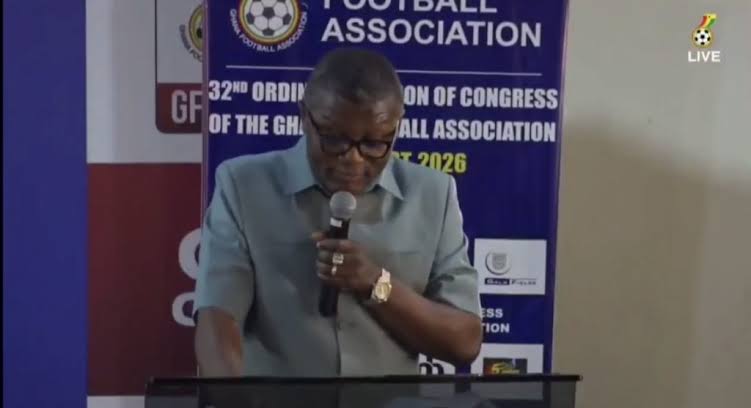
Mr Adams disclosed the revised target while addressing the 32nd Ghana Football Association Ordinary Congress at the Ghanaman Soccer Centre of Excellence in Prampram, where he also called for stronger structures across Ghana football, particularly the domestic league.
The original commitment was to construct six mini stadia in the six regions created in 2019. Mr Adams said the President had since reviewed that plan and increased the number of facilities.
“His Excellency the President [John Mahama], during his campaign, promised to build six mini stadia for the six new regions,” Mr Adams said.
“I dare tell you that his Excellency has since reviewed that decision and he’s no more going to build the six mini stadiums. He’s going to build 10.”
The expansion would broaden the infrastructure programme beyond the six newer regions — Western North, Oti, Ahafo, Bono East, Savannah and North East — and extend facilities to additional parts of the country.
“So the Western North region will have one, Oti Region will have one, Ahafo [Region] will have one, Bono-East [Region] will have one, Savannah [Region] will have one, North East [Region] will have one, these are the new regions,” Mr Adams said.
He added that the Upper East, Upper West and Volta regions would also receive facilities.
“Upper East [Region] will have one, Upper West [Region] will have one and then Volta Region will have another one making 10 [stadia],” he said.
The announcement reflects a wider government effort to improve access to sports infrastructure outside Ghana’s largest cities, where the shortage and poor condition of facilities have remained persistent concerns for football administrators and local sporting communities.
For football development, the importance of mini stadia extends beyond hosting competitive matches.
Smaller regional facilities can provide training grounds for clubs, youth academies and school competitions while creating venues capable of supporting women’s football, lower-division leagues and community sporting programmes.
The policy could therefore become particularly important for the Ghana Football Association if the facilities are developed to consistent technical standards and accompanied by sustainable maintenance arrangements.
Ghana’s domestic football system has long faced an infrastructure problem in which a relatively small number of major venues carry a disproportionately large share of competitive fixtures.
That can create pressure on playing surfaces and limit scheduling flexibility, while clubs in areas without suitable venues may be required to travel considerable distances or use facilities that fall below desired standards.
Increasing the number of smaller stadia could help ease some of those constraints.
But the scale-up from six to 10 will also raise questions about financing, construction timelines and maintenance.
Sports infrastructure projects can impose significant recurrent costs after construction, meaning the long-term value of the programme will depend not only on completing the facilities but ensuring they remain usable.
The choice of location will similarly matter. Mini stadia can have a larger developmental impact when situated within communities that already have active football structures, schools, clubs and sufficient demand for the facilities.
They can also support local economic activity by attracting matches and events that generate business for transport operators, food vendors and other small enterprises.
Mr Adams’ announcement at the GFA Congress therefore carries significance beyond the numerical increase in planned facilities.
It places infrastructure at the centre of the government’s attempt to strengthen Ghana’s sporting ecosystem.
Moving from six proposed mini stadia to 10 represents a more ambitious commitment, but its contribution to Ghana football will ultimately depend on whether the facilities are delivered, properly equipped and maintained well enough to support competitive and grassroots sport over the long term.

