

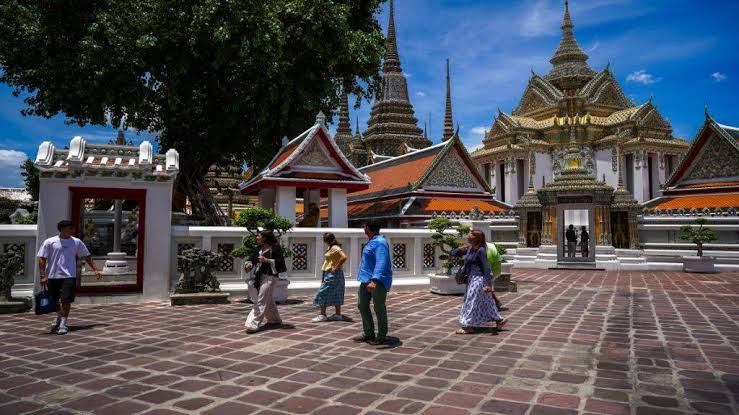

- Thailand Cuts Visa-Free Stays as Bangkok Tightens Access to World’s Most Visited City
Thailand has tightened visa-free entry rules for travellers from some of its biggest tourism markets, cutting permitted stays for citizens of the United States, Canada, the United Kingdom, Australia and South Africa while removing Morocco from its exemption list altogether.
The measures took effect on September 15, 2026, replacing the broader 60-day visa-free regime introduced in 2024 for 93 countries and territories. The overhaul comes as Bangkok remains the world’s most visited city by international arrivals, receiving 30.3m visitors in 2025.
Under the new framework, passport holders from 60 countries and territories can enter Thailand without a visa for tourism for up to 30 days, half the previous allowance for many nationalities.
Travellers from the US, UK, Australia and Canada retain visa-free access but now receive only 30 days instead of 60, while South Africans face the same reduction. The changes mark a significant reversal from Thailand’s post-pandemic strategy of liberalising entry requirements to accelerate tourism recovery.
Thailand’s Ministry of Foreign Affairs said the revised arrangements take account of national security, tourism, economic interests and reciprocity with other countries. Authorities also want to reduce overlapping visa privileges and encourage greater use of the country’s expanded electronic visa system.
The tightening follows concerns that longer visa-free stays were being used for purposes unrelated to tourism, including illegal employment and commercial activity.
Officials have also linked the policy rethink to enforcement concerns surrounding foreign visitors who breach local laws or misuse tourist status. Earlier this year, authorities ordered a nationwide crackdown on foreigners involved in unlawful activity, warning that visa cancellation and deportation could follow serious violations.
Thailand is therefore attempting to preserve its attractiveness as one of the world’s largest tourism destinations while placing tighter limits on how long visitors can remain without additional immigration scrutiny.
African travellers face particularly uneven outcomes under the new system. South Africans remain visa-exempt for 30 days, while Mauritius has been moved to a 15-day visa-free arrangement, alongside Seychelles. Morocco faces the sharpest change, becoming one of 21 countries whose nationals must now obtain a visa before travelling to Thailand, after previously benefiting from the 60-day exemption.
The changes are significant because Africa had only limited representation in Thailand’s previous visa-free regime. South Africa, Mauritius and Morocco were the only African countries among the 93 territories covered by the earlier 60-day arrangement, meaning the new rules effectively tighten access across each of the African markets previously enjoying the most generous entry terms.
For travellers, the impact ranges from shorter holiday or business stays to the additional administrative and financial burden of applying for a visa before departure
Thailand has also sharply narrowed its Visa on Arrival programme. Only citizens of Azerbaijan, Belarus and Serbia now qualify for the 15-day facility, down from 31 countries and territories under the previous regime.
The reduction suggests Bangkok is moving away from a broadly permissive entry model towards one that differentiates more aggressively among nationalities according to security, economic and reciprocal considerations.
The policy shift comes at a delicate moment for Thailand’s tourism economy. Bangkok attracted 30.3m international visitors in 2025, placing it ahead of Hong Kong, London and Macau according to Euromonitor International data and reinforcing Thailand’s position as one of Asia’s most important travel markets.
International arrivals across Asia-Pacific rose 10.00% last year, the strongest increase among global regions, while the Middle East and Africa recorded growth of 7.00%.
That strong rebound partly reflects the very visa liberalisation Thailand is now scaling back. Easier entry, improved infrastructure and a succession of cultural and sporting events helped drive tourism flows higher across the region, making border policy an increasingly important tool in the competition for visitors and tourism spending.
Thailand’s challenge is therefore to tighten enforcement without undermining the accessibility that helped Bangkok become the world’s leading destination by international arrivals.
For travellers from markets such as the US, Canada and South Africa, the practical impact may be manageable for conventional holidays, which often last less than a month. But the changes will matter more for long-stay tourists, remote workers, retirees and repeat visitors who had become accustomed to using the 60-day exemption without arranging a visa in advance.
Those groups will now need to shorten visits, seek extensions where permitted or move onto alternative visa categories if they want to remain longer.
The broader economic question is whether tighter entry conditions will materially affect spending. Long-stay visitors often contribute disproportionately to accommodation, food, transport and local services because they remain in the country for longer periods, making them economically valuable even if their numbers are smaller than short-stay tourists.
Thailand appears to be betting that the security and regulatory advantages of greater control outweigh the risk of losing part of that spending.
Bangkok’s global popularity gives the government more room to make that calculation than many competing destinations. With tens of millions of visitors arriving each year, Thailand can tighten conditions without necessarily surrendering its status as a tourism powerhouse, particularly if demand remains strong from Asia and other short-haul markets.
But the decision still represents an important shift in emphasis: from maximising ease of access after the pandemic to managing the consequences of that openness more carefully.
For African travellers, the new framework also highlights how quickly visa privileges can change when destination countries reassess security, reciprocity and economic priorities. South Africa retains relatively favourable access, Mauritius keeps a shorter exemption and Morocco loses visa-free entry entirely, illustrating the differentiated treatment increasingly built into global mobility regimes.
Thailand’s latest rules therefore offer a reminder that even the world’s most visited destinations are willing to sacrifice some convenience at the border when governments conclude that tourism growth must be balanced against tighter immigration control.

