

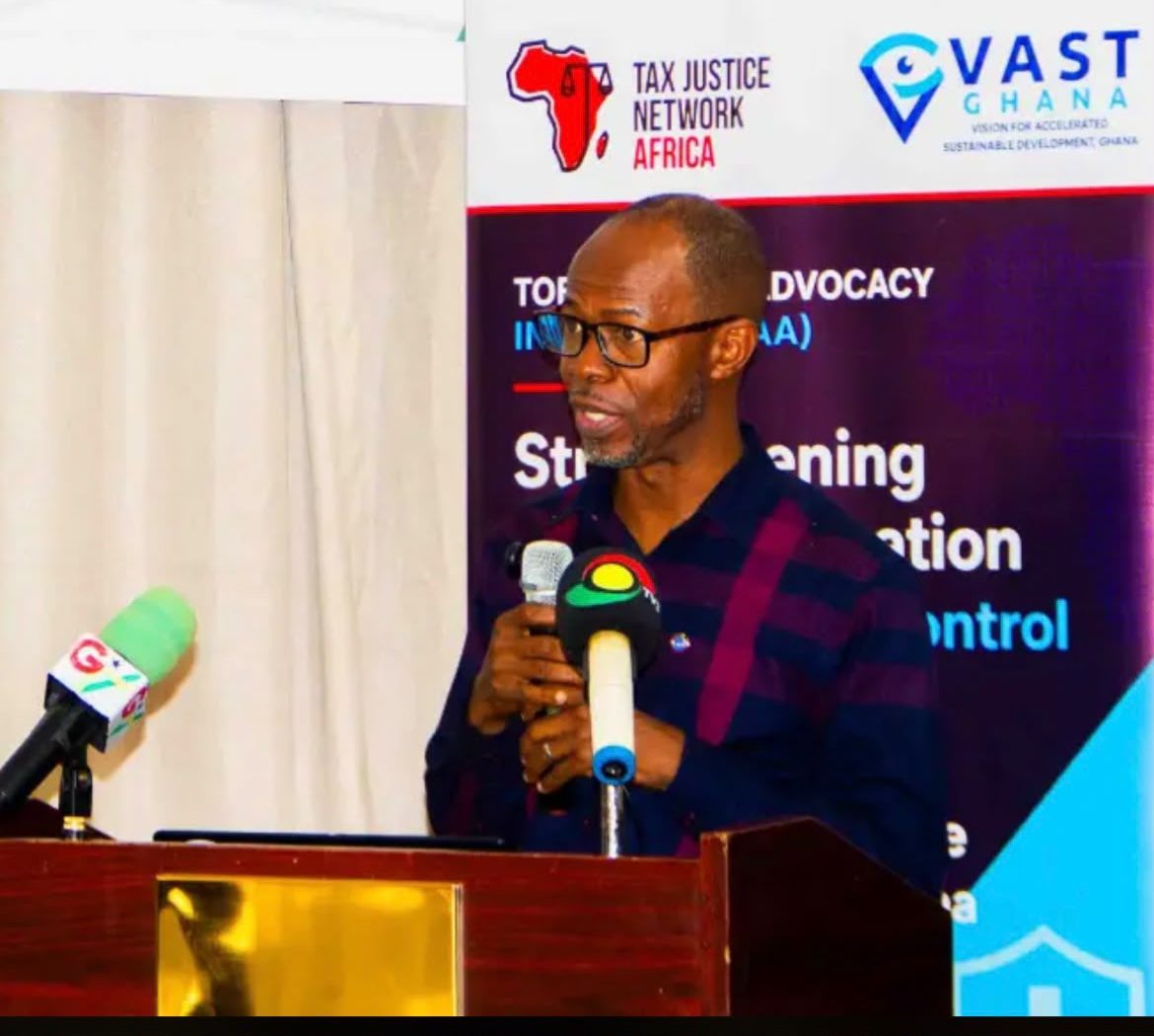

- Tobacco Tax Policy Must Follow Health Burden, Not Revenue Alone — Labram Musah
Ghana must judge the effectiveness of tobacco taxation not simply by the GH¢713.1m collected in 2025, but by whether higher prices reduce consumption among the groups most exposed to tobacco-related disease and economic hardship, according to Vision for Accelerated Sustainable Development Ghana.
Labram Musah, Executive Director of VAST Ghana, said gender, income, geography and access to healthcare should be built directly into the design and evaluation of tobacco taxes.
Speaking at a stakeholder dialogue in Accra on incorporating gender responsiveness into Ghana’s tobacco fiscal policies, Mr Musah argued that national consumption and revenue figures could conceal significant differences in who uses tobacco, who is able to quit and who bears the cost of related illness.
“Our discussion today goes beyond the simple question of whether people smoke, chew or otherwise use tobacco products,” he said.
“It is also about who uses tobacco, who is most vulnerable, who bears the health and economic consequences, and whether our policies adequately respond to these differences.”
The intervention comes as Ghana increasingly uses excise taxation both to mobilise public revenue and to discourage consumption of products associated with non-communicable diseases.
Figures presented by the Ghana Revenue Authority at a separate VAST Ghana engagement showed that tobacco taxes generated GH¢713.1mn in 2025.
That amount demonstrates the fiscal significance of the sector. But a tobacco tax that raises substantial revenue without materially reducing initiation or increasing cessation may be financially productive while falling short of its principal public-health objective.
The critical question is therefore what happened after prices increased.
Did fewer young people begin using tobacco? Did existing consumers reduce consumption or quit? Did low-income users move towards cheaper or illicit products? And did the communities bearing the greatest health burden receive a corresponding share of prevention and treatment resources?
An analysis of Ghana’s 2022 Demographic and Health Survey found a significant difference in tobacco use between men and women.
Smoking prevalence stood at 4.7 per cent among men, compared with 1 per cent among women. Smokeless tobacco use was estimated at 1.6 per cent for men and 0.08 per cent for women.
The research also found variations associated with education, income and geography.
These differences mean that a uniform increase in tobacco taxation may produce unequal behavioural and welfare outcomes.
Men may experience a larger direct impact because their consumption rates are higher. Women who do not personally use tobacco may nevertheless face exposure to second-hand smoke or assume caregiving and household financial responsibilities when relatives develop tobacco-related illnesses.
A household’s economic burden can therefore extend beyond the individual buying the product.
“Who uses tobacco products? Who is most exposed to tobacco smoke? Who can afford these products? Who is able to quit? And who experiences tobacco-related illnesses the more?” Mr Musah asked.
“And who carries the economic and caregiving consequences of tobacco-related illnesses?”
Those questions challenge policymakers to look beyond the formal taxpayer.
A tobacco user pays the excise duty at the point of purchase, but the cost of consumption may later be shared by spouses, children, employers and the public health system through medical bills, lost income and unpaid care.
Effective tobacco taxation should make tobacco products less affordable, discourage initiation and encourage existing users to quit.
It should also generate resources that can support health programmes during the period in which consumption and tobacco-related disease remain significant.
“The question before us, therefore, is whether Ghana is designing and implementing its tobacco-control and fiscal policies in ways that adequately recognise differences in exposure, affordability, consumption and vulnerability among different population groups,” Mr Musah said.
A headline tax rate provides only part of the answer.
Policymakers need to measure the retail price of tobacco products against household income, because affordability determines behaviour more directly than the nominal tax rate.
They must also examine whether consumers substitute cigarettes with cheaper brands, smokeless tobacco or illicit products after tax increases.
If higher taxes cause affluent consumers to quit while poorer users migrate towards cheaper and potentially more harmful alternatives, the policy could widen health inequality even as aggregate consumption falls.
Tax design must therefore work alongside enforcement. Ghana needs effective product tracking, stronger border controls and market surveillance to prevent illicit tobacco from weakening both the health objective and the revenue base.
The deeper fiscal issue is whether tobacco-tax proceeds are visibly connected to the public costs created by tobacco use.
Previous estimates in Ghana’s tobacco-control investment case found that tobacco consumption imposes economic costs through healthcare expenditure, disability, premature deaths and lost productivity.
The burden is not distributed evenly. Communities with limited access to screening, cessation services and specialised treatment may experience worse outcomes even when their consumption levels are similar.
A gender-responsive approach would require disaggregated data showing consumption patterns, exposure, cessation, disease and financial consequences across sex, income, age and location.
Without such information, government may know how much tax it has collected but remain unable to determine whether the policy is reducing harm equitably.
Mr Musah warned that gender should not be introduced only after the main fiscal decisions have been made.
“Gender cannot be treated as an additional issue that is considered after developing tobacco policy,” he said. “It needs to be part of how we frame the problem, how we design the responses.”
That would require closer coordination among the Ministry of Finance, Ghana Revenue Authority, Ministry of Health, Food and Drugs Authority, National Development Planning Commission and institutions responsible for gender and social protection.
Ghana already has a broader policy framework for gender-responsive planning and budgeting. The NDPC published a toolkit in 2026 for incorporating gender into planning, budgeting, monitoring and evaluation.
The challenge is to apply that framework to tobacco-tax design, enforcement and the allocation of resulting revenues.
Gender-responsive tobacco taxation does not necessarily mean imposing different tax rates on men and women.
Rather, it means assessing how one tax affects different groups and designing complementary interventions to address those differences.
Revenue could support cessation services targeted at groups with higher usage, public education for young people, protection against second-hand smoke and treatment for communities carrying disproportionate disease burdens.
The government should also publish regular assessments of how tobacco taxes affect affordability, consumption and illicit trade, rather than treating annual revenue as the principal measure of success.
“Our objective is not to discuss gender per se,” Mr Musah said. “Our objective is determining how gender can be incorporated into the actual policies and laws.”
For Ghana, the next phase of tobacco-tax reform is therefore not only about whether excise duties should increase.
It is about who changes behaviour when prices rise, who moves to cheaper products, who successfully quits and who continues to pay through illness, lost income and caregiving.
The GH¢713.1mn collected in 2025 is an important fiscal result. The more consequential measure is whether that revenue accompanies a decline in tobacco use and whether the health gains reach the people facing the greatest risk.

