

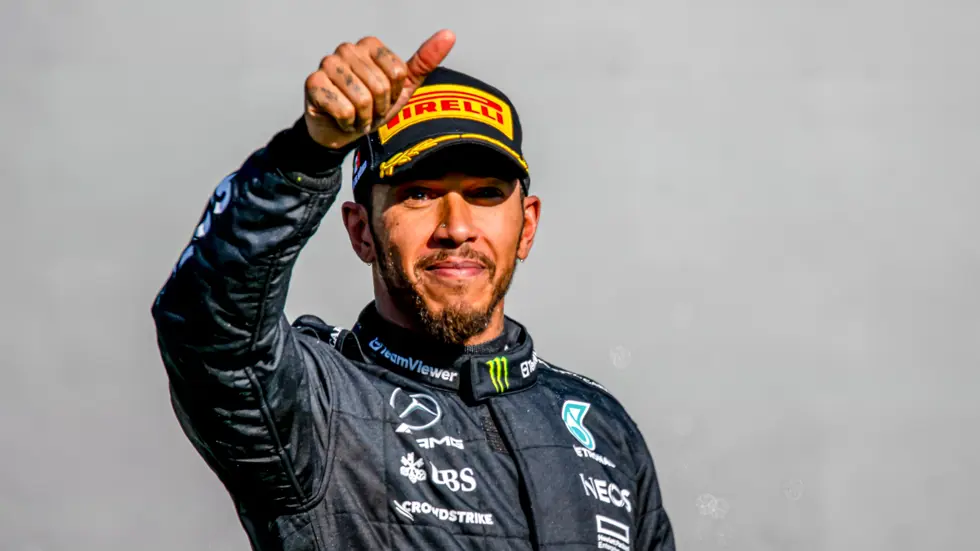

- Hamilton Rejects Ferrari Personnel Shake-Up Claims Ahead of Azerbaijan GP
Lewis Hamilton has rejected reports that he asked Ferrari to make personnel changes, moving to calm speculation over tensions inside the team ahead of the Azerbaijan Grand Prix after a difficult run of races weakened his Formula One title challenge.
Italian media reports this week claimed the seven-time world champion had been pushing Ferrari team principal Frederic Vasseur to make operational changes following disappointing weekends at Monza and Madrid.
Hamilton responded publicly on Thursday, insisting that he had not asked for members of his team to be replaced.
“I’ve never asked for anyone on my team to be replaced,” Hamilton wrote on social media, adding that Ferrari staff continued to work hard and that his intention was to support and strengthen the people around him rather than seek personnel changes.
The clarification comes at a sensitive point in Ferrari’s season.
Hamilton has scored only eight points across the past two rounds and now sits 101 points behind Mercedes driver Kimi Antonelli in the drivers’ championship with nine rounds remaining.
Ferrari introduced an upgraded engine at its home Italian Grand Prix at Monza, hoping to close the performance gap to Mercedes and mount a stronger challenge in the final part of the season. Hamilton, however, could manage only sixth place, while team-mate Charles Leclerc failed to finish.
Hamilton’s frustration at Monza was compounded by an opening-lap incident involving Leclerc.
The British driver was forced onto the gravel after the two Ferrari cars made contact, costing him several positions and prompting him afterwards to question whether the team had sufficiently clear rules governing how its drivers should race one another.
Hamilton said the responsibility for establishing those rules ultimately rested with Vasseur, while Leclerc later accepted responsibility for the incident after discussions involving both drivers and senior Ferrari management.
That episode followed earlier tensions at the Dutch Grand Prix, where Hamilton criticised Ferrari’s race execution after the team hesitated to move Leclerc aside while the pair were running different strategies.
Hamilton subsequently acknowledged that his radio messages and post-race comments reflected frustration and said he had not shown “the best version” of himself.
The distinction between criticism of Ferrari’s operational decisions and demands for personnel changes is therefore important.
Hamilton has publicly questioned aspects of strategy, race management and driver protocols in recent weeks, but his latest intervention directly rejects the suggestion that he has attempted to have individual team members replaced.
The pressure has been intensified by Ferrari’s competitive position.
Hamilton retired from the Spanish Grand Prix in Madrid with a brake problem, his first retirement of the season, after qualifying fourth. The result left him more than 100 points behind Antonelli and effectively ended realistic hopes of fighting for a record eighth drivers’ championship.
Speaking after Madrid, Hamilton conceded that Mercedes and Antonelli had established an advantage that would be extremely difficult to overturn.
“I think there’s no stopping him and Mercedes this year,” Hamilton said of Antonelli, who has won eight of the opening 14 races.
Mercedes also holds a substantial lead over Ferrari in the constructors’ championship, increasing scrutiny on whether the Italian team’s upgrades and operational changes are delivering sufficient improvement.
The challenge for Ferrari is therefore no longer simply technical.
Hamilton’s recent comments have brought attention to how efficiently the team executes strategy, manages two high-profile drivers and converts car performance into results under pressure.
At Zandvoort, Hamilton openly compared Ferrari’s hesitation over team orders with the speed at which Mercedes executed a similar instruction between its drivers. At Monza, he questioned internal racing protocols. In Madrid, reliability ended his race prematurely.
Those incidents have helped create an environment in which reports of deeper internal disagreements have gained traction.
Hamilton’s public denial is consequently an attempt to draw a line between legitimate competitive frustration and claims that he is seeking organisational upheaval.
His message also places responsibility on Ferrari’s existing structure to solve the problems.
The team has continued to develop its car, including the power-unit upgrade introduced at Monza, but Mercedes’ advantage suggests Ferrari requires more than incremental technical gains if it is to challenge consistently at the front.
The Azerbaijan Grand Prix, scheduled for September 24-26, begins a three-race sequence and will be held on a Saturday, giving Ferrari an opportunity to reset after two difficult weekends.
For Hamilton, the immediate priority will be restoring performance and avoiding further operational controversy as the championship moves deeper into its final phase.
The latest statement may settle one question: Hamilton says he has not asked Ferrari to remove members of his team.
It does not, however, remove the broader pressure surrounding the Scuderia.
Ferrari still has to improve race execution, clarify how its two drivers are managed and close a substantial competitive gap to Mercedes. For Hamilton, the challenge is equally clear: translate criticism into better results and ensure that frustration over Ferrari’s shortcomings does not become a defining feature of the remainder of his 2026 season.

