


- IPEC Transition Must Balance Fair Pay with Fiscal Sustainability — Pelpuo
Ghana’s planned transition to an Independent Public Emoluments Commission is emerging as more than an institutional restructuring of the country’s wage-setting machinery, with the government seeking to use the reform to address longstanding tensions between fair remuneration, public-sector productivity and the affordability of the national wage bill.
Minister for Labour, Jobs and Employment Dr Rashid Pelpuo has placed social dialogue at the centre of that transition, arguing that consultation, fairness and consensus will be critical if the proposed commission is to command the confidence of workers and public institutions.
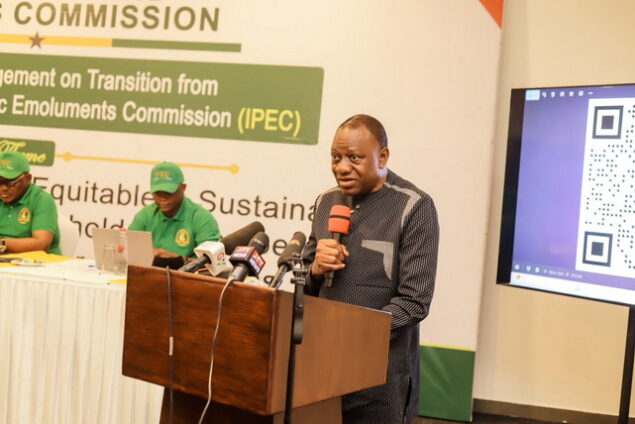
Speaking at the opening of a two-day stakeholder engagement between the Fair Wages and Salaries Commission and Organised Labour in Accra, he described the reform as part of a broader attempt to reshape Ghana’s compensation architecture.
“We are transitioning to create a society different from what we have known, and one that addresses the challenges we have confronted for years,” Dr Pelpuo said.
His emphasis on consultation is significant because public-sector compensation remains one of Ghana’s most politically sensitive areas of economic management, sitting at the intersection of workers’ living standards, government expenditure, labour productivity and fiscal sustainability.
For government, the creation of IPEC offers both an opportunity and a considerable policy risk. A credible independent institution could bring greater consistency, transparency and predictability to remuneration decisions, but without sufficient confidence from workers and unions, the reform could simply transfer longstanding disagreements over salaries, allowances and market premiums from one institution to another.
Dr Pelpuo said the engagement with Organised Labour reflected government’s commitment to transparency, inclusiveness and consensus-building before the new system becomes fully operational.
That approach recognises that public-sector compensation cannot be treated merely as the monthly payment of salaries and allowances because wage decisions also influence household consumption, morale, employee retention, productivity and the government’s wider fiscal position.
The challenge is particularly difficult because Ghana’s compensation structure has accumulated disparities across institutions and categories of workers. Differences in allowances, market premiums and conditions of service have repeatedly become sources of disagreement, creating demand for a framework perceived to be more equitable while remaining financially sustainable.
An independent commission could potentially create greater insulation from short-term political pressures and establish clearer principles for determining remuneration. Independence by itself, however, will not resolve those tensions unless it is backed by transparent methodology, credible economic and labour-market data and a process in which workers believe their concerns are genuinely represented.
That explains why dialogue has become central to the proposed transition. Public-sector pay reform can create winners and losers, particularly where government seeks to rationalise allowances, address historical distortions or introduce stronger links between remuneration and productivity, making broad consultation essential to the political and industrial sustainability of the reforms.
The fiscal dimension is equally important because compensation represents a substantial component of recurrent public spending. Wage settlements therefore affect the amount of fiscal space available for infrastructure, healthcare, education and other priorities, requiring government to reconcile workers’ demands for improved real incomes with the revenue available to finance those commitments.
Dr Pelpuo has stressed that remuneration extends beyond salaries and allowances because it affects livelihoods, workplace fairness, productivity and the wider health of the economy. That relationship becomes particularly sensitive during periods of changing inflation, when employees seek wage adjustments that preserve purchasing power while government attempts to prevent compensation growth from undermining broader fiscal objectives.
IPEC could provide a mechanism for managing that tension if its mandate is supported by clearly defined rules. Rather than allowing negotiations to become predominantly reactive, the commission could encourage a more structured approach that considers inflation, productivity, fiscal capacity, labour-market conditions and differences in skills and responsibilities when compensation decisions are made.
Such a framework would also force Ghana to confront the difficult relationship between remuneration and productivity. Higher pay without corresponding improvements in efficiency can increase fiscal costs without necessarily improving public services, while persistent wage compression and perceived inequities can damage morale, encourage skilled employees to leave the public sector and weaken institutional performance.
The challenge for IPEC will therefore be to shift the debate from how much public workers should be paid towards how the compensation system can support a more productive and efficient state. That will require credible mechanisms for measuring performance without reducing complex public-service roles to simplistic productivity indicators.
The transition could also strengthen collective bargaining if workers and government have access to a common set of economic assumptions and transparent compensation principles. Ghana has periodically experienced industrial disputes over salaries, allowances, market premiums and conditions of service, and a more predictable framework could reduce the frequency with which disagreements escalate into strikes.
Institutional independence will, however, need to be demonstrated in practice rather than simply written into law. Organised Labour will want assurance that IPEC does not become a mechanism for imposing fiscal ceilings without meaningful negotiation, while government will need safeguards against compensation commitments that exceed the state’s capacity to finance them sustainably.
The emerging emphasis on dialogue is therefore an important starting point. If properly designed, IPEC could provide Ghana with a more coherent mechanism for balancing fairness, productivity and affordability while improving the predictability of wage expenditure and reducing some of the distortions that have complicated public-sector compensation for years.
The deeper test will come when the commission begins confronting competing claims for higher remuneration against finite fiscal resources. Ghana’s public-sector pay challenge has never been solely about determining salaries; it is ultimately about how the state values labour, rewards productivity and allocates limited public resources.
IPEC offers an opportunity to redesign that relationship, but its credibility will depend less on the creation of another institution than on whether government and workers can build the transparent, evidence-based and trusted system of dialogue that Dr Pelpuo says must underpin it.

