

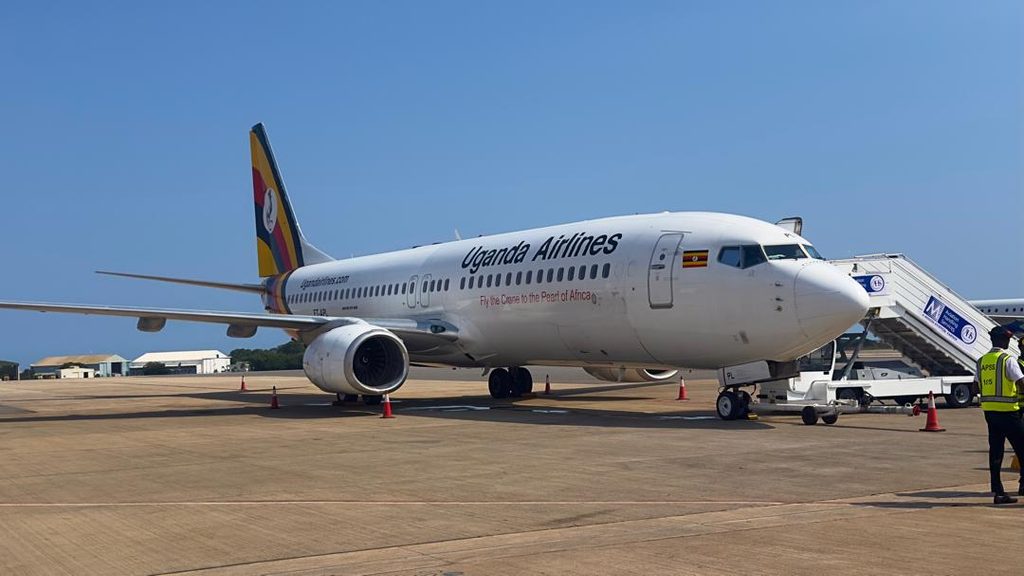

- Uganda Airlines Begins Accra Flights, Deepening Air Links Between East and West Africa
Uganda Airlines has commenced scheduled commercial flights to Accra, expanding passenger connectivity between East and West Africa and creating a new aviation bridge for trade, tourism and investment.
The Ugandan national carrier began operating the service on October 27, 2026, with four weekly flights connecting Entebbe, Lagos and Accra. The route introduces an additional travel option for passengers moving between the two regions and could intensify competition among airlines operating within the African market.
The service is commercially significant because poor intra-African air connectivity continues to increase travel times and costs for businesses and tourists. In some cases, passengers travelling between African cities must connect through hubs outside the continent, adding hours to journeys that are geographically shorter.
Uganda Airlines’ new service will not eliminate the wider connectivity problem, but it provides another route linking important markets in East and West Africa. The inclusion of Lagos could also strengthen the commercial viability of the operation by combining demand from Ghana, Nigeria and Uganda.
The route’s success, however, will depend on more than its launch ceremony. Passenger volumes, competitive fares, convenient schedules and reliable operations will determine whether the service can be sustained over the long term.
Yvonne Nana Afriyie Opare, Managing Director of the Ghana Airports Company Limited, described the airline’s arrival as a milestone in the relationship between Ghana and Uganda.
She said the service would expand passenger options while supporting tourism, cultural exchanges, trade and wider economic cooperation between the two countries.
For Ghana, the entry of another African carrier reinforces Accra’s role as an aviation gateway. Ghana’s geographical position, political stability and international connections provide a foundation for serving passengers travelling within West Africa and between the continent and other regions.
But becoming a genuine aviation hub requires more than attracting additional airlines. The country must ensure that airport charges, ground-handling services, passenger processing and transfer arrangements remain competitive.
Travellers choosing a connecting airport are influenced by convenience, price, reliability and the quality of the overall experience. Airlines also assess operating costs, fuel availability, airport efficiency and the potential for connecting traffic before committing additional aircraft and frequencies.
The arrival of Uganda Airlines therefore creates an opportunity for Ghana to demonstrate that Accra can function as an efficient connection point, rather than merely a destination.
The new service may also strengthen bilateral commerce. Ghanaian and Ugandan businesses operate within different regional economic ecosystems, and improved air access could make it easier for investors, executives and entrepreneurs to explore opportunities in both markets.
Air connectivity does not create trade automatically, but it removes one of the practical barriers that can discourage commercial engagement. Frequent services reduce travel uncertainty, make business visits easier and support faster movement of time-sensitive goods.
Cargo could become an important part of the route’s economics. Agricultural products, pharmaceuticals, documents, small manufactured goods and other high-value consignments often depend on air transport. The ability to carry cargo alongside passengers could broaden the commercial contribution of the service.
However, businesses will need information about available cargo capacity, pricing, handling arrangements and delivery timelines. Aviation authorities, trade-promotion institutions and private-sector groups could work with Uganda Airlines to identify products capable of moving profitably along the route.
Tourism provides another potential source of demand. Ghana and Uganda offer different cultural, historical and natural attractions, giving travellers reasons to move in both directions.
Uganda’s tourism proposition includes wildlife and natural experiences, while Ghana can draw visitors through its heritage, cultural events and position as a gateway to West Africa. Easier access could encourage tour operators to develop packages combining destinations across the two regions.
The service could also support conference travel, education and cultural exchanges. Yet these benefits will depend on active promotion. Opening an air route is only the first step; tourism boards and industry operators must translate the additional capacity into marketable travel products.
Uganda Airlines Chief Executive Girma Wake said the carrier’s operations in Ghana would make travel between East and West Africa more accessible and support stronger commercial relationships among markets along the route.
The four-times-weekly schedule offers passengers a reasonable level of flexibility, although demand patterns will determine whether the airline eventually increases or adjusts its frequency.
Competitive pricing will be crucial. African air travel is often considered expensive because of fuel costs, taxes, airport charges, limited competition and the operational complexity of serving multiple jurisdictions.
If Uganda Airlines can offer fares that are attractive without undermining the route’s financial sustainability, its presence could put pressure on competing carriers to improve prices and services.
Transport Minister Joseph Bukari Nikpe said the government remained committed to investing in aviation infrastructure to improve Ghana’s competitiveness and strengthen its position as a preferred international destination.
Infrastructure investment must nevertheless be matched by aviation policy reform. Airports can be modern and still struggle to attract traffic if operating costs are high or administrative procedures remain cumbersome.
Ghana must therefore treat Uganda Airlines’ entry as part of a broader regional connectivity strategy. The objective should be to attract routes that improve access to underserved African markets while supporting sustainable airline operations.
For Uganda Airlines, Accra expands its regional footprint and provides access to a commercially important West African destination. For Ghana, the route brings additional passenger capacity and strengthens its links with East Africa.
The larger test will be whether the service produces measurable increases in passenger movement, cargo volumes, tourism and business activity.
If those gains materialise, the route could become an example of how African carriers can connect the continent more directly. If demand remains weak or operating costs prove excessive, it could struggle like many intra-African routes before it.
The first flight is therefore important, but continuity will matter more. Africa’s connectivity gap will be closed not by ceremonial launches, but by reliable routes that passengers and businesses can afford to use repeatedly.

