

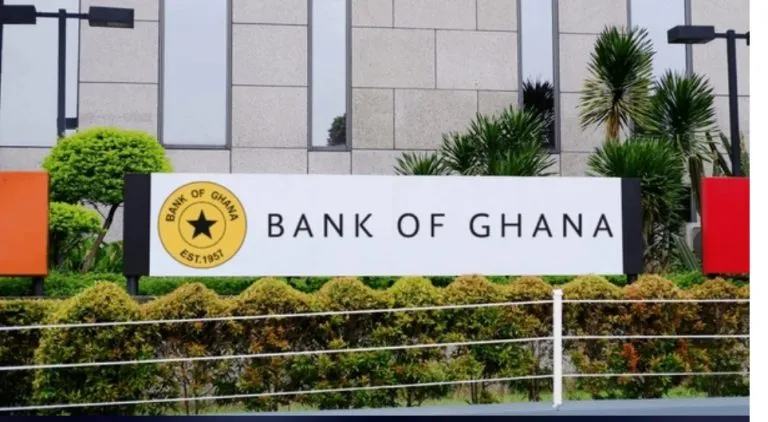

- 14-Day BoG Bill Auction Absorbs GH¢13.79bn at 10.50% Interest Rate
The Bank of Ghana has withdrawn GH¢13.79 billion from the financial system through its latest 14-day bill auction, maintaining the short-term instrument’s interest rate at 10.50% as the central bank continues active liquidity management alongside its broader monetary policy framework.
Results of Tender 873, held on August 3, 2026, show that the Bank sold GH¢13,792.19 million in 14-day securities, representing one of its principal mechanisms for absorbing excess liquidity from commercial banks and other eligible market participants.
The bills were allotted at a weighted average discount rate of 10.46%, translating into an annualised interest rate of 10.50%.
The Bank received bids within a narrow range of 10.46%, with the same rate allotted in full, indicating that pricing was effectively uniform across the auction.
The GH¢13.79 billion mop-up is significant because Bank of Ghana bills are primarily monetary policy instruments rather than conventional government borrowing securities.
Unlike Treasury bills issued on behalf of government to finance fiscal operations, central bank bills are used largely to manage the amount of money circulating within the banking system.
When the BoG sells the securities, banks exchange part of their available cash for the short-term instruments. That temporarily removes liquidity from the market until the bills mature, helping the central bank influence short-term interest rates and monetary conditions.
The August 3 operation therefore provides another indication that the Bank remains focused on maintaining liquidity conditions consistent with its inflation and exchange-rate objectives.
The instrument has a maturity of just 14 days, allowing the central bank to adjust its liquidity position relatively quickly as market conditions evolve.
According to the official auction notice, the weighted average discount rate for the period from August 3 to August 4 stood at 10.46%, while the corresponding interest rate was 10.50%.
The narrow difference between the discount and interest rates reflects the short maturity of the security.
For banks, participation offers an opportunity to place temporary excess liquidity in a short-dated central bank instrument rather than leaving funds idle.
For the BoG, however, the more important objective is the monetary effect.
Large liquidity balances within the banking system can weaken the transmission of monetary policy if banks have substantially more cash than they require for settlement and lending operations.
Excess liquidity can also potentially spill into the foreign exchange market or fuel credit and broader money growth if left unmanaged.
The sale of GH¢13.79 billion in BoG bills therefore effectively sterilises that amount of liquidity for the duration of the instrument.
The operation comes at an important point in Ghana’s monetary policy cycle.
The Bank has recently introduced a uniform 20.00% Cash Reserve Ratio for commercial banks as part of efforts to improve liquidity management and strengthen the transmission of monetary policy.
That reserve requirement already immobilises a portion of banking-sector deposits at the central bank.
BoG bills provide an additional and more flexible instrument for managing liquidity above those reserve balances.
The coexistence of the two tools illustrates how monetary tightening can operate through several channels simultaneously.
The CRR creates a structural minimum amount that banks must hold with the central bank, while short-term BoG securities can be used to absorb temporary or unexpected liquidity surpluses.
The scale of Tender 873 also demonstrates that significant liquidity remains available within the financial system despite the tighter reserve framework.
A GH¢13.79 billion placement into 14-day central bank securities represents a substantial amount of short-term financial resources that banks were prepared to commit at an annualised return of 10.50%.
That does not necessarily mean all of the funds represent unwanted excess liquidity. Commercial banks routinely manage their cash positions across lending, government securities, central bank instruments and interbank markets.
But large BoG bill auctions provide an indication of the magnitude of liquidity the central bank believes should be temporarily removed from circulation.
There is also a cost dimension.
Unlike reserve balances held under the CRR, which are generally non-interest-bearing, BoG bills carry an interest cost for the central bank.
The larger the volume of securities issued and the higher their rates, the greater the monetary-policy cost associated with sterilisation.
That creates an incentive for the Bank to balance its different liquidity-management instruments carefully.
A greater reliance on reserve requirements can reduce the amount of interest-bearing securities needed to absorb liquidity, but excessively high reserve requirements can constrain banks’ ability to lend and affect profitability.
Short-term securities are more flexible, but they impose direct interest expenses on the central bank.
The challenge is therefore to achieve the appropriate liquidity conditions at the lowest sustainable cost without undermining financial intermediation.
Tender 873 also provides a useful market signal through its stable pricing.
The weighted average interest rate of 10.50% indicates that short-term liquidity is being absorbed at a rate significantly below levels seen during the height of Ghana’s inflation and monetary tightening cycle.
Lower sterilisation rates can reduce the cost to the Bank of conducting open-market operations, provided liquidity conditions remain consistent with price stability.
For commercial banks, the rate must also be assessed against alternative uses of funds, including Treasury bills, interbank placements and lending.
The attractiveness of BoG securities therefore depends partly on their short maturity and relatively low credit risk rather than yield alone.
The auction notice, signed by Secretary of the Bank Aimee Vyda Quashie, confirms that the total amount sold under Tender 873 was GH¢13.79 billion.
The operation reinforces the central bank’s increasingly active approach to managing financial-system liquidity.
With inflation management, exchange-rate stability and credit conditions all influenced by the amount of money circulating through the banking sector, liquidity sterilisation remains a critical part of the monetary policy toolkit.
The GH¢13.79 billion mop-up therefore goes beyond a routine securities auction.
It provides a snapshot of the scale at which the Bank of Ghana is currently intervening in short-term money markets to ensure banking-sector liquidity remains aligned with its broader macroeconomic objectives.

