

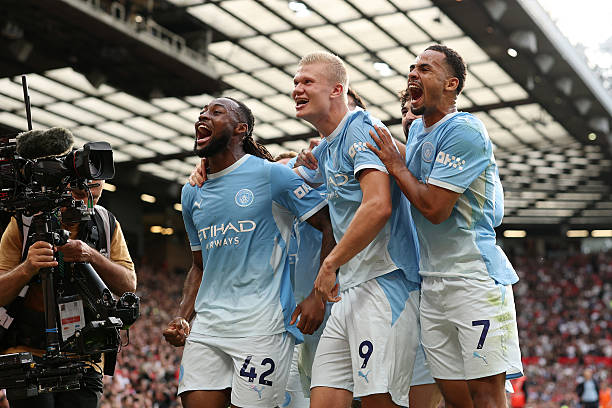

- United Fail to Exploit Numerical Advantage as Haaland Hands City Derby Victory
Erling Haaland scored the decisive goal as 10-man Manchester City produced a resilient defensive performance to beat Manchester United 1-0 in a dramatic Premier League derby at Old Trafford on Sunday.
City played for more than an hour with a numerical disadvantage following Phil Foden’s first-half dismissal but survived sustained United pressure before Haaland struck in the 62nd minute to secure the visitors a valuable victory and local bragging rights.
The result will carry particular frustration for United, who had started brightly, enjoyed the numerical advantage for the majority of the contest and twice struck the woodwork but could not convert their territorial pressure into the goals required to take advantage of City’s predicament.
United looked the more threatening side during the opening exchanges, attacking from the flanks and attempting to force City backwards before the complexion of the match changed significantly with Foden’s dismissal.
The England international was shown a straight red card after kicking out at Bruno Fernandes while the pair were on the ground. The incident was reviewed by the Video Assistant Referee before the referee’s decision was confirmed, leaving City to negotiate the remainder of the derby with 10 players.
United attempted to capitalise almost immediately. Marcus Rashford came closest to opening the scoring before the interval, curling a free-kick against the post as City struggled to contain the home side’s growing pressure.
There were also promising United attacks from wide positions, but City reorganised effectively following the sending-off and ensured that their opponents were unable to transform possession into a sustained sequence of clear-cut chances.
The first half consequently ended goalless, with Rashford’s effort against the woodwork representing the closest either side had come to finding the breakthrough.
United emerged after the interval expected to increase the pressure on a City side facing the demanding task of defending with a player fewer, but Pep Guardiola’s team remained compact and disciplined.
Instead, it was City who delivered the decisive blow. A move down the left in the 62nd minute eventually found Haaland at the far post, where the Norwegian striker converted from close range to put the visitors ahead.
The goal initially appeared to have been ruled out for offside, creating uncertainty inside Old Trafford.
VAR subsequently intervened and determined that the ball had taken a touch from a Manchester United player before reaching Haaland, meaning the striker was adjudged onside and the goal was allowed to stand.
The decision prompted frustration among the home support, particularly as replays appeared to place Haaland beyond United’s last defender before the ball reached him, but the intervention confirmed City’s advantage.
For United, the challenge then changed from finding an opening goal against 10 men to recovering from a deficit against opponents increasingly prepared to protect what they had.
The home side pushed more players forward and attempted to stretch City’s defensive structure, but the visitors repeatedly blocked crosses, disrupted passing lanes and prevented United from consistently creating high-quality opportunities inside the penalty area.
Kobbie Mainoo came close to restoring parity when his long-range attempt struck the post, the second time United had been denied by the woodwork during the afternoon.
Bruno Fernandes also threatened as United increased the pressure, but City goalkeeper Gianluigi Donnarumma produced an important save to preserve the visitors’ narrow advantage.
United committed increasingly large numbers to attack during the closing stages, aware that the opportunity to take something from the derby was slipping away despite their numerical superiority.
City, however, remained organised. Their defensive unit absorbed the pressure while limiting the space available around the penalty area, turning the final phase of the contest into a test of concentration and resistance rather than the open attacking football normally associated with Guardiola’s side.
Haaland’s goal consequently proved enough. For City, the manner of the victory may carry almost as much significance as the three points. Foden’s dismissal presented them with more than an hour of football in which United held the numerical advantage, yet the visitors found a way not merely to survive but to score the only goal of the contest.
Haaland again provided the decisive intervention, demonstrating his capacity to influence matches even when City are unable to dominate possession and territory in their customary fashion.
For United, the defeat will inevitably prompt questions about their attacking efficiency.
The home side were handed a significant advantage relatively early in the contest and created moments of danger through Rashford, Mainoo and Fernandes, but their inability to break through City’s defensive organisation left them vulnerable to precisely the type of counterpunch Haaland eventually delivered.
United’s failure to convert pressure into goals was particularly costly given that both Rashford and Mainoo struck the woodwork, while several attacks from promising positions failed to produce decisive final passes or finishes.
City’s performance, by contrast, was built on tactical adjustment and defensive discipline after circumstances forced them away from their preferred game plan.
The visitors had to sacrifice attacking freedom following Foden’s red card, but remained sufficiently dangerous to exploit the opportunity that came their way after the break.
When it arrived, Haaland made it count. The Norwegian’s 62nd-minute finish ultimately separated Manchester’s two rivals and completed a memorable afternoon for City, who left Old Trafford with victory despite playing most of the match with 10 men.
For United, it was an afternoon of opportunity lost. For City, it was a derby won through resilience, organisation and another decisive contribution from their prolific striker.

