


Unlicensed Lenders Threaten Financial Stability as BoG Pushes COCLAB to Move From Dialogue to Action
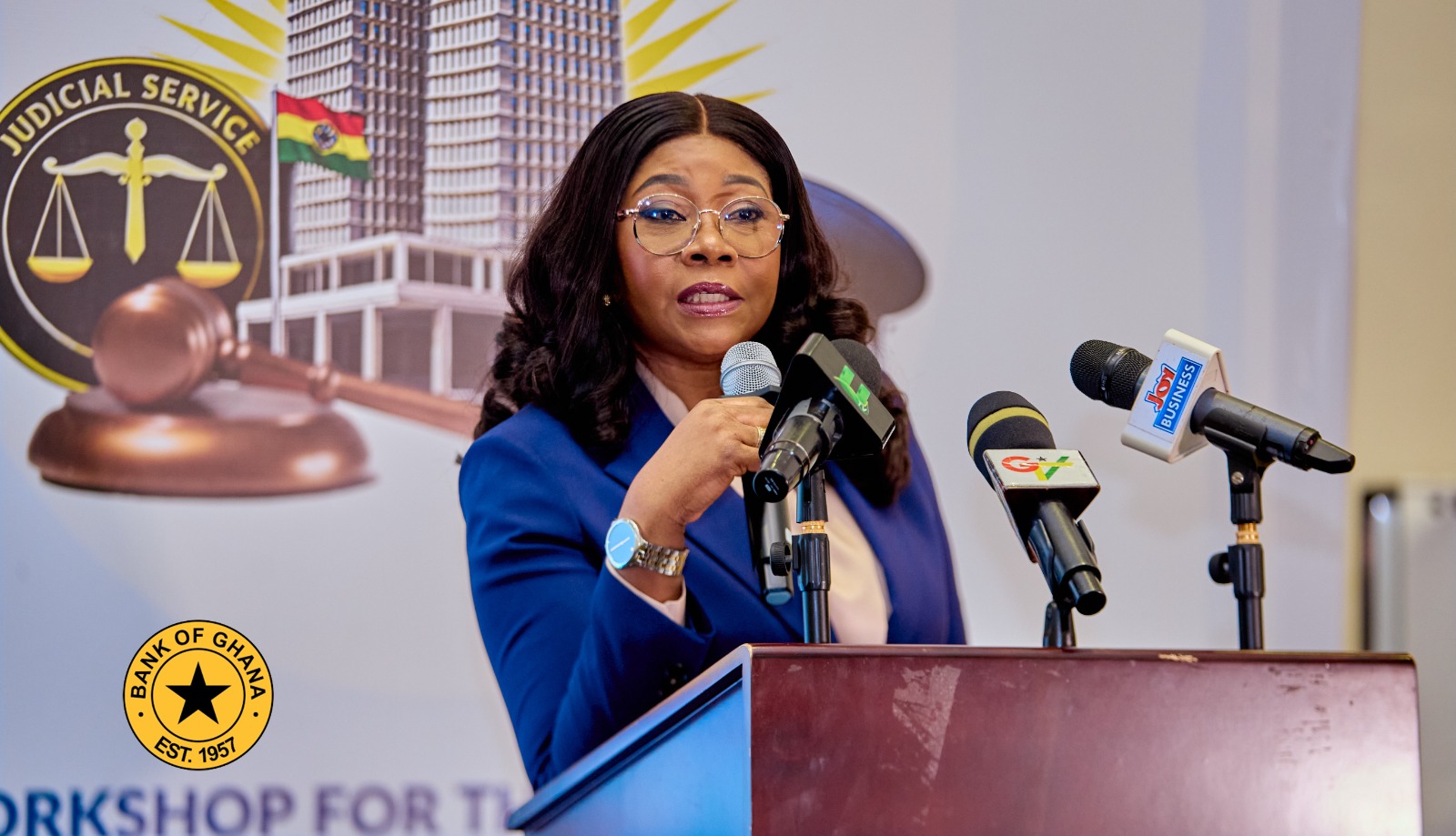
Second Deputy Governor of the Bank of Ghana (BoG), Matilda Asante-Asiedu, has called for a shift from dialogue to action in the fight against unlicensed and criminal financial operators, urging stronger inter-agency coordination to safeguard confidence in Ghana’s financial system.
She has specifically tasked the Technical Committee of the Committee for Cooperation between Law Enforcement Agencies and the Banking Community (COCLAB) to consider establishing structured multi-agency working groups to analyse the modus operandi of illicit financial actors and recommend joint enforcement and preventive measures.
According to her, elevating selected COCLAB engagements to the Heads of Institutions’ level would also help strengthen implementation and accountability across agencies.
“Collaboration must move beyond dialogue to execution. Each stakeholder—regulators, law-enforcement agencies, the banking industry, telecommunications operators, and the media—has a vital role to play. Only a unified and sustained approach will preserve confidence in our financial system,” she stated.
Ms. Asante-Asiedu made these remarks while delivering a keynote address at a COCLAB workshop held on Thursday, December 18, 2025.
She noted that the call for decisive action has become more urgent as Ghana prepares for its third-round Mutual Evaluation by the Inter-Governmental Action Group Against Money Laundering in West Africa (GIABA) in the first quarter of 2026.
According to her, demonstrating effective inter-agency cooperation and a strategic national response to unlicensed financial institutions would be critical to Ghana’s assessment under international Anti-Money Laundering and Counter-Terrorist Financing (AML/CFT) standards.
“Unlicensed and criminal operators are beginning to exploit vulnerable borrowers with products that appear attractive but conceal punitive terms, abusive recovery practices, and data-privacy violations,” she warned.
She explained that many of these actors operate across multiple sectors, advertising through traditional and social media, offering bank-like products without licences, and disbursing and recovering funds through mobile money platforms.
“Each of these activities falls under different regulatory and enforcement mandates. When responsibilities are fragmented, enforcement weakens. This challenge clearly requires joint ownership and coordinated action,” she added.
Ms. Asante-Asiedu disclosed that in 2024 alone, the Bank of Ghana received more than 50 complaints related to unregulated savings, investment, and lending schemes.
She said these entities often mimic legitimate financial products while imposing exorbitant charges and engaging in abusive practices that ultimately erode public confidence in the financial system.
The Second Deputy Governor noted that the central bank, working with COCLAB members and other stakeholders, has taken steps to address the problem through public warnings and enforcement actions.
She revealed that, in collaboration with the Economic and Organised Crime Office (EOCO), arrests have been made, but acknowledged that existing measures remain insufficient.
“The persistence of these operators calls for new strategies, deeper intelligence sharing, and stronger institutional coordination,” she stressed.
She cautioned that the trust, soundness, and stability of Ghana’s financial system are at stake, adding that the COCLAB Technical Committee is uniquely positioned to lead a coordinated national response to the growing threat.
Meanwhile, Ms. Asante-Asiedu highlighted the significant expansion of Ghana’s financial sector over the past decade, supported largely by digitalisation and innovation.
She noted that total financial sector assets increased from GHS102.1 billion in 2015 to about GHS461.51 billion as at October 2025.
According to her, banking sector credit grew by 15.86 per cent as at September 2025, while consumer confidence reached an all-time high of 119.2 in June 2025, up from 81.2 a year earlier.
She added that financial inclusion has also improved markedly, expanding access to affordable financial services across the country.
At the same time, she observed that digital finance has transformed how Ghanaians access credit and make payments, with interoperability enabling instant micro-loans, sometimes as low as GHS50, delivered through mobile platforms.
She disclosed that online banking transactions surged from GHS10.9 billion in February 2024 to GHS28.8 billion in February 2025, underscoring both the opportunities and risks created by rapid digital financial innovation.

