


- Gov’t Accepts 87.27% Of Treasury Bill Bids but Falls Short of Borrowing Target
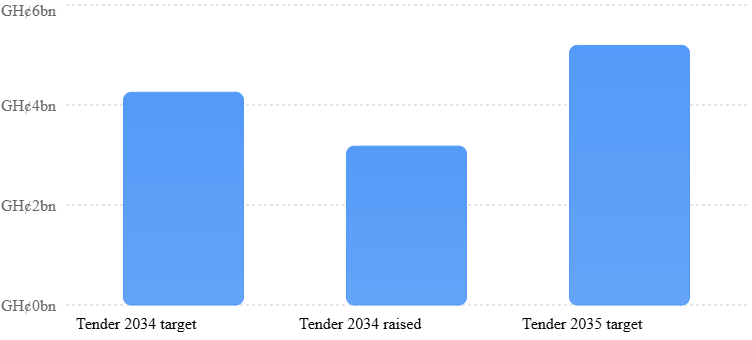
The Government of Ghana failed to meet its Treasury bill borrowing target for the latest auction, raising GH¢3.18 billion against a target of GH¢4.25 billion, as investor subscriptions declined sharply from the preceding week.
Official results from the Bank of Ghana’s Tender 2034, conducted on Friday, November 20, 2026, show that investors submitted bids worth GH¢3.64 billion across the 91-day, 182-day and 364-day Treasury bills.
The government accepted GH¢3.18 billion, representing 87.27% of the amount tendered, but falling GH¢1.08 billion short of its GH¢4.25 billion target.
The amount raised represented 74.68% of the government’s intended borrowing, leaving a 25.32% shortfall.
The outcome marks a deterioration from the previous auction on November 13, when investors submitted GH¢4.33 billion in bids and the government accepted GH¢3.45 billion.
Subscriptions consequently declined by GH¢692.89 million, representing a 15.99% reduction, while the value of accepted bids fell by GH¢274.68 million, equivalent to 7.96%.
The decline comes as Ghana’s domestic money market adjusts to changing interest-rate expectations, with investors assessing the relative attractiveness of short-term government securities against alternative financial instruments.
However, the auction results alone do not establish the underlying reasons for the decline in subscriptions.
The auction results indicate that demand remained concentrated in the shortest available maturity.
The 91-day Treasury bill attracted GH¢2.36 billion in bids, of which GH¢2.19 billion was accepted.
This represented approximately 68.79% of the total amount raised during the auction, making the three-month instrument the dominant source of government financing.
The 182-day Treasury bill attracted GH¢645.97 million in subscriptions, with GH¢590.57 million accepted.
The 364-day bill received GH¢636.98 million in bids, but only GH¢401.00 million was allotted.
The distribution demonstrates the importance of short-term government securities within Ghana’s domestic borrowing programme.
Although the 91-day instrument accounted for the largest share of accepted bids, the government accepted a much smaller proportion of subscriptions for the 364-day bill.
Approximately 92.70% of bids for the 91-day instrument were accepted, compared with 91.42% for the 182-day bill and 62.95% for the 364-day bill.
This suggests that the government’s willingness to accept bids varied considerably across maturities.
The difference may reflect pricing considerations and the authorities’ preferred financing structure, although the auction notice does not explicitly state the reasons for individual allotment decisions.
Breakdown of accepted Treasury bill bids
| INSTRUMENT | BIDS SUBMITTED | BIDS ACCEPTED | WEIGHTED AVERAGE INTEREST RATE |
| 91-day | GH¢2,357.41m | GH¢2,185.40m | 4.5193% |
| 182-day | GH¢645.97m | GH¢590.57m | 6.1210% |
| 364-day | GH¢636.98m | GH¢401.00m | 9.4471% |
| Total | GH¢3,640.36m | GH¢3,176.97m | — |
Weighted average annualised interest rates are those published for November 23–27, 2026.
The yield structure also provides insight into pricing conditions within the short-term debt market.
The weighted average interest rate for the 91-day Treasury bill settled at 4.5193%, compared with 6.1210% for the 182-day instrument and 9.4471% for the 364-day bill.
The difference between the three-month and one-year rates stood at approximately 4.93 percentage points.
The higher interest rate on longer-dated bills indicates that investors required greater annualised returns for committing funds over an extended period within the same auction.
However, the results do not establish whether rates increased or decreased compared with the preceding auction, because the Bank of Ghana’s latest notice provides only the previous week’s aggregate subscription and sales figures, not its individual interest rates.
What is clear is that the government continued to raise short-term financing at rates substantially differentiated by maturity.
The 91-day bill’s 4.5193% annualised interest rate also illustrates the lower returns currently available on the shortest government instrument.
For institutional investors, the decision to purchase short-term securities involves balancing yield, liquidity requirements and expectations about future interest rates.
Investors anticipating changes in monetary conditions may prefer certain maturities depending on their portfolio objectives and cash-flow requirements.
For the government, the corresponding challenge is to secure sufficient financing without accepting bids at rates considered inconsistent with its borrowing strategy.
Friday’s auction outcome shows that this balance remains important.
Despite receiving GH¢3.64 billion in bids, the government rejected or did not allot GH¢463.39 million.
Consequently, the borrowing shortfall cannot be attributed entirely to inadequate subscriptions.
Total investor bids were already GH¢613.64 million below the government’s target, but the decision not to accept all submissions increased the final shortfall to GH¢1.08 billion.
This distinction matters because a government may deliberately accept less than its target when bid pricing is considered unfavourable.
Conversely, weak subscription levels can indicate insufficient investor demand at prevailing market conditions.
The latest auction reflects both a subscription shortfall and selective allotment, although the available data do not establish their relative policy motivations.
The result also reinforces the importance of monitoring weekly financing developments rather than relying exclusively on aggregate borrowing targets.
Treasury bills remain a central instrument through which the government finances short-term obligations and manages its domestic debt requirements.
Unlike the Bank of Ghana’s own monetary operations, government Treasury bill issuance is principally a fiscal financing activity.
Its relationship with financial-system liquidity depends on the broader movement of government deposits, repayments, spending and financial-sector funds.
The performance of weekly auctions can therefore provide useful indications of financing conditions without independently establishing the overall liquidity position of the banking system.
For investors, the latest auction presents another consideration: whether the government’s borrowing requirements will remain elevated during the closing weeks of 2026.
The Bank of Ghana has announced a significantly higher target of GH¢5.19 billion for the next Treasury bill auction, Tender 2035.
That represents an increase of GH¢938.00 million, or approximately 22.05%, over the GH¢4.25 billion target set for Tender 2034.
It is also GH¢2.02 billion above the amount actually raised in Friday’s auction.
Government targets versus accepted bids
GH¢ billion; latest auction and next announced target
The higher target places additional importance on whether investor demand recovers during the coming auction.
A stronger subscription response could help the government meet its financing requirement without materially changing its acceptance strategy.
However, continued weakness in demand could create another shortfall, particularly if the authorities remain selective about acceptable yields.
The announced target should not automatically be interpreted as additional net borrowing.
Gross Treasury bill issuance may include amounts required to refinance maturing securities, and the Bank of Ghana’s notice does not disclose the corresponding maturity obligations needed to calculate net financing.
The distinction is important when assessing implications for public debt. An increase in gross issuance does not necessarily mean that the government’s outstanding debt will rise by the same amount.
Similarly, an auction shortfall does not automatically establish that the government faces an immediate financing crisis.
The fiscal implications depend on available cash balances, upcoming obligations, alternative financing sources and the government’s broader debt-management strategy.
Nevertheless, the latest figures provide an important signal about the government’s ability to mobilise domestic financing at prevailing market rates.
The central development is that Ghana raised less than its Treasury bill target despite accepting more than 87.00% of investor bids, highlighting a combination of weaker subscriptions and selective allotment.
For the government, the immediate challenge will be to achieve stronger participation in subsequent auctions while managing interest costs.
For investors, attention will turn to whether short-term yields remain attractive relative to other available instruments.
And for financial market participants, the next auction will provide a clearer indication of whether Friday’s decline represents a temporary adjustment or the beginning of a more sustained moderation in Treasury bill demand.
With the government targeting GH¢5.19 billion in the next auction, the coming week will provide an important test of domestic financing conditions.
The outcome will be particularly relevant as the authorities seek to balance their borrowing requirements against the objective of maintaining manageable domestic debt-servicing costs

