

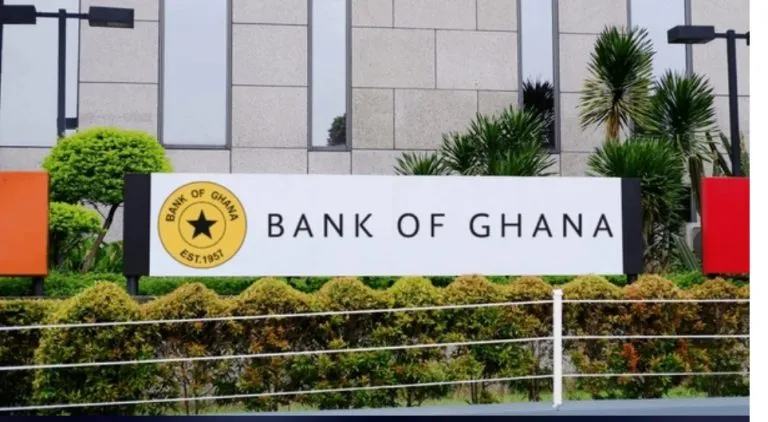

- BoG Maintains 10.5% Yield as Short-Term Liquidity Absorption Crosses GH¢10bn
The Bank of Ghana has sold GH¢10.52bn in 14-day central bank bills, increasing the size of its short-term liquidity operation by more than 60% within five days while leaving the yield virtually unchanged.
Results of Tender 882, held on October 5, show that the central bank allotted the two-week securities at a weighted average interest rate of 10.4972%.
The amount sold was GH¢3.99bn higher than the GH¢6.53bn raised through the previous 14-day bill tender on September 30, representing an increase of approximately 61.1%.
| Indicator | October 5 | September 30 | Change |
| Total amount sold | GH¢10.52bn | GH¢6.53bn | +GH¢3.99bn |
| Weighted average discount rate | 10.4550% | 10.4533% | +0.17 basis points |
| Weighted average interest rate | 10.4972% | 10.4955% | +0.17 basis points |
| Bid-rate range | 10.4000%–10.4578% | 10.4000%–10.4578% | Unchanged |
| Tenor | 14 days | 14 days | Unchanged |
The two auctions have sold a combined GH¢17.06bn in Bank of Ghana bills within less than a week.
The scale of the October 5 operation points to a substantial amount of liquidity available within Ghana’s banking system, even though the auction document does not disclose the total value of bids submitted or rejected.
It would therefore be inaccurate to describe the tender as oversubscribed from the published information alone. What the data confirm is that the Bank of Ghana accepted and sold GH¢10.52bn a significantly larger amount than in the preceding operation.
Despite the increase in volume, the weighted average interest rate moved by only 0.17 basis points, within 10.50%.
The range of bid rates was unchanged at 10.40% to 10.50%, and the full range was allotted.
This suggests that the additional liquidity was absorbed without requiring the central bank to offer a materially higher return.
The pricing stability is significant. Ordinarily, a sharp expansion in the amount of securities sold could place upward pressure on yields if investors demanded greater compensation for committing additional funds.
Instead, the Bank of Ghana increased the size of its operation by almost two-thirds while keeping the cost near 10.5%.
That may indicate strong institutional demand for short-term central bank paper, abundant liquidity among commercial banks or limited alternative instruments offering a similar combination of safety and short maturity.
The 10.50% weighted average interest rate is about 3.5 percentage points below the Bank of Ghana’s 14% monetary policy rate.
This spread reflects the different functions of the two rates.
The policy rate signals the broad stance of monetary policy and influences the pricing of money across the financial system. The 14-day bill rate, by contrast, is determined through a short-term liquidity-management operation.
Banks may be willing to accept a lower return because Bank of Ghana bills carry minimal credit risk and allow surplus funds to be placed for only two weeks.
The gap nevertheless provides useful information about conditions in the money market. When short-term funds are abundant, financial institutions may compete strongly for central bank securities, keeping yields below the policy rate.
That means the policy stance cannot be assessed only by looking at the headline 14% rate. The effective degree of monetary tightness also depends on banking-system liquidity and the rates at which the central bank absorbs surplus funds.
Bank of Ghana bills should not be confused with Treasury bills issued by the government.
Government securities finance public borrowing requirements and form part of the state’s debt-management programme. Central bank bills are primarily used for monetary operations, including withdrawing excess cedi liquidity from the financial system.
By selling the securities, the Bank of Ghana temporarily removes funds that banks could otherwise deploy into credit, foreign exchange or other financial assets.
The October 5 sale therefore represents a liquidity-absorption exercise rather than new financing for the government budget.
The operation could support exchange-rate and inflation management by limiting the amount of excess money available to chase foreign currency and goods.
However, the funds will return to the banking system when the bills mature after 14 days, unless the central bank rolls over the securities or conducts another sterilisation operation.
This creates a recurring liquidity-management requirement. Large short-dated operations can remove money quickly, but their brief maturity means the Bank of Ghana must repeatedly decide whether to absorb the returning funds.
The GH¢10.52bn operation may reflect several sources of banking-system liquidity, including government payments, maturing securities, foreign-exchange transactions or changes in banks’ reserve positions.
The auction result alone does not identify which source was dominant.
It nevertheless raises an important question: if the banking system can place more than GH¢10bn into two-week central bank bills, how much of that liquidity is translating into productive private-sector credit?
Commercial banks may prefer short-term sovereign or central bank instruments when lending risks remain elevated or when businesses are unwilling to borrow at prevailing commercial rates.
For the central bank, the operation helps manage liquidity and reinforce monetary control. For the wider economy, however, repeated large placements in short-dated official securities could also signal that surplus banking funds are circulating within the financial system rather than financing investment and business expansion.
The next auction will show whether the October 5 increase was temporary or part of a sustained rise in the Bank of Ghana’s liquidity-absorption requirement.
If sales remain above GH¢10bn while yields hold near 10.5%, it would provide stronger evidence that liquidity remains abundant and that institutions continue to value safety and short maturity over alternative uses of their funds.

