

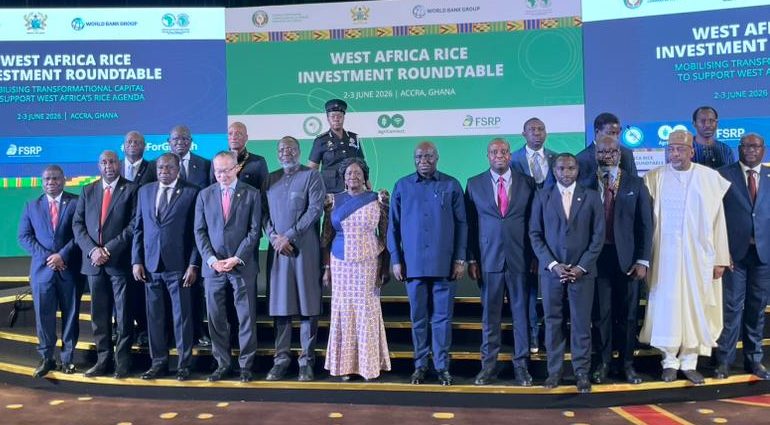

- Vice President Calls for Long-Term Investment to Transform West Africa’s Rice Sector
Ghana has called for the mobilisation of large-scale, long-term investment into West Africa’s rice sector, as policymakers seek to transform agriculture from a subsistence activity into a modern, commercially competitive industry.
Speaking at the West Africa Rice Investment Roundtable in Accra, Vice President Professor Jane Naana Opoku-Agyemang said unlocking the region’s agricultural potential would require what she described as “transformational capital” capable of supporting entire value chains.
“The challenge before us is not simply about growing more rice,” she said. “It is about mobilising the scale of capital required to transform agriculture from a subsistence sector into commercial production and from fragmented production into integrated value chains.”
The Vice President argued that rice should be viewed not only as a staple food crop but also as a strategic economic asset capable of generating employment, increasing farmer incomes, supporting industrial growth and strengthening economic resilience.
“West Africa must see rice as a strategic economic asset,” she said. “It is about jobs for our young people, incomes for farmers and strengthening the resilience of our economies against future global shocks.”
Her remarks come at a time when West Africa continues to spend billions of dollars annually on rice imports despite having the land, water resources, labour and market demand required to build a competitive regional rice economy.
For Ghana and its neighbours, the rice question is no longer simply about food security. It is about foreign exchange conservation, rural incomes, industrialisation and the ability of the region to protect itself from global supply-chain shocks.
Professor Opoku-Agyemang outlined Ghana’s Agriculture for Economic Transformation Agenda, which seeks to connect production with processing, logistics, exports and agro-industrial development through an integrated ecosystem.
According to her, agriculture must be positioned as a major driver of industrial growth, export competitiveness and job creation rather than treated as a low-productivity survival sector.
The Vice President also called for greater participation from development finance institutions, commercial banks, pension funds, sovereign wealth funds and private investors.
“Put simply, this means financing agriculture as an industry,” she said.
She noted that climate-conscious investments would be essential to the long-term success of the sector, citing the growing impact of climate variability on rainfall patterns, productivity and food systems across West Africa.
Investments in irrigation infrastructure, water management systems, climate-resilient seeds, digital agriculture and modern farming technologies, she said, would be crucial to ensuring sustainable growth.
“The sector represents one of our greatest opportunities for investment, industrial development and export expansion,” Professor Opoku-Agyemang told delegates.
With global food demand increasing and supply chains being reshaped, the Vice President said Africa must position itself as a major production hub rather than remain a perpetual importer of staple foods.
“The future of African food security must be grown in African soil, financed through beneficial partnerships, powered by African enterprise and sustained through regional innovation,” she said.
Her remarks underscore a growing consensus among policymakers that achieving food security will require more than political declarations and production targets.
It will require bankable projects, patient capital, modern infrastructure, climate-smart farming systems and private-sector investment capable of turning agriculture into a cornerstone of economic transformation.
The region already has the demand. What it now needs is the capital, coordination and execution discipline to turn rice from an import burden into a platform for jobs, industrial growth and regional resilience.

