

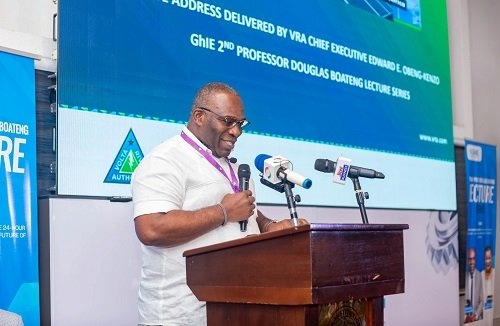

- VRA Chief Says 24-Hour Economy Must Be Built on Dependable Electricity Supply
Ghana’s ambition to build a 24-hour economy will depend heavily on the country’s ability to guarantee stable, reliable and affordable electricity to businesses, the Chief Executive Officer of the Volta River Authority, Ing. Edward E. Obeng-Kenzo, has warned.
The VRA chief executive said the policy, which seeks to encourage selected industries and businesses to operate extended or multiple shifts, cannot deliver its full promise unless firms have confidence that power will be available when needed.
His caution places the energy sector at the centre of Ghana’s economic transformation agenda, suggesting that the 24-hour economy will not be determined by policy ambition alone, but by the strength, resilience and financial sustainability of the electricity value chain.
For manufacturers, agro-processors, exporters, logistics operators and service providers, reliable power is not a secondary condition. It is the foundation on which extended production hours, higher output, employment growth and private-sector competitiveness must rest.
The proposed 24-hour economy policy is one of government’s flagship economic programmes. It is intended to increase productivity, expand job opportunities, improve use of infrastructure, stimulate industrial output and deepen export capacity by encouraging businesses to operate beyond traditional working hours.
But Ing. Obeng-Kenzo’s warning highlights a practical constraint: businesses cannot meaningfully extend operating hours if electricity supply remains uncertain, expensive or vulnerable to disruptions.
The issue is particularly important for sectors expected to drive the 24-hour economy, including manufacturing, food processing, cold-chain logistics, transport, hospitality, ports, health services, retail, security services and digital operations. Many of these sectors require uninterrupted electricity to protect machinery, preserve goods, meet delivery schedules and maintain customer confidence.
Power interruptions increase operational costs. Firms are forced to rely on diesel generators, absorb production delays, repair damaged equipment or pass higher costs to consumers. For small and medium-sized enterprises, the burden can be even more severe because they often lack the financial capacity to invest in backup power systems.
The VRA CEO’s intervention therefore points to a wider policy truth: Ghana’s productivity agenda will only be as strong as the infrastructure that supports it.
The 24-hour economy requires more than enthusiasm from businesses. It demands power generation adequacy, fuel security, reliable transmission, efficient distribution, cost-reflective but competitive tariffs, and stronger financial discipline across the electricity sector.
The Volta River Authority remains one of Ghana’s most important power producers, with a central role in generation and energy security. Its position in the sector gives weight to the warning that rising demand from an around-the-clock production model must be matched by stronger planning and investment.
If factories, logistics hubs, cold stores, ports and commercial centres begin operating longer shifts, electricity demand patterns could change significantly. Peak demand could spread across longer hours, and the system would need to be sufficiently flexible to supply businesses at night, early morning and across weekends without compromising household supply.
That would require coordinated investment across the entire energy chain. Generation capacity must be reliable and diversified. Transmission systems must be strong enough to move power efficiently. Distribution companies must reduce losses and improve service quality. Fuel supply for thermal plants must be predictable. The sector’s financial obligations must also be managed to prevent arrears from weakening utilities and independent power producers.
The warning also raises an important competitiveness issue. Ghana is not only trying to produce more; it is trying to attract investment and expand exports. Investors assessing Ghana’s industrial prospects will consider whether electricity supply is reliable, whether tariffs are predictable and whether the regulatory framework gives them confidence to operate at scale.
In this context, energy reliability becomes an investment promotion tool. A country that can provide stable power at competitive rates has a stronger chance of attracting manufacturing, agro-processing, technology, logistics and export-oriented investments.
The opposite is also true. If energy supply is unreliable, the 24-hour economy risks becoming an expensive slogan for firms already struggling with financing costs, taxation, logistics constraints and competition from imports.
Ing. Obeng-Kenzo’s caution should therefore be read not as opposition to the policy, but as a reminder that implementation must be grounded in infrastructure reality.
The government’s 24-hour economy agenda has already been framed around job creation, industrial expansion and export development. But for the policy to work, energy planning must be integrated into the programme from the beginning rather than treated as a supporting afterthought.
That means identifying priority sectors and industrial zones where power demand is likely to rise, assessing network readiness, investing in grid upgrades, strengthening energy efficiency and ensuring that utilities can respond to new commercial load patterns.
It also means linking the 24-hour economy to renewable energy, battery storage and distributed power solutions where appropriate, especially for agro-processing zones, industrial parks, logistics centres and public facilities that require dependable supply.
The VRA CEO’s message is ultimately a warning about sequencing. Ghana cannot ask firms to operate longer, produce more and employ more people if the energy system is not ready to support that shift.
For the 24-hour economy to become a credible growth model, reliable power must move from the background of the conversation to the centre of policy execution.
The promise of continuous production, stronger exports and job creation will be measured not by policy announcements, but by whether businesses can keep their machines running, their cold rooms active, their ports operating, their lights on and their workers productive across the full day.
Without dependable electricity, Ghana’s 24-hour economy risks remaining an aspiration. With reliable power, it could become one of the country’s most important productivity reforms.

