


- Israel’s Desert Farms Show How Water Stress Can Become Innovation Strategy
In the Negev desert, where the soil is sandy, the air is dry and water is too precious to waste, Israel has built one of the world’s most persuasive demonstrations of how agriculture can be redesigned for scarcity rather than defeated by it.
The lesson from the Ramat Negev Agro-Research Center is not that deserts can be conquered by slogans. It is that arid land can be made productive only when science, discipline, water pricing, farmer training, market access and relentless experimentation are treated as a single agricultural system.
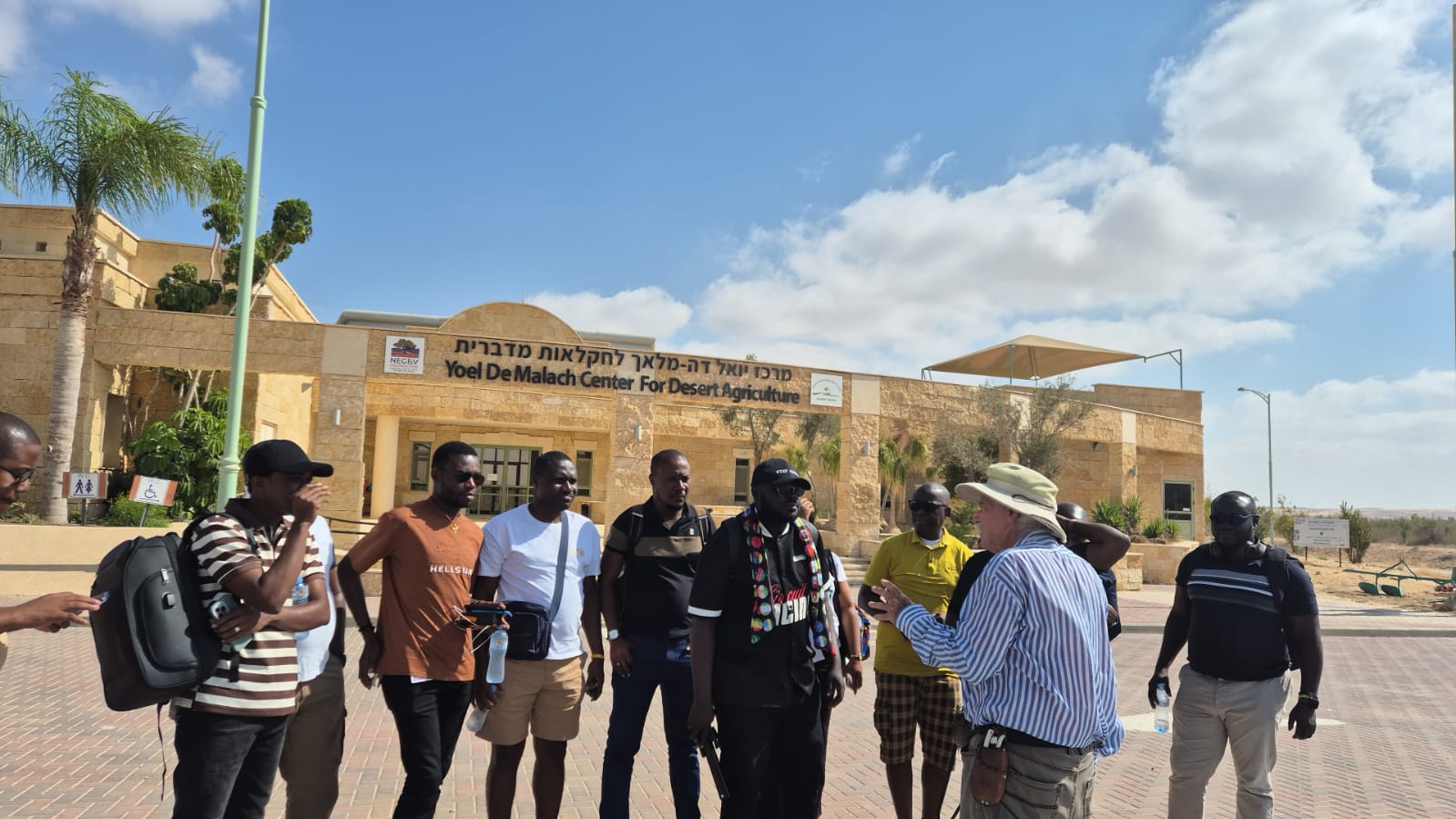
For countries facing climate stress, including Ghana’s northern belt, the Negev model is increasingly relevant. During a walking tour captured in a transcript shared with NorvanReports, a Ghanaian visitor identified himself as a managing editor from Ghana, after which the guide immediately drew a comparison with the northern part of Ghana, near Burkina Faso, where arid and semi-arid conditions also shape farming realities.
That exchange matters. Israel’s desert story is not merely a Middle Eastern curiosity. It is a policy argument for any country asking how to feed people, create rural jobs and build resilience when rainfall becomes unreliable, water becomes expensive and land degradation threatens food systems.
At Ramat Negev, the landscape itself seems to challenge old assumptions about what can grow in a desert. A 2016 account of the research centre describes acacia trees, greenhouses, pumpkins, cherry tomatoes and sweet peppers growing in abundance in a desert environment, with tomatoes hanging above sand under careful irrigation and nourishment.
The centre is overseen by the Ramat Negev Regional Council, with experiments conducted by onsite researchers and scientists from institutions including Ben-Gurion University, the Hebrew University’s agriculture faculty, the Volcani Center and others, in consultation with Israel’s extension service.
This institutional architecture is central to the story. The desert did not become productive because one farmer improvised alone. It became a living laboratory because local authorities, research institutions, extension officers, farmers and markets were connected around a common question: what can grow here, with which water, under what conditions, and at what profit?
The official Ramat Negev presentation describes the region as hot and arid, with sandy and clay-baked soil, and says the centre was inaugurated more than 50 years ago to find productive uses for brackish, semi-salty water pumped from local wells. After hundreds of practical studies, the region’s agriculture developed into a state-of-the-art technology base.
That is the heart of the Israeli desert agriculture model. It starts by refusing to treat bad water as useless water.
During the tour, the guide explained that eucalyptus, pomegranates and olive trees were being irrigated with brackish water and could still prosper. In the case of olives, he said yields were not lower than with sweet water, while the stress from salinity could increase the percentage of oil in each kilo by about 10.00%.
The economic insight is subtle but powerful. In conventional thinking, brackish water is a constraint. In Ramat Negev, it becomes a variable to be tested. Which crops tolerate it? Which varieties perform better? At what salt level does the plant suffer? At what point does stress improve quality or market value? This is agriculture treated not as a gamble with the weather, but as applied science.
The centre’s work has included crops such as tomatoes, peppers, melons, herbs, cucumbers, eggplants, olives, pomegranates, edible and wine grapes, dates and jojoba. It also conducts practical research into variety testing, irrigation and fertilisation efficiency, labour-saving techniques and crop profitability.
The Ramat Negev approach is not only about what is grown, but how water reaches the plant. The Desert and Cities Sing account notes that scientists at the centre determined the importance of directing brackish water beneath the plant so it reaches the roots without touching sensitive leaves, where salt can cause damage. The centre also relies on drip irrigation, a technology associated with Israel’s Netafim company, headquartered in the Negev at Kibbutz Hatzerim.
That principle water to the root, not water everywhere is what separates productive desert agriculture from wasteful irrigation. In many countries, irrigation still means flooding fields. In the desert, that is not just inefficient; it can be fatal to the crop and the soil.
Israel’s broader water system helps explain why such technologies have taken root. The OECD describes Israel as highly water-stressed, with deserts making up more than half of its surface, but says the country has combined regulation, pricing, desalination and wastewater reuse to reduce overexploitation of freshwater resources.
According to the OECD, Israel reuses more than 87.00% of wastewater effluent for agriculture, while five desalination plants supply over 80.00% of domestic urban water. Agriculture’s share of freshwater abstractions also fell from 64.00% in 2000 to 35.00% in 2018.
This is where the Israeli lesson becomes uncomfortable for many developing countries. Technology matters, but institutions matter more. Drip irrigation without water governance is an expensive gadget. Desalination without pricing discipline is fiscally dangerous. Research without extension does not reach farmers. And pilot farms without markets remain donor-funded demonstrations.
At Ramat Negev, experimentation appears almost obsessive. The transcript describes hydroponic lettuce grown in pools where water circulates with compressed air, hanging strawberries cultivated in coconut-shell substrate, and a recycling system that collects water not absorbed by the plants and pumps it back to save expensive drinking water. The guide said the strawberries must receive about 120.00% of their water requirement to achieve yield, making recovery of excess water essential.
The same tour explains that strawberries receive desalinated water, but that some normal, salty water is deliberately added because boron is needed for flower setting and fruit development. Some lines are also connected to heating units to enable earlier crops.
This is not romantic farming. It is controlled-environment agriculture, where water quality, nutrients, temperature, light and timing are managed as production inputs. It is also a warning against simplistic agricultural policy. The question is not only whether a country has land. It is whether it can manage the chemistry, biology, infrastructure and economics that make land productive.
The guide’s discussion of potatoes shows how market logic sits beside agronomy. Potatoes grown with salty water may produce smaller “baby potatoes”, he said, but the yield loss can be offset because the smaller product earns more than double the money.
That is a profound point for agricultural transformation. The aim is not always maximum tonnage. Sometimes the smarter strategy is to produce what the market values more, using the environmental constraint as part of the product identity. Desert farming becomes viable when the crop, water source, production technology and buyer preference are aligned.
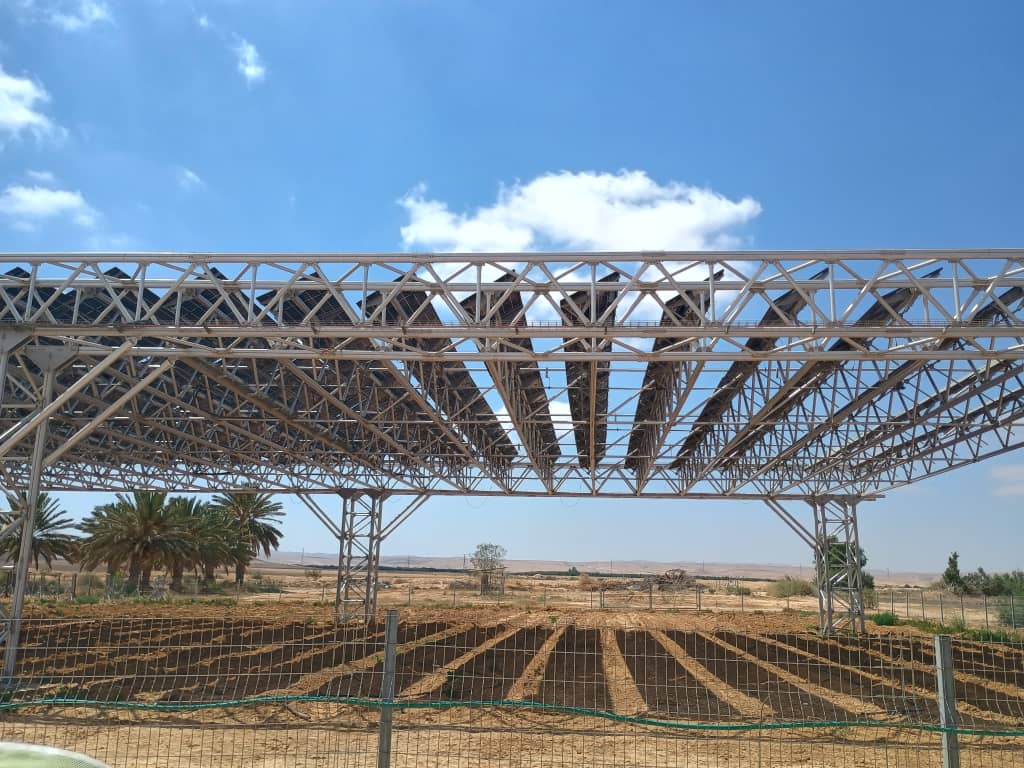
Energy is the other side of the Negev story. The transcript describes a solar power tower surrounded by 50,600 mirrors, heating water to 500°C and producing power for about 60,000 homes, while nearby agricultural plots experiment with solar panels above crops.
The agrivoltaic system described on the tour is especially important. Movable solar elements above crops can shift direction, adjust angles and control shade. In a region where the guide said 85.00% of days are cloudless, light itself becomes something to manage: more sun when crops need it, partial shade when heat stress becomes excessive, and electricity production from the same land.
This is the emerging frontier of arid agriculture: not choosing between food and energy, but designing systems that produce both. The guide called it “double product” electricity and crops from the same land and said comparisons are conducted between shaded and unshaded areas, and between normal, reduced and increased irrigation, to determine what actually works.
The method is almost deceptively simple: test, compare, measure, adjust, repeat. It is the opposite of policy by announcement.
The centre also functions as an export platform for knowledge. The Ramat Negev presentation says it runs an annual 11-month training programme for about 500 agriculture students from abroad, combining classroom learning with practical hands-on training from farmers in the region. The programme is managed jointly by Israel’s ministries of foreign affairs, agriculture and interior.
The Desert and Cities Sing article similarly notes that Israeli agro-scientists are sent to Africa, Asia, Latin America, Central Europe and the Middle East, while farmers and scientists from abroad are brought to Israel to study areas such as semi-arid farming, desertification control, irrigation, water management and strategies for small farmers.
This is where Ghana and other African countries should look closely. The transferable lesson is not that northern Ghana should become the Negev. The climates, land tenure systems, water resources, farmer structures and markets are different. The lesson is that dryland agriculture needs permanent local research infrastructure tied to farmers, not occasional projects that end when funding ends.
Northern Ghana does not need copied Israeli farms. It needs its own Ramat Negev-style centres: practical, farmer-facing, market-oriented research stations that test crops, irrigation, brackish groundwater use, solar-powered systems, storage, seed varieties, soil conditions and profitability in local conditions.
Such centres should not be treated as academic museums. They should be linked to commercial farms, outgrower schemes, district assemblies, water authorities, universities, agribusiness investors and farmer cooperatives. The Israeli model works because the farm is a laboratory, the laboratory is connected to farmers, and farmers are connected to markets.
The guide’s final philosophy may be the most useful line in the entire transcript. Asked about fertiliser, he said compost was a good answer, but that the best fertiliser for any land is “the boots of the farmer” the more often the farmer visits, the better the field becomes.
For governments, the equivalent is presence. Policies must be present in the field. Extension officers must be present. Data must be present. Water monitoring must be present. Financing must be present. Markets must be present. Otherwise, agriculture remains a seasonal hope rather than an organised production system.
Israel’s desert agriculture story is often told as a miracle. It is better understood as discipline. The desert was not made green by optimism alone. It was made productive through decades of research, irrigation engineering, water reuse, desalination, price signals, farmer training, crop testing and a national willingness to treat scarcity as a design problem.
For Ghana, the challenge is not whether the north can become another Negev. It cannot, and it should not try to imitate blindly. The real question is more practical and more urgent: can Ghana build institutions that help farmers produce more with less water, less waste, better technology, better markets and stronger local knowledge?
In the Middle East, Israel has shown that arid land need not be abandoned. But it has also shown that turning desert into arable land is not a one-time project. It is a system of continuous learning.
The future of agriculture in water-stressed regions will belong not to countries with the most fertile land, but to those that can best manage the land they have. That is the lesson from Ramat Negev. And for countries facing climate pressure, food insecurity and rural underemployment, it is a lesson that can no longer be treated as distant.

