
- Presidency Directs Ministers to Enforce Compulsory Retirement Rules Across State Institutions
The Presidency has directed all Ministers of State to enforce Ghana’s constitutional retirement requirements across public institutions and state-owned organisations, ordering chief executives who have reached the compulsory retirement age of 60 without valid post-retirement contracts to prepare their handover notes and vacate office.
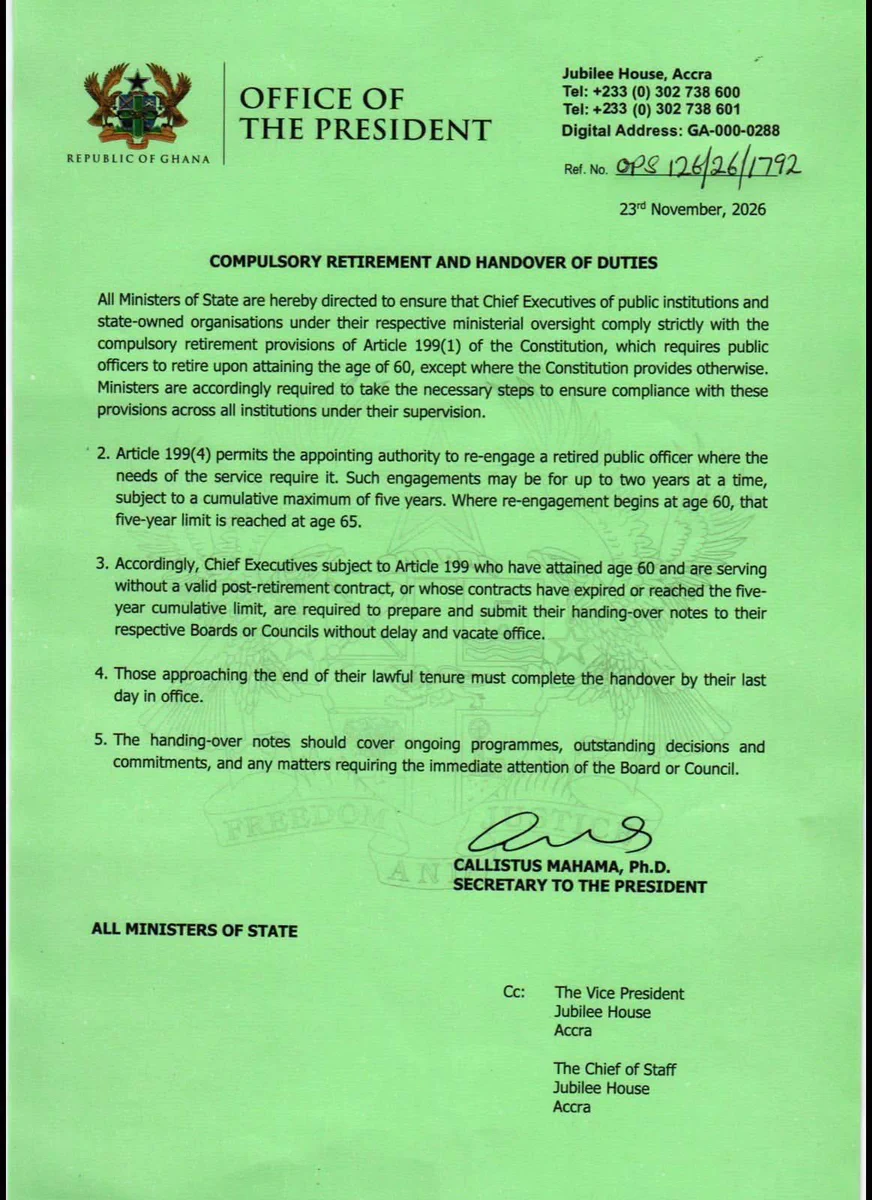
The directive, contained in an official communication dated November 23, 2026, and signed by the Secretary to the President, Dr Callistus Mahama, also applies to chief executives whose post-retirement contracts have expired or who have exhausted the maximum five-year period permitted for re-engagement.
The instruction represents a move by President John Dramani Mahama’s administration to strengthen compliance with constitutional provisions governing public service employment, potentially affecting leadership arrangements across ministries, departments, public institutions and state-owned organisations whose chief executives fall within the relevant constitutional framework.
Under Article 199(1) of the 1992 Constitution, public officers are required to retire upon attaining the age of 60, except where the Constitution provides otherwise.
However, Article 199(4) allows the appointing authority to re-engage a retired public officer where the needs of the service require continued employment.
Such engagements may be granted for periods not exceeding two years at a time, subject to a cumulative maximum of five years.
The Presidency has made clear that where re-engagement begins at age 60, the cumulative five-year limit is reached at age 65.
The directive states, “All Ministers of State are hereby directed to ensure that Chief Executives of public institutions and state-owned organisations under their respective ministerial oversight comply strictly with the compulsory retirement provisions of Article 199(1) of the Constitution.”
Ministers have consequently been instructed to take the necessary administrative steps to ensure compliance across institutions operating under their respective supervisory responsibilities.
The instruction distinguishes between public officers who have lawfully been re-engaged after retirement and those continuing in office without the necessary contractual authorisation.
This distinction is important because attaining the age of 60 does not automatically prohibit every form of continued public service.
Rather, continued engagement must satisfy the constitutional requirements and be authorised by the relevant appointing authority.
Article 199(4) recognises that certain circumstances may justify retaining experienced officials beyond the ordinary retirement age, particularly where their expertise or services remain necessary.
However, the provision does not establish an unrestricted entitlement to continue occupying public office.
The Presidency’s latest directive seeks to ensure that such extensions remain within the prescribed legal limits.
It specifically identifies three categories of chief executives required to vacate office: those aged 60 or above serving without valid post-retirement contracts, those whose contracts have expired, and those who have exhausted the cumulative five-year extension period.
The letter states, “Accordingly, Chief Executives subject to Article 199 who have attained age 60 and are serving without a valid post-retirement contract, or whose contracts have expired or reached the five-year cumulative limit, are required to prepare and submit their handing-over notes to their respective Boards or Councils without delay and vacate office.”
The directive further requires officials approaching the end of their lawful tenure to complete the handover process by their final working day.
This requirement is intended to prevent interruptions to institutional operations when senior public officials leave office.
Chief executives have been instructed to document ongoing programmes, outstanding decisions, existing commitments and matters requiring the immediate attention of their respective governing boards or councils.
Such documentation is particularly important for public institutions managing substantial financial resources, ongoing procurement arrangements, development projects and contractual obligations.
An orderly transition can help incoming leadership understand an institution’s financial position, operational priorities and outstanding responsibilities.
It may also reduce the risk of administrative delays or disputes arising from incomplete records during changes in management.
The directive does not, however, announce the immediate replacement of every public institution chief executive aged 60 or above.
Its application depends on the legal classification of the position, the existence of a valid post-retirement engagement and whether the applicable constitutional requirements have been satisfied.
The distinction could become particularly significant for state-owned enterprises operating under separate statutory and corporate governance arrangements.
Although the Presidency’s letter refers broadly to public institutions and state-owned organisations, Article 190 of the Constitution distinguishes between public corporations established as commercial ventures and institutions forming part of the public services.
Consequently, determining whether an individual chief executive is subject to Article 199 may require examination of the institution’s establishing legislation, employment arrangements and applicable constitutional provisions.
The directive itself recognises that qualification by specifically referring to chief executives subject to Article 199.
For the government, enforcing retirement requirements presents an opportunity to strengthen administrative consistency and ensure that the tenure of public institution leaders is supported by proper legal authorisation.
Public institutions perform important functions in economic regulation, service delivery, infrastructure management and the implementation of government policy.
Their leadership arrangements therefore have implications extending beyond individual appointments.
Where executives remain in office after the expiry of their legally authorised tenure, questions may arise over governance, accountability and the proper exercise of appointing powers.
The Presidency’s intervention seeks to establish a uniform expectation that institutions operating under ministerial supervision must comply with applicable retirement provisions.
However, the effectiveness of the directive will depend on how ministers and governing boards interpret and implement the requirements.
In particular, institutions will need to establish the employment status of affected executives, examine relevant contracts and confirm whether existing extensions remain legally valid.
The exercise may also require coordination with appointing authorities, governing councils and the institutions responsible for public sector administration.
A failure to distinguish between lawfully re-engaged officials and those whose tenure has expired could generate unnecessary administrative disputes.
Conversely, failing to enforce expired contracts or statutory limits would undermine the objectives of the presidential instruction.
The broader governance implications are also significant.
Senior executives in public institutions often exercise substantial authority over staffing, procurement, strategic planning and financial commitments.
Ensuring that such authority is exercised within a legally valid tenure is important for institutional legitimacy and public confidence.
At the same time, an orderly leadership transition requires continuity in the implementation of government programmes and the management of ongoing obligations.
This explains the Presidency’s emphasis on comprehensive handover notes rather than simply instructing affected executives to leave office.
The requirement ensures that institutions retain documented information about pending decisions and commitments.
For boards and councils, it also provides an opportunity to review outstanding operational matters and establish clear responsibilities during leadership transitions.
The communication, issued from Jubilee House in Accra under reference number OPS 126/26/792, was addressed to all Ministers of State, with copies forwarded to the Vice President and the Chief of Staff.
The distribution places responsibility for compliance directly on ministers while ensuring that the Presidency’s senior administrative offices are informed of the exercise.
The central significance of the directive is that continued service beyond the compulsory retirement age must be supported by lawful authorisation rather than treated as an automatic extension of tenure.
Its implementation could result in leadership changes across affected institutions, although the number of executives involved has not been disclosed.
The letter does not identify individual chief executives, provide a list of affected organisations or announce successors.
Its immediate effect is therefore an instruction to enforce existing constitutional requirements, rather than a blanket dismissal of all public sector executives who have reached age 60.
For ministers, the priority will be reviewing the status of executives within their supervisory portfolios and ensuring compliance.
For governing boards and councils, attention will turn to receiving the required handover documentation and maintaining institutional continuity.
And for the Presidency, the effectiveness of the intervention will be measured by whether the retirement provisions are applied consistently, lawfully and without unnecessary disruption to public administration.
The November 23 directive reinforces an established constitutional framework while placing renewed responsibility on the executive branch to ensure that public service leadership arrangements remain within the limits prescribed by law.