

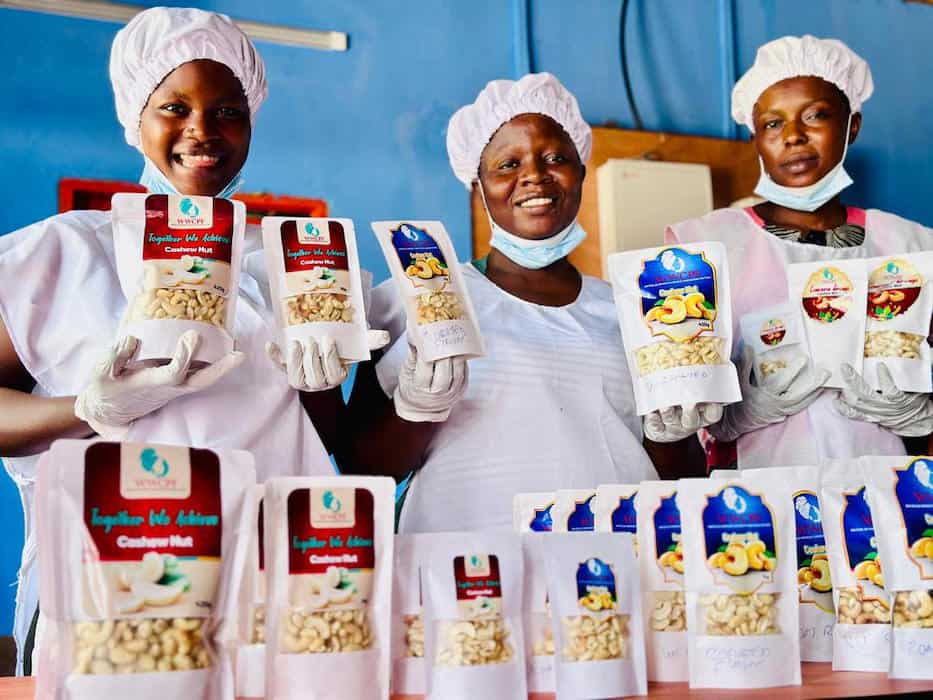

- WAGE Project Targets Women-Led Cashew Processing to Boost Rural Incomes
Ghana’s drive to deepen agricultural value addition has received a fresh push with the launch of the Women in Agribusiness for Growth and Empowerment project, a three-year initiative aimed at transforming women from seasonal farm labourers into agribusiness entrepreneurs within the cashew value chain.
The project, known as WAGE, is being spearheaded by Agrico Hub with support from Plan International and local partners. It is designed to address one of the most persistent structural weaknesses in Ghana’s cashew industry: the limited participation of women in the higher-value segments of processing, packaging, branding and marketing.
Although women play a major role in cashew harvesting, their earnings remain largely tied to seasonal farm labour, with many working for only three to six months during the harvesting period.
The WAGE project seeks to change that by equipping women, youth and persons with disabilities with the technical and entrepreneurial skills needed to build sustainable agribusinesses beyond the harvest season.
The intervention comes at a time when Ghana is seeking to retain more value from its agricultural exports, particularly in sectors where raw commodities continue to dominate trade.
Despite Ghana’s growing cashew production, less than 10.00% of harvested cashew nuts are processed locally. This means the bulk of the value generated from processing, packaging, product development and export-ready branding is captured outside the country.
For a sector with strong income and job-creation potential, that represents a major value loss.
The WAGE project is therefore targeting not only income generation but a structural shift in how rural women participate in the cashew economy.
Speaking at the launch, Agrico Hub Chief Executive Officer George Antwi Boasiako said the initiative was designed to create year-round economic opportunities for women who currently depend heavily on seasonal farm work.
He noted that empowering women with processing, business development and value-addition skills would improve household incomes while strengthening Ghana’s domestic agro-processing base.
The project will train beneficiaries to move beyond harvesting into more profitable activities such as cashew nut processing, packaging, quality control, product development and marketing.
This is critical because value in the cashew industry is not concentrated only at the farm gate. Higher margins are often captured after harvesting, where raw nuts are processed, graded, branded and sold into domestic and export markets.
By helping women enter these stages of the value chain, WAGE seeks to convert agricultural participation into agribusiness ownership.
The project will also promote the commercial use of the cashew apple, a largely underutilised by-product of the cashew industry.
In many producing areas, cashew apples are left to rot after the nuts are removed, creating waste and lost economic opportunity. Through processing, the cashew apple can be transformed into marketable products such as juice, jam, vinegar, syrup, animal feed and other value-added goods.
The commercial use of cashew apples could therefore create an additional income stream for women-led enterprises while reducing post-harvest losses.
Cashew is already an important cash crop in several parts of Ghana, but the income generated at the household level remains limited when farmers and labourers remain locked into raw commodity production. Processing changes the economics of the sector by creating jobs in handling, sorting, roasting, packaging, logistics and retail.
That point was emphasised by project promoters, who argue that women’s participation in cashew must move from temporary labour to structured enterprise development.
The Regional Director of Agriculture, James Adu, described the WAGE project as a strategic intervention that addresses one of the weakest links in Ghana’s cashew value chain: local processing.
He said expanding domestic processing capacity would help retain more value within the economy, create jobs and improve the competitiveness of Ghana’s cashew industry.
His comments reflect a wider policy challenge facing Ghana’s agricultural sector.
The country produces several important agricultural commodities, but value addition remains limited across many value chains. Raw exports may generate foreign exchange, but they often deliver lower domestic employment, weaker industrial linkages and reduced income opportunities compared with processed products.
If Ghana can raise local processing levels from below 10.00% to a much higher share, the country could retain more income from each tonne of cashew produced. It could also create more rural jobs, strengthen small businesses, attract private investment and reduce dependence on raw nut exports.
It places women at the centre of rural industrialisation by recognising that agricultural transformation cannot be achieved if women remain confined to low-paid, seasonal and informal roles.
Women are already present in the cashew sector. The question is whether they will remain at the bottom of the value chain or be supported to move into ownership, processing and market access.
The project’s inclusion of youth and persons with disabilities also gives it a wider social impact.
Agribusiness can become a pathway for inclusive economic participation if training, financing, equipment, market linkages and technical support are properly structured. For young people in rural communities, value-added cashew processing could offer an alternative to migration or underemployment.
For persons with disabilities, targeted agribusiness support can open income opportunities that are often unavailable in traditional labour markets.
But the success of WAGE will depend on more than training.
Beneficiaries will need access to processing equipment, affordable finance, certification, packaging materials, storage facilities, reliable markets and business advisory support. Without these, skills training alone may not translate into sustainable enterprises.
Women-led agribusinesses often struggle to obtain credit because they lack collateral, formal records or established banking relationships. If the WAGE project is to create real businesses, it must connect beneficiaries to financial institutions, grant support, cooperative structures or blended financing models.
Producing processed cashew products is only the first step. Beneficiaries must be able to sell consistently into local shops, supermarkets, hotels, schools, export channels and online platforms.
This means quality standards, packaging, branding and pricing must be treated as central parts of the project, not afterthoughts.
The project also has implications for Ghana’s wider agro-processing strategy.
For years, policymakers have argued that agriculture must be linked to industry if Ghana is to create jobs and reduce rural poverty. WAGE offers a practical example of what that linkage can look like at community level: raw cashew converted into processed products, women converted into entrepreneurs, and rural labour converted into year-round income.
The initiative also speaks to Ghana’s import-substitution and export-diversification agenda.
Processed cashew products can serve both domestic and external markets. If properly branded and certified, Ghanaian cashew can compete in regional and international food markets, especially where buyers are increasingly interested in ethically sourced and women-led products.
When women earn more stable income, household welfare often improves. Increased women’s income can support children’s education, nutrition, healthcare and family resilience. Rural women’s economic empowerment therefore has broader effects beyond individual earnings.
Transforming a value chain takes time. A three-year project can build capacity, demonstrate models and support enterprise formation, but scaling local cashew processing will require sustained policy support, private-sector investment and infrastructure development.
Energy supply, roads, storage, standards enforcement and export facilitation will all matter.
There is also the challenge of consistency in raw material supply. If processors cannot secure adequate volumes of quality raw cashew nuts at predictable prices, they will struggle to meet market demand.
This means stronger coordination between farmers, processors, aggregators and buyers will be needed.
The WAGE project could therefore benefit from cooperative or cluster-based models, where women-led groups pool resources, share equipment, aggregate supply and negotiate better market terms.
Such models can reduce individual risk and improve the commercial viability of small-scale processing.
For Ghana’s cashew sector, the launch of WAGE should be seen as both an empowerment initiative and an industrial policy intervention.
It tackles income inequality, gender exclusion and youth unemployment, but it also addresses a hard economic problem: Ghana is losing value by exporting too much of its cashew in raw form.
If WAGE succeeds, it could provide a replicable model for other agricultural value chains where women provide labour but capture limited value.
Agricultural transformation is not only about producing more. It is about who earns more from what is produced.
For too long, women in the cashew sector have helped bring in the harvest without owning enough of the business that follows.
Its success will be measured not only by the number of people trained, but by the number of women-led enterprises created, the volume of cashew processed locally, the income generated beyond the harvest season and the value retained in rural communities.
Ghana’s cashew industry has the raw material.

