

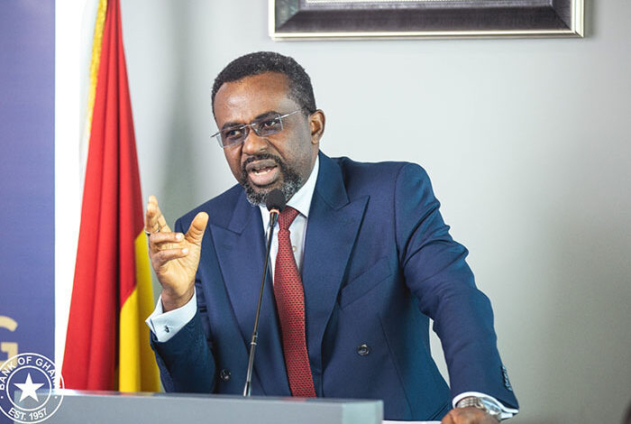

- We Need Reforms, AI-Driven Innovation to Secure Ghana’s Economic Transformation – BoG Governor
Governor of the Bank of Ghana, Dr Johnson Pandit Asiama, has called for deeper financial sector reforms, accelerated digital transformation and stronger institutional discipline to strengthen investor confidence and position Ghana for long-term economic competitiveness.
Speaking at the 10th Ghana CEO Summit in Accra, Dr Asiama said the central bank was intensifying efforts to rebuild trust in the financial system through stronger monetary policy measures, improved liquidity management and enhanced transparency.
According to him, restoring credibility within the financial sector remains critical to supporting businesses, households and long-term investment flows needed to sustain economic growth.
The Governor disclosed that the central bank is adopting a more forward-looking and risk-sensitive supervisory framework designed to identify vulnerabilities early and respond swiftly to emerging threats within the financial sector.
The shift, he suggested, reflects the Bank’s determination to move beyond reactive regulation and build a financial system capable of supporting Ghana’s economic transformation agenda.
Dr Asiama further underscored the growing importance of innovation and digital transformation in reshaping business models, financial services and national competitiveness.
He said technologies such as artificial intelligence, cloud computing, data analytics and digital finance are rapidly redefining global financial systems, creating both opportunities and risks for emerging economies.
“Artificial intelligence, data analytics, cloud computing, and digital finance are redefining business models and market structures globally, and Ghana cannot afford to be a passive observer,” he stated.
The Governor revealed that the Bank of Ghana has established specialised units, including the FinTech and Innovation Department and the Data Analytics and Artificial Intelligence Department, to accelerate digital transformation across the financial ecosystem.
The move signals a more deliberate attempt by the central bank to place technology, data and innovation at the centre of financial sector supervision, payments modernisation and policy formulation.
Dr Asiama also highlighted progress on Ghana’s proposed Central Bank Digital Currency initiative, saying the project could improve cross-border payment systems and enhance operational efficiency within the country’s financial architecture.
The potential of a digital currency, he noted, sits within a wider agenda to modernise payment systems, reduce transaction frictions and improve Ghana’s integration into emerging global digital finance platforms.
But the Governor cautioned that innovation must be matched with strong safeguards.
“As we embrace technological transformation, we must ensure innovation remains responsible, inclusive, and secure,” he said.
His comments come at a time when financial regulators globally are grappling with how to encourage innovation while protecting consumers, preserving financial stability and strengthening cybersecurity resilience.
For Ghana, the stakes are particularly high. Digital financial services have become central to payments, savings, credit access and financial inclusion. But the rapid expansion of technology-driven finance also raises concerns around data protection, fraud, operational risks and consumer vulnerability.
Dr Asiama therefore stressed the need for governance structures, cybersecurity controls and consumer protection mechanisms to keep pace with innovation.
Beyond the financial sector, the Governor called on chief executives and private-sector leaders to support Ghana’s broader economic transformation agenda through industrialisation, economic diversification, stronger public-private partnerships and improved institutional integrity.
“Economic transformation will not happen by accident. It will require disciplined policy choices, resilient institutions, innovative businesses, and courageous leadership,” he added.
His message adds to a recurring theme from the 10th Ghana CEO Summit: Ghana’s recovery must now move from stabilisation to execution.
After years of high inflation, exchange rate pressure, debt restructuring and constrained private-sector activity, the country’s next policy challenge is to convert macroeconomic stability into durable growth, jobs and industrial competitiveness.
Dr Asiama’s intervention places artificial intelligence, institutional discipline and financial sector reform at the heart of Ghana’s transformation debate.
The argument is clear: Ghana cannot build a competitive economy on stability alone. It must combine credible policy, strong institutions and responsible innovation to create the conditions for sustained industrial growth and inclusive prosperity.

