

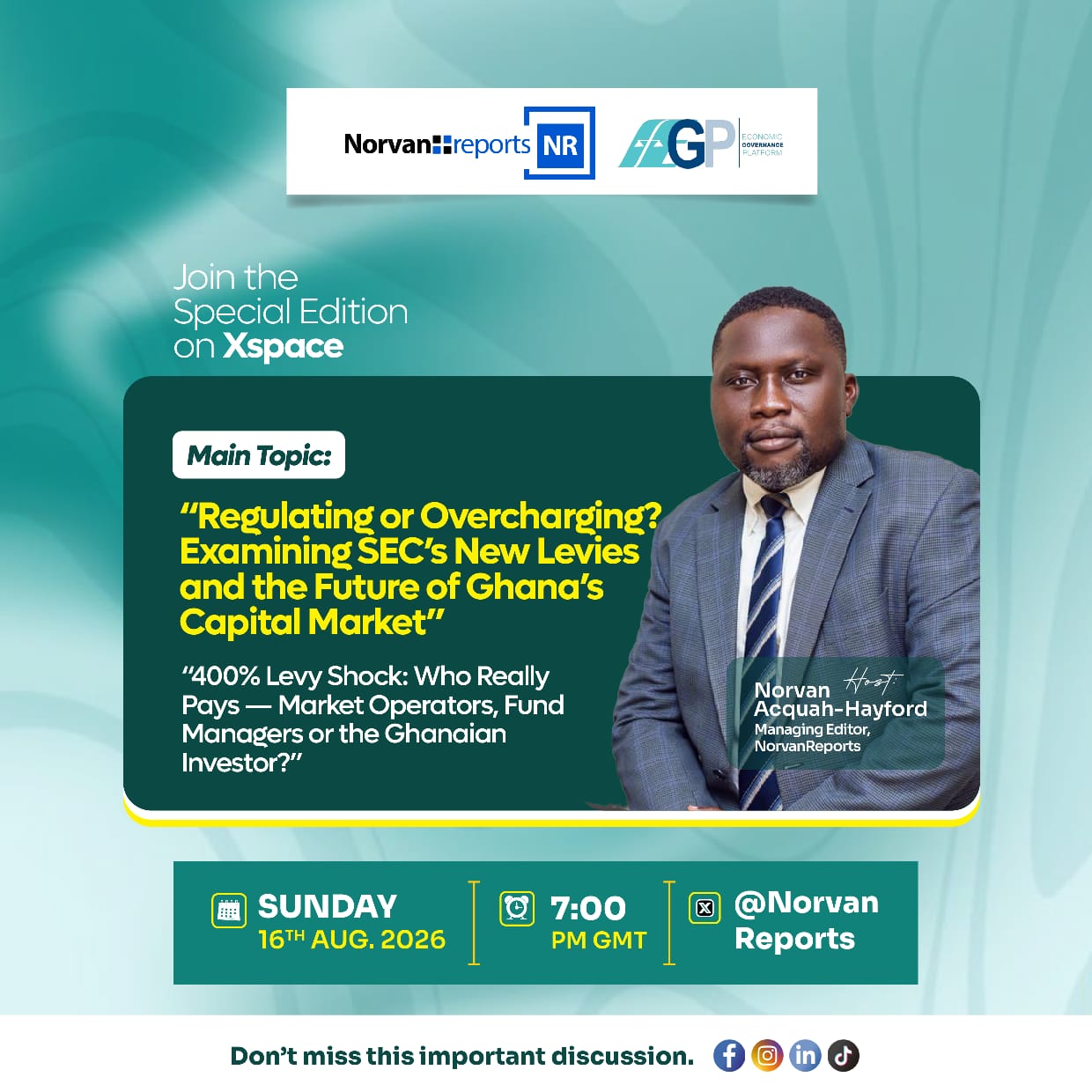

- Who Really Pays? NorvanReports XSpace to Probe SEC’s New Levies and Cost to Ghanaian Investors
Ghana’s securities industry is set for a major policy conversation on Sunday evening as NorvanReports brings together investment professionals to interrogate the Securities and Exchange Commission’s new market levy regime and its potential implications for investors, fund managers and the future development of the country’s capital market.
The special edition of NorvanReports Live on XSpace, scheduled for 7:00 PM GMT on Sunday, August 16, 2026, will examine the topic: “Regulating or Overcharging? Examining SEC’s New Levies and the Future of Ghana’s Capital Market.”
The discussion will further drill down into the subtopic: “400% Levy Shock: Who Really Pays, Will it be Market Operators, Fund Managers or the Ghanaian Investor?”
The conversation comes amid growing scrutiny of the SEC’s 2026 market levy framework, which has significantly raised fixed annual charges across several categories of regulated market operators while retaining transaction-based levies and introducing an annual levy on non-pension funds under management.
Joining the conversation will be a Chief Investment Officer from Capital Advisors and a Fund Representative.
The programme will be hosted by Norvan Acquah-Hayford, Managing Editor of NorvanReports.
At the heart of the discussion is a fundamental question confronting Ghana’s financial markets: how much should effective regulation cost, and who should ultimately bear that cost?
Under the SEC’s 2026 Guidelines on Market Levies, the annual levy for a Stock Exchange has been set at GH¢250,000, while a Securities Depository is also required to pay GH¢250,000. Primary Dealers, Custodians and Issuing Houses are required to pay GH¢100,000 each, while Fund Managers face an annual levy of GH¢37,500 and Broker-Dealers GH¢25,000.
Historical levy data reviewed ahead of the XSpace shows that several of these charges represent a 400% increase between 2025 and 2026.
The levy for Fund Managers, for instance, has risen from GH¢7,500 to GH¢37,500, while Broker-Dealers have moved from GH¢5,000 to GH¢25,000. Issuing Houses have seen their annual levy increase from GH¢20,000 to GH¢100,000, with Stock Exchanges moving from GH¢50,000 to GH¢250,000.
The scale of the increases has triggered questions over whether the adjustment reflects a clear levy-setting methodology tied to the size, activity or supervisory risk of individual operators, or whether the uniform increases could raise the cost of participation across the entire market.
But the debate extends beyond the fixed annual levies.
The SEC already participates in market activity through transaction-based levies. Under the 2026 guidelines, the Commission receives 0.15% of the value of share transactions, 0.0025% of bond trades, while repurchase transactions also attract an SEC component.
For fund managers and investors, the discussion takes on an additional dimension.
The SEC has imposed an annual levy of 0.225% on the Net Asset Value of non-pension funds under management. The charge is calculated using the daily closing NAV of applicable funds rather than the profitability of the fund manager or the returns generated for investors.
That means a GH¢100 million non-pension portfolio could theoretically generate about GH¢225,000 in annual levy obligations at a constant NAV, while a GH¢1 billion portfolio could amount to approximately GH¢2.25 million.
The issue of who ultimately pays has become particularly significant because the SEC guidelines provide that fund managers should ensure clients have sufficient funds in their trust accounts to meet the levy. This can include keeping part of the interest earned on investments in cash, while fund managers may alternatively pay the levy and subsequently arrange reimbursement.
That provision raises difficult questions for institutional and retail investors alike.
Should the cost of regulating a fund manager be borne by the institution providing the investment-management service, or by the investor whose assets are being managed?
And if regulatory charges ultimately reduce investment returns, does investor protection require regulators to consider not only fraud, misconduct and financial stability, but also the cumulative cost imposed on the investor?
Sunday’s XSpace will also examine whether the levy structure risks creating multiple layers of regulatory participation in the same economic activity.
Market operators may face fixed annual levies while transaction fees continue to apply to the trading activity they facilitate. Issuing Houses may incur fixed annual charges while separate regulatory fees can arise when securities are brought to market. Fund Managers face their annual operator levy while non-pension assets under management are additionally subject to the 0.225% levy.
For Ghana, the debate carries implications beyond the immediate financial burden on regulated firms.
Successive governments and market institutions have sought to deepen the domestic capital market, mobilise long-term savings, expand investment options and provide businesses with alternatives to traditional bank financing.
The question is whether sharply higher regulatory costs could inadvertently work against those objectives by raising the breakeven threshold for smaller intermediaries, encouraging industry consolidation, weakening competition or making certain capital-market activities less commercially attractive.
There is also the issue of regulatory predictability.
If annual levies can rise fivefold within a single year, market operators may question how they should forecast future compliance costs, plan investments and allocate capital without a publicly understood long-term levy-setting framework.
Yet the debate is not expected to be one-sided.
A credible securities regulator requires adequate resources to supervise increasingly complex markets, enforce rules, protect investors and maintain confidence in the financial system. The challenge is therefore not simply to determine whether the SEC should collect levies, but whether the structure and scale of those levies are proportionate to the regulatory responsibilities they are intended to finance.
That is the tension NorvanReports intends to place at the centre of Sunday evening’s conversation.
Is Ghana strengthening regulation, or making regulated investment increasingly expensive?
Are the new levies necessary to protect investors, or could the cost of that protection ultimately be passed back to the same investors the regulator seeks to protect?
And perhaps most importantly, what levy structure would give the SEC sufficient resources while preserving competition, liquidity, investor returns and confidence in Ghana’s capital market?
The conversation begins at 7:00 PM GMT on Sunday, August 16, 2026, live on @NorvanReports XSpace.
For anyone with money invested through a fund manager, anyone operating within Ghana’s securities industry, or anyone interested in how the country finances businesses and mobilises long-term capital, this is a conversation worth joining.

