
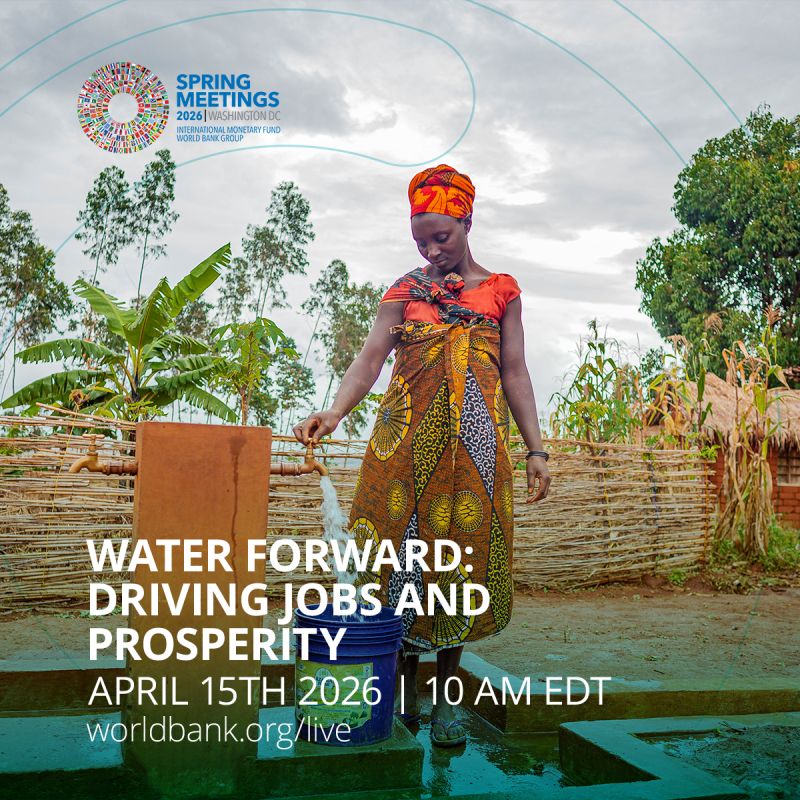

- World Bank launches ‘Water Forward’ platform to improve water security for 1bn people by 2030
The World Bank Group has launched a new global initiative aimed at improving water security for more than 1bn people by 2030, betting that better-managed water systems can become a powerful engine for jobs, productivity and private investment across developing economies.
Announced in Washington at the sidelines of the 2026 spring meetings on April 15, the initiative, branded Water Forward, brings together the World Bank Group, multilateral development banks, development finance institutions and other partners around a common goal: to align policy reform, financing and implementation support in a sector long constrained by weak regulation, underperforming utilities and insufficient investment.
The move reflects a growing recognition among development institutions that water is no longer merely a social service issue. It is becoming a central economic variable.
“Water is foundational to how economies function. When water systems work, farmers produce, businesses operate, and cities attract investment,” said Ajay Banga, President of the World Bank Group. “Our task now is to align reform, financing, and partnerships to deliver reliable water services at scale.”
That framing is significant. For years, water has often sat at the margins of macroeconomic debate, treated largely as an infrastructure or public health concern. But the World Bank is now placing it closer to the centre of development strategy, linking water security directly to labour markets, food systems, energy resilience and investor confidence.
According to the Bank, water underpins health, food production, energy systems and an estimated 1.7bn jobs worldwide, yet 4bn people still experience water scarcity. In many developing economies, progress has been slowed by “unclear policies, weak regulations, and financially unsustainable utilities”, conditions that have not only weakened service delivery but also discouraged private capital from entering the sector.
Water Forward is intended to change that by helping countries build what the Bank calls “stronger, more reliable water systems” that can “unlock productivity, support livelihoods, and enable private investment.”
At the centre of the initiative are country-led water compacts national reform frameworks through which governments identify priorities, commit to stronger institutions and map out investment pathways for their water sectors. Fourteen countries have already announced their national water compacts under the programme, with more said to be in development.
That country-compact model matters because it suggests the Bank wants this to be more than another financing announcement. The emphasis is on reform discipline as much as on money: stronger institutions, improved financial performance by utilities and a clearer pipeline of investment-ready projects.
The World Bank Group said it is committing to help deliver water security for 400m people by 2030, while the broader Water Forward coalition expects to reach more than 1bn people through additional partner commitments.
Those partners include a wide group of multilateral and development finance institutions: the Asian Development Bank, Asian Infrastructure Investment Bank, Council of Europe Development Bank, European Bank for Reconstruction and Development, European Investment Bank, Inter-American Development Bank, Islamic Development Bank, New Development Bank, OPEC Fund for International Development, and the International Fund for Agricultural Development.
The economic case for the initiative is also tied to demographics. With more than 1.2bn young people expected to enter the workforce in developing countries over the next 10 to 15 years, the Bank argued that reliable water systems will be critical to building economies capable of supporting jobs at scale.

