

- World Bank Says Carbon Pricing Now Covers Nearly 30% of Global Emissions
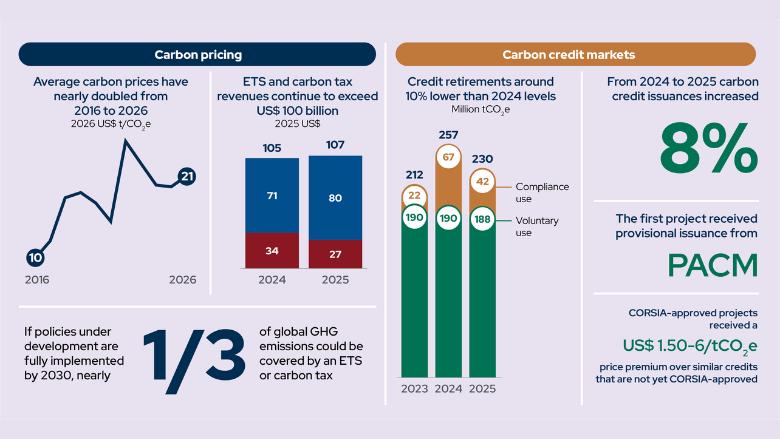
Global revenues from carbon pricing mechanisms rose above $107 billion in 2025, reinforcing the growing role of emissions markets and carbon taxes in financing the transition to low-carbon economies.
The World Bank, in its 2026 State and Trends of Carbon Pricing report, said carbon pricing instruments now cover nearly 30 per cent of global greenhouse gas emissions, with 87 implemented policies across the world. The report said carbon pricing mobilised more than $107 billion for public budgets in 2025, extending the expansion of climate-linked fiscal instruments.
Revenues were generated through emissions trading systems, carbon taxes and related carbon pricing frameworks that require companies and sectors to pay for their greenhouse gas emissions. Reuters reported that global carbon pricing revenues rose by 2 per cent in 2025, highlighting continued momentum despite uneven carbon prices across major markets. The development underscores a broader shift in global climate policy: carbon pricing is no longer being treated only as an environmental tool, but increasingly as a revenue, investment and industrial-policy instrument.
The World Bank said carbon pricing can help mobilise finance and support development outcomes, particularly when revenues are channelled into clean energy, social protection, green infrastructure, industrial decarbonisation and climate adaptation. The report also showed that all large middle-income economies have either implemented or are planning direct carbon pricing instruments, a signal that emerging economies are beginning to play a more prominent role in shaping the next phase of global carbon markets.
That trend is visible across Asia and Africa. Japan’s newly launched green transformation emissions trading system is expected to support future financing for energy transition and industrial decarbonisation, while countries such as India and Viet Nam are moving to broaden carbon market frameworks from 2026 onward.
Nigeria is also positioning itself to participate more actively in the carbon economy. The country has been advancing a national carbon market framework as part of wider energy transition and climate finance reforms, with authorities seeking to attract investment through carbon credit trading and climate-linked instruments.
For African economies, the carbon market opportunity is significant but complicated. The continent holds major potential in forest conservation, renewable energy, clean cooking, methane reduction, sustainable agriculture and nature-based carbon projects. Yet its ability to benefit from global carbon pricing will depend on credible regulatory systems, transparent monitoring, reporting and verification, and stronger investor confidence in the quality of carbon credits issued.
The World Bank noted that carbon credit issuances rose by 8 per cent from 2024 to 2025, although credit prices declined slightly during the year. It added that certain categories of projects continued to attract price premiums, including those eligible for use by international airlines and highly rated forest conservation and reforestation projects.
That distinction is important for Africa. As buyers become more selective, countries with weak verification systems or unclear land and community-benefit arrangements may struggle to attract high-value carbon finance. By contrast, markets with credible governance frameworks could draw stronger demand from corporates and compliance buyers seeking quality credits.
Advanced economies still account for the bulk of carbon pricing revenues because they have more mature trading systems and generally higher carbon prices. But the expansion of carbon pricing into large emerging markets could reshape global climate finance flows over the next decade.
For governments facing fiscal constraints, carbon pricing offers a potentially attractive source of public revenue. But it also carries political risks. Poorly designed carbon taxes or emissions schemes can increase costs for households and businesses, especially in energy-intensive sectors, unless revenues are recycled carefully through subsidies, tax relief, targeted compensation or green investment.
The central policy challenge is therefore not simply whether countries can price carbon, but whether they can do so credibly, fairly and productively.
For Africa, the question is even sharper: can carbon markets become a serious development finance channel, or will the continent remain mainly a supplier of low-priced credits to richer economies?
The World Bank’s latest data suggest that carbon pricing is becoming an increasingly important part of the global climate-finance architecture. But for emerging economies, the real test will be whether the growth in carbon revenues translates into cleaner industries, stronger public finances, new jobs and credible progress toward net-zero ambitions.

